Model Context Protocol (MCP) is a breakthrough that is already being called an event on the scale of the emergence of Bitcoin.
Sounds very loud and even clickbaity, right? Let's figure out why MCP really could become a revolution on the level of Bitcoin.
Bitcoin made money decentralized - it took away the monopoly of banks and states on the accounting of value.
MCP makes interaction with the internet autonomous - now not humans, but AI agents can directly use websites, services, and applications.
This is not just an API - it is a new level of internet protocol, where machine intelligence acts as a full-fledged user.
AI gets "hands"
Until now, AI only generated - text, images, code. But it could not act. MCP changes this: it allows agents to perform real actions:
make purchases,
book services,
work with data in applications,
and everything you do online.
In other words, MCP is a bridge between the language model and the real internet.
A new layer of the internet - "Agent Web"
Just as Bitcoin once launched the blockchain economy, MCP launches the agent economy. In it, websites, services, and applications open special "entry points" for AI to interact without human involvement.
This changes the very paradigm of the web - from UX (User Experience) for people to AX (Agent Experience) for artificial intelligence.
Effect of scale
Like Bitcoin in the 2010s, MCP is still in its early stages. But as soon as large companies - Google, OpenAI, Shopify, GitHub and others - start supporting it, the internet will receive a new standard of integration between AI and websites.
Those who adapt first will gain a colossal advantage.
The protocol already allows AI agents to directly interact with websites and applications.
If it's an online store - the artificial intelligence can place an order.
If it's an application - the agent can use it just like a person.
Analysts compare MCP to the moment when the internet first became interactive. The principle of interaction itself is changing: AI becomes an active user, not just a tool for searching or generating text.
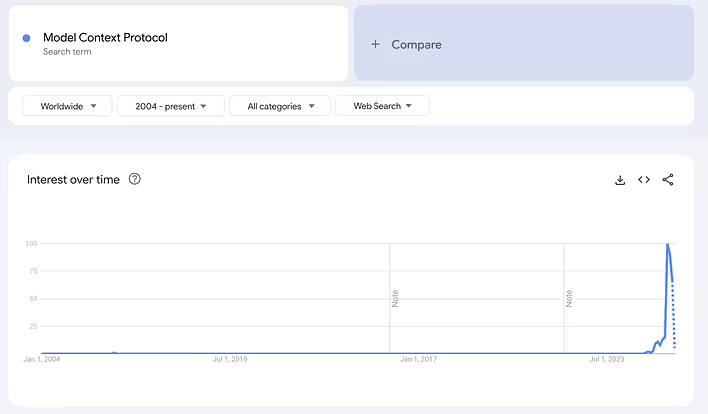
According to Google, interest in the topic is growing exponentially, and in the coming years, MCP could become the new standard of the internet.
Those who adapt first will win - because the new internet is no longer for people. It is for agents.
MCP Security: when AI pays the bills, and you don't even know
Like any technology that opens the door to a new era, MCP carries not only opportunities but also risks. When an AI agent can independently interact with a website, it means it has a certain level of access, actions, and trust. And this is where it gets interesting.
Potential vulnerabilities
Unauthorized actions - if the agent receives incorrect instructions or is compromised, it can perform actions that no one planned. For example, not just ordering pizza, but… paying the entire utility bill for the neighbors.
Next-generation phishing - instead of fake emails, we will get fake "AI endpoints" that look legitimate but lead nowhere.
Infrastructure overload - when you designed a website for people, but thousands of agents are accessing it simultaneously, "communicating" faster than you can blink.
Privacy and control - AI may see more than it should. If the agent's context is not limited, it may "accidentally" extract data that is not intended for external systems.
How to prevent this
Agent verification: just as people have logins and passwords, AI agents should have digital "passports".
Rights limitations: the agent should not see or do more than necessary for a specific task.
Sandbox modes: before giving the agent "real access," test it in an isolated environment.
Audit and logging: if AI "messes up" something, it is important to have a history of its actions to understand where it decided to be too proactive.
Once MCP becomes mainstream, there will be those who will fundamentally reject it. "Anti-MCP", "digital purists" or "offlineists" - there are many potential names, and they all point to one thing: the desire to return to a world where a person interacted with the website, not an agent. They will wear "No AI Endpoints" and will demonstratively press buttons themselves. We shall see... ^_^