This content has been automatically translated from Ukrainian.
What is gentrification?
The word "gentrification" comes from the English "gentrification," which, in turn, has its roots in the word "gentry" - a term that referred to the British wealthy and influential class of society. In the 1960s, British sociologist Ruth Glass first used this term to describe changes in the social composition of London neighborhoods. She noted how working-class areas were transformed into prestigious zones where middle-class representatives moved in, displacing poorer populations.
Gentrification is the process of transforming urban areas, during which old houses and infrastructure are restored or updated, leading to a change in the social composition of the population. Typically, this means an increase in housing costs and, as a result, the displacement of original residents - people with lower incomes.
What does it look like in practice?
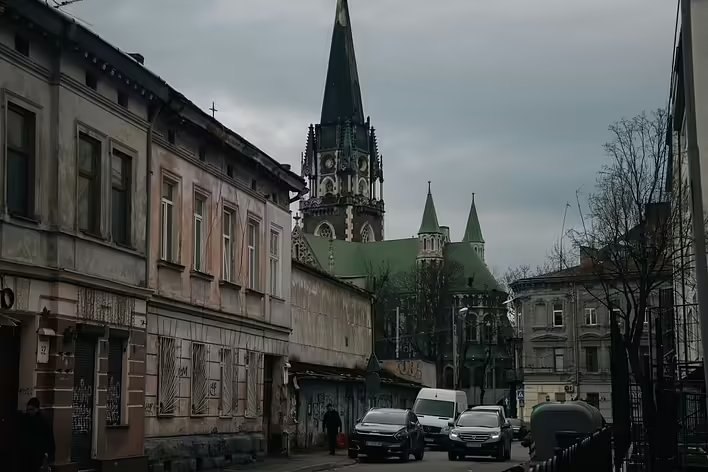
Imagine a neighborhood where old houses are on the brink of collapse, shops have remained unchanged for decades, and residents lead simple and, at first glance, unpretentious lives. One day, new people start to arrive - entrepreneurs, young professionals, artists. They open cafes with trendy coffee, vintage clothing stores, and contemporary art galleries. The houses are gradually restored, taking on a new, stylish appearance. It seems as if the neighborhood is coming to life.
But along with these changes, rental and property prices begin to rise. Local residents, who are used to low rates, can no longer afford to live here and are forced to move to other areas. The community that has existed here for years disintegrates, giving way to new, wealthier residents.
Pros and cons of gentrification
Like any social phenomenon, gentrification has both positive and negative aspects.
Positive aspects:
- Economic development: neighborhoods that were once neglected receive a second life. This leads to the creation of new jobs, growth of small businesses, and improvement of infrastructure.
- Improvement of quality of life: as neighborhoods are updated, new parks, cultural institutions, and educational establishments emerge, contributing to an overall improvement in residents' quality of life.
- Increased safety: gentrification usually also leads to a decrease in crime rates in revitalized areas.
Negative aspects:
- Displacement of original residents: one of the main downsides of gentrification is that local residents who cannot afford to live in expensive neighborhoods are forced to relocate to other, less prestigious areas.
- Loss of authenticity: often, along with gentrification, the neighborhood loses its historical and cultural authenticity, becoming similar to many other places.
- Social inequality: gentrification can exacerbate social inequality, where the rich become richer, and the poor become poorer.
Gentrification in Ukraine
To understand gentrification in Ukraine, it is worth looking at our history. After the collapse of the Soviet Union, Ukrainian cities found themselves in conditions of economic and social decline. Industrial areas that were once centers of production began to deteriorate, and many houses were left without proper care. However, by the 2000s, as the economy began to gradually recover, interest in revitalizing old neighborhoods started to grow.
One of the first examples of gentrification in Ukraine was Podil in Kyiv. Historically, it was a trading and craft center of the capital, where merchants, craftsmen, and later workers and intellectuals lived. After the 1990s, the area experienced a period of decline, but in the early 2000s, Podil became attractive to young entrepreneurs and creative individuals. New cafes, bars, and galleries opened, and property prices began to rise rapidly.
Features of Ukrainian gentrification
Ukrainian gentrification has its own characteristics that distinguish it from similar processes in Western countries. Firstly, it often occurs in the absence of clear urban policies and planning. Ukrainian cities typically lack long-term development strategies for specific neighborhoods, leading to uneven territorial development.
Secondly, gentrification in Ukraine is often accompanied by processes of informal construction and reconstruction. For example, in many cases, the restoration of old houses occurs without regard to architectural standards, leading to the loss of the historical appearance of neighborhoods. Moreover, new buildings often appear in place of old structures without proper public discussion or consideration of local residents' needs.
Thirdly, unlike Western countries, where gentrification is usually accompanied by the development of cultural infrastructure, in Ukraine, this process is often limited to commercialization. Cafes, restaurants, and boutiques displace small local shops, and housing becomes unaffordable for most local residents. As a result, gentrification is often perceived as a threat rather than an opportunity for development.
Examples of gentrification in Ukrainian cities
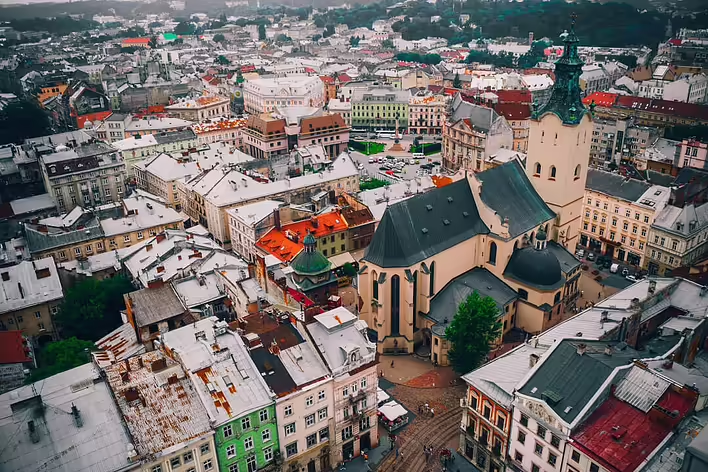
In addition to Podil, gentrification can be observed in other Ukrainian cities. In Lviv, for example, the Pidzamche area, which was an industrial zone, is gradually transforming into one of the most popular among young people. Creative spaces, art galleries, and modern residential complexes are emerging here. However, as in the case of Podil, this process is accompanied by rising property prices and the displacement of local residents.
In Odesa, gentrification affects areas such as Moldavanka and Lanzheron. These old neighborhoods, which have long been neglected, are starting to attract the attention of developers and young entrepreneurs. But, as in other Ukrainian cities, gentrification here is accompanied by both positive and negative consequences.
Challenges and opportunities
Gentrification in Ukraine is a challenge for local communities and city authorities. On one hand, it can become a catalyst for economic development, attract investments, and make cities more attractive to tourists and new residents. On the other hand, there is a real threat of losing the authenticity of Ukrainian cities and social injustice.
For gentrification in Ukraine to bring more benefits than harm, it is important to consider the experience of other countries and adapt it to our conditions. For example, it is necessary to implement policies that support affordable housing for local residents, preserve the historical heritage of neighborhoods, and develop cultural infrastructure.
Like it?React
🧵
This post doesn't have any additions from the author yet.