This content has been automatically translated from Ukrainian.
In this blog, daily reports on the performance of my solar system are automatically published, but I will compile the monthly reports myself. This allows for a comprehensive look at the numbers and an analysis of interesting anomalies.
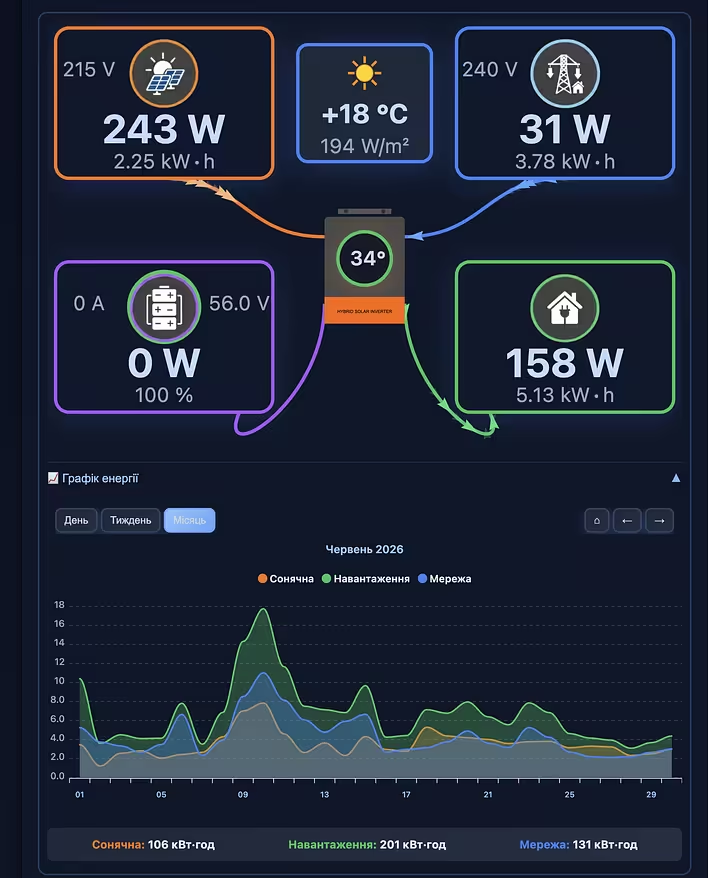
So, the final results of June.
Hardware configuration:
- Panels: 6 pieces Longi TWMNH-66HD640 (N-type bifacial, double glass, 640 W each).
- Total peak power of the array: 3840 W
- Installation: Vertical, strictly south-facing.
Thanks to the monitoring system SolCloudy, we have (almost) a complete picture of generation, household consumption, and our interaction with the city grid.
Overall statistics for the month (kWh)
- Sun generated: 105.92 kWh
- House consumed (Load): 200.65 kWh
- Taken from the grid (Grid): 130.90 kWh
How did the weeks distribute?
- Week 1 (01.06 - 05.06): The beginning of the month was calm. The sun provided 12.52 kWh, but due to significant household consumption (28.19 kWh), we had to actively draw energy from the grid.
- Week 2 (06.06 - 12.06): The most productive segment of the month. We generated as much as 31.42 kWh! At the same time, the house was bustling with activity - consumption jumped to 69.38 kWh. The reason is simple: a powerful heater was turned on in the basement to dry out the dampness, so there was active consumption for several days in a row.
- Week 3 (13.06 - 19.06) and Week 4 (20.06 - 26.06):The station leveled out, generating almost equally - 25.62 and 25.78 kWh per week, respectively. The grid was connected only to compensate for evening or peak loads.
- End of the month (27.06 - 30.06): "Zero" efficiency At the end of the month, household consumption significantly dropped (to an average of 3.5–4.3 kWh per day). This allowed for the maximum useful and complete utilization of solar watts for current needs.
Records, anomalies, and the solar paradox
- Generation peak (June 10): The sun produced a record 7.84 kWh in a day! The previous day, June 9, was only slightly behind (7.00 kWh).
- Load peak (also June 10): The house "consumed" a record 17.75 kWh due to the aforementioned drying of the basement with the heater.
- Gloomiest day (June 2): Generation fell to a modest 1.21 kWh.
Nuance and paradox of monitoring:
Here lies an interesting point: if the day is perfectly sunny, but the battery is charged and the house consumes nothing — the inverter simply stops drawing current from the panels. The panels run idle, and on the graphs, we see 0 W.
This creates a paradox: the station is capable of providing maximum output, but we don't see it because there's nowhere to put the energy. That's why June 10 became a record generation day: the turned-on heater acted as a "pump," forcing the inverter to extract everything possible from the panels. If the basement hadn't been drying, the solar production numbers for that day would have been much lower!
Summary of autonomy: where is the balance?
If we subtract the total household consumption (200.65 kWh) from what we drew from the grid (130.90 kWh), it turns out that 69.75 kWh we provided ourselves.
Thanks to solar generation and the operation of the buffer battery, in June we managed to independently cover 34.76% (over 35%) of all household needs with clean autonomous energy.
The rest of the generated solar kilowatts for the month (105.92 - 69.75 = 36.17 kWh) went towards the technical self-sufficiency of the system: the continuous power supply of the inverter (~30-40 W per hour) and chemical losses in the battery's efficiency (charge/discharge). For home hybrid systems, such a balance of expenses is an absolutely healthy technical norm. But this needs to be known. For most, it is not an obvious fact.
When the electricity bill arrives, I will update the post.
Like it?React
I asked in the SolCloudy community chat about the inverter's consumption.
I don't trust the GPT chat. So I asked again in the chat.
Typically, the actual consumption (without conversion losses) is from 50W, which is from 1200W per day on the inverter
Рахунок прийшов на 634 грн.З ціною за кВт 4.32 грн - це 146.75 кВт.
Трохи відрізняється від того, що я нарахував разом з логером.
Згідно з логером - 130.90 кВтФактичний рахунок - 146.75 кВт
Розбіжність - 15.85. В цілому не критично. Орієнтуватися в ситуації логер дозволяє всеодно.
При бажані можна поставити окремі лічильники.