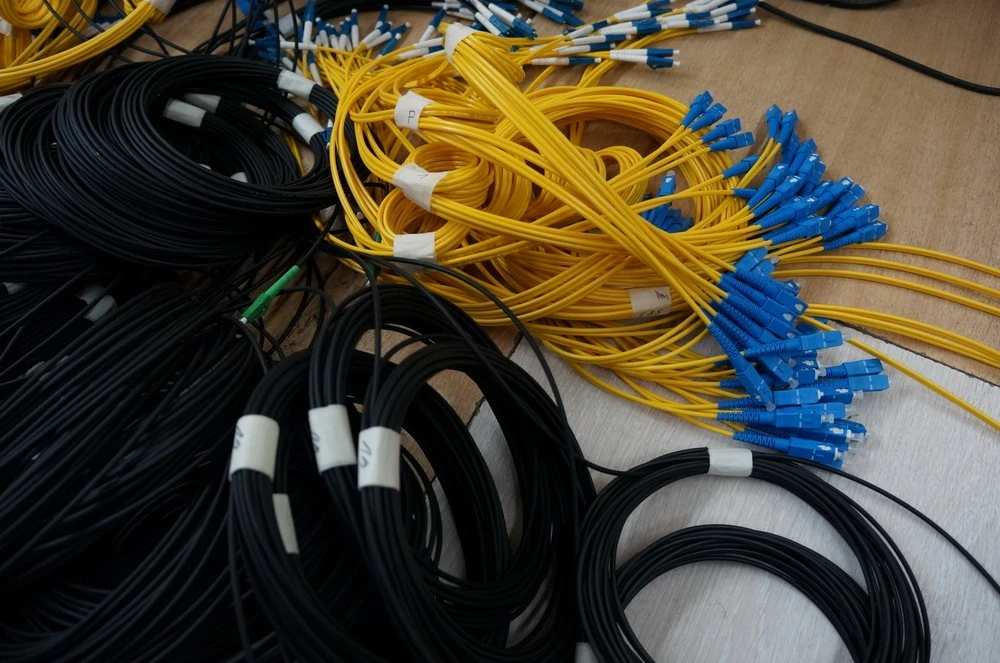
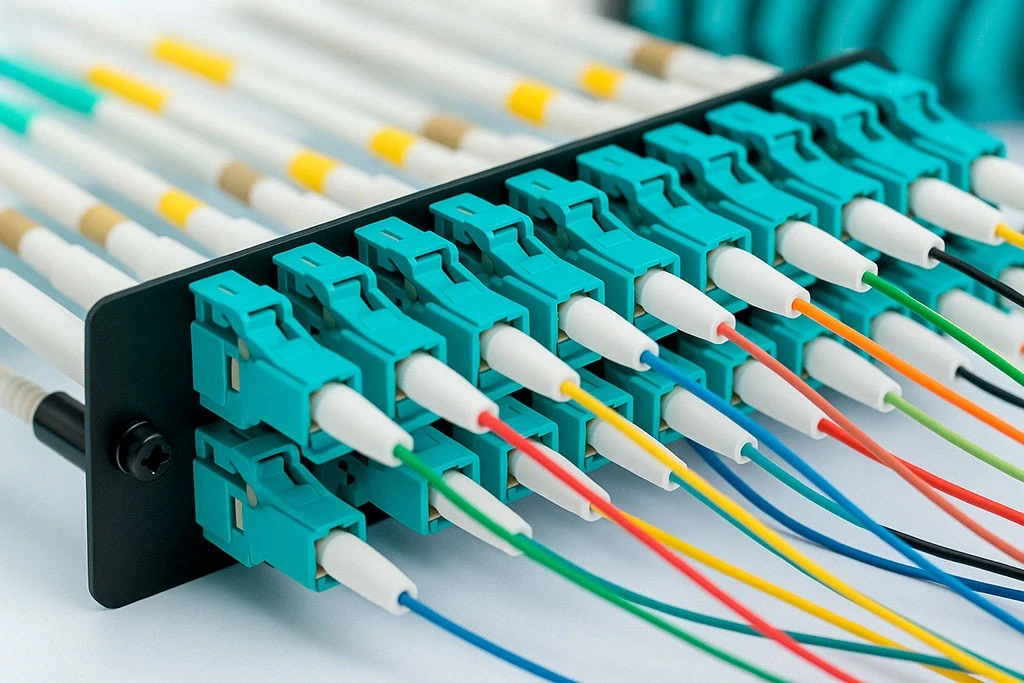
An optical pigtail is a section of fiber optic cable that has a connector on one end, factory pre-installed, while the other end remains unconnected. This allows one side of the pigtail to connect to an optical device and the other to connect to an optical cable. Optical pigtails are used to terminate optical cables using mechanical connections or splicing.
Quality pigtails, when adhering to splicing techniques, ensure optimal performance in terminating optical cables. The term "pigtail" comes from the English word "pigtail" (which means "pig's tail"). This reflects both the appearance of this patch cable and the way it connects. Such products are indispensable when it is necessary to terminate the endpoint of a linear optical cable.
Design Features of Pigtails
The classification of pigtails is related to the characteristics of the cable and connectors (at one of the two ends). The optical fiber in a pigtail can be:
single-mode,
multi-mode.
In diameter, the former are several times smaller than the latter. For example, a single-mode cable marked 9/125 is characterized by a 125 µm outer diameter and a fiber with a diameter of 9 µm, while a multi-mode pigtail may have markings of 50/125, 62.5/125, etc.
A single-mode pigtail guarantees signal transmission without dispersion between modes, as there is only one in this case. The principle of operation of multi-mode pigtails is tied to these dispersions. By standard, the outer sheath of pigtails is colored in different colors, depending on which determines the type of fibers – single-mode are yellow, while multi-mode are orange. However, you should remember that there can be more color options in general, related to the diameter and classes of optical fiber. But absolutely for all pigtails, the diameter of the sheath is the same – 125 µm.
Main Areas of Application for Pigtails
Optical pigtails find wide application in various fields where fiber optic communication is used:
Important characteristics of pigtails include the number of connection cycles for which the connector is rated. Typically, this indicator averages around 1000 connections. There is also a temperature range for each type of wire in which it can operate. The most common operate at temperatures from -40 to +80. To easily distinguish the variety of cords, manufacturers use special labeling.
The price of an optical pigtail depends on all these characteristics as well as the manufacturer. It is not advisable to choose very cheap options, as there is a risk of buying low-quality cable that will not transmit the signal in the required volume and quality. Therefore, it is worth choosing not by price but by the quality of the product. Saving in this case is definitely inappropriate.
These patch cords differ by the type of connector installed at one end. Today, pigtails with SC, ST, FC, and other types of connectors are widely used. However, for the arrangement of modern fiber optic telecommunication systems designed for transmitting various information, the SC type pigtail is most often used. Furthermore, a special splice may be used to connect to another optical cable.






![[List 🍋] Where to find lemons in the MonoBank app?](https://d3kb0xa9zqcv9v.cloudfront.net/9p3ymxb33jxgba5gd8e20dlsbm7u)