This content has been automatically translated from Ukrainian.
The video starts off quite normally: a person is preparing dinner. Then they pour sauce directly onto the table, break spaghetti in half, and wash cheese with dish soap. In the comments, there are already thousands of messages: some explain how to actually cook, others are outraged by the waste of food, and someone sends the video to friends with the words: “Just look at this.”
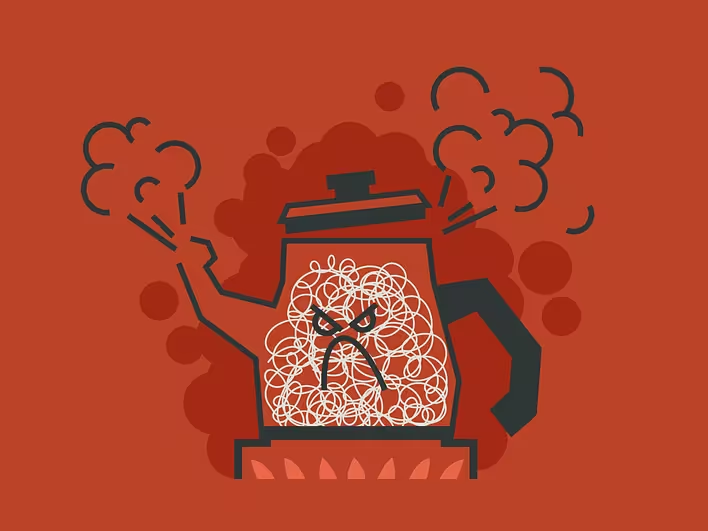
This type of content is called rage bait. These are publications deliberately created to anger, offend, or provoke the audience into a dispute. A mistake, a nonsensical action, or a categorical statement here serves as bait, while comments, views, and shares become the reward.
What does the term "rage bait" mean?
The English phrase rage bait consists of the words rage — “fury,” “intense anger” — and bait — “lure” or “entrapment.” It can be literally translated as “lure for anger.”
Oxford University Press defines rage bait as online content deliberately created to provoke anger or outrage through its provocative, offensive, or irritating nature. It is usually published to increase page visits or social media activity.
The first recorded online use of the phrase dates back to 2002. Initially, it referred to provoking aggressive reactions on the road, but later it transitioned into internet language and acquired its modern meaning.
In 2025, rage bait was named the word of the year by Oxford University Press, and its usage frequency tripled over the previous twelve months. The phenomenon itself, of course, is much older: newspapers, television, and advertising have long used scandals and outrageous statements to attract attention. What is new is the scale this practice has reached on social media.
Outrage as a unit of attention
A regular post may be liked but not provoke a desire to comment. Rage bait works differently: it creates a feeling that one cannot remain silent. There is an immediate urge to correct the author, defend the offended, point out the lies, or at least ensure that others have also noticed the absurdity of the situation.
At this moment, emotion turns into action:
irritation → comment → discussion → new views → more reach.
Algorithms of different platforms have their own principles of operation, but active interaction with a post can signal that it holds the audience's attention. The system does not necessarily understand why people leave hundreds of comments. For it, the publication simply turns out to be one where users stop, argue, and return to the discussion.
For the author, an angry comment is often no worse than a positive one. Even a message like “Stop promoting this nonsense” helps maintain activity under the post.
Three common scenarios of rage bait
Rage bait does not have one recognizable format. It can look like a recipe, a life story, a political statement, an advertisement, or an innocent question. However, similar scenarios often lie behind different publications.
Obvious mistake
The author mispronounces a well-known word, confuses elementary facts, uses an item for the wrong purpose, or gives a nonsensical piece of advice. The mistake is made noticeable enough for almost everyone to recognize it.
The viewer gets a pleasant feeling of their own competence and rushes to write the correct answer. Thus, hundreds of identical corrections appear under the video, even though they might have been its true purpose.
Violation of unwritten rules
The other scenario is built not on a mistake but on contempt for what people consider normal. The author ruins food, wastes water, behaves rudely towards a service worker, or demonstratively uses an expensive item in a nonsensical way.
Here, it is not the desire to correct that kicks in but a sense of injustice. A person comments because they want to condemn the behavior and show that such actions are unacceptable.
Moral trap
The author describes a conflict but removes important context or deliberately takes a position that the audience is almost certain to recognize as unfair. For example, they tell a story about a family, relationships, or work in such a way that readers immediately start looking for a culprit.
In a more complex version, the conflict can be organized deliberately. Researchers from the University of Manchester describe a format in which the author provokes a public confrontation but presents themselves as a person restoring justice. Viewers feel they are witnessing the punishment of bad behavior, while in reality, the conflict has been turned into a repeatable entertainment.
Rage bait doesn’t always scream
The simplest provocations are easy to spot: they are exaggerated, rude, and obviously absurd. However, rage bait can be much more restrained.
Sometimes it is enough to cut a short fragment from a longer video, remove explanations, or formulate a headline in such a way that a neutral event seems scandalous. The author does not necessarily have to lie outright — they can simply lead the audience to the worst possible interpretation.
A separate technique is feigned sincerity. A person speaks calmly and convincingly, although their statement is deliberately categorical or offensive. The self-assuredness enhances the effect: the viewer feels that the author is not just mistaken but also does not doubt their own correctness.
A sign of manipulation may not be the provocation itself but the behavior of the account in general. If almost every publication generates the same scandal, and the author constantly fuels disputes in the comments, outrage has likely become their main content strategy.
Not every outrageous post is rage bait
The line here is not always obvious. People do make mistakes, have strange habits, express unpopular opinions, and create unsuccessful jokes. A publication can provoke a wave of criticism even if the author did not intend to provoke anyone.
Therefore, the audience's anger alone does not make the material rage bait. What matters is the intent: was the provocation a tool for gaining attention?
The author's intent is not always provable. However, it is worth being cautious if a post combines several signs:
- the mistake is too obvious and conveniently placed in the frame;
- the video lacks context necessary for understanding the situation;
- the author uses categorical statements without any clarifications;
- the audience is pushed to choose one of two opposing sides;
- similar conflicts regularly recur in other publications;
- the author does not try to explain their position but only stirs up the dispute;
- the headline or cover provokes anger even before viewing the material.
Rage bait, clickbait, and trolling are not the same
All three phenomena are related to provocation, but they work differently.
Clickbait stirs curiosity and hides the main information. Its task is to make a person click on the headline: “You won’t believe what happened next” or “This simple method changed everything.”
Rage bait bets on negative emotions. It wants not only to get a click but also to engage the user in interaction: to prompt them to write a comment, argue, or share the post with condemnation.
Trolling often aims to entertain the provocateur with the reactions of others. For the rage bait author, measurable results — reach, subscribers, influence, or money — may be more important.
When provocations are created regularly and systematically, the term rage farming — “growing anger” — is also used. The author is no longer just publishing one outrageous post but building an entire page, media persona, or political campaign around conflicts.
When the bait is created by AI
Generative AI has simplified the mass production of publications, images, and videos. Now, fictional conflicts, false stories, and visually convincing scenes that never existed can be created quickly.
Behind an outrageous post, there does not necessarily stand a person who sincerely adheres to the expressed position. It could be text automatically generated to maintain activity on the page.
In research published in the journal New Media & Society, cases are described where automated tools generated questions with signs of rage bait. The system reproduced common online communication patterns and created topics capable of provoking hostile and polarized discussions.
AI does not necessarily “want” to anger anyone. It may simply mimic the content it was trained on and perform tasks of creating attention-grabbing publications. However, for the audience, the result remains the same: an artificially created controversy consumes time and generates real emotions.
How not to pay with your attention
The most insidious trait of rage bait is that even its exposure can work in the author's favor. A comment like “People, this is an obvious provocation” still increases activity under the post. Sharing with a critical caption brings new audiences to it.
Therefore, before responding, it is useful to take a short pause and ask yourself:
- Why do I feel such an urgent need to react?
- Was this mistake created specifically for corrections?
- Do I see the full context?
- Will my comment change the discussion?
- Who benefits from my reaction?
If a publication seems to be a deliberate provocation, it is better not to argue with its author. You can close the material, hide the account, choose the “Not interested” feature, or report the post if it violates platform rules.
Rage bait turns the desire to restore justice into free advertising. It makes a person feel like a participant in an important dispute, even though in reality, they may only be helping someone else's publication gain reach. Sometimes the best way to win such a discussion is not to start it.
Like it?React
🧵
This post doesn't have any additions from the author yet.