This content has been automatically translated from Ukrainian.
The manor is a word that has its roots in history, preserving not only the traces of ancient agrarian relations but also reflecting the change of economic systems and social orders in Ukrainian lands. It is an interesting and complex topic that deserves deeper research.
What is a manor?
A manor is a word that comes from the Polish language "folwark" and originally meant a lord's estate or farm where the feudal lord engaged in agriculture with the help of serfs. It was a system of organizing agriculture that emerged in medieval Europe and was widely spread in Poland, Lithuania, as well as in the territory of modern Ukraine, especially in Volhynia and Galicia.
The main essence of the manor system was that landowners used the labor of peasants for their own economic needs. Peasants had to work a certain number of days on the manor land, for which they were allowed to cultivate their own plots. This was essentially a form of serfdom, as peasants had no choice but to submit to the feudal lord and fulfill his demands.
How did manors appear in Ukrainian lands?
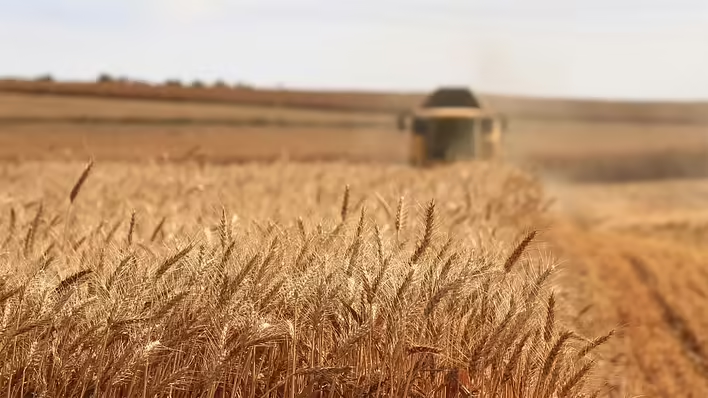
The introduction of the manor system in Ukrainian lands is associated with the spread of Polish feudal influence in the 14th-16th centuries. After the annexation of part of Ukrainian territories to Poland and the Grand Duchy of Lithuania, Polish magnates began actively creating manor estates. These estates were the center of the agrarian economy, where wheat, barley, oats, flax, and other crops were grown, which often went for export to Western Europe.
An average manor consisted of several parts: the lord's house, granaries, barns, stables, and large fields. The estate utilized the labor of local peasants who performed mandatory work, known as corvée, for which they had the right to cultivate their own small plots of land. They could not leave the land without their lord's permission, which effectively made them dependent.
Economic and social consequences
Manors had a significant impact on the economic development of Ukrainian lands at that time, as they provided Polish magnates with profits and products for the domestic and foreign markets. This allowed for the formation of a wealthy landowning class, which became the foundation of the social and political system in Poland and Lithuania.
However, for the Ukrainian peasantry, the manor system became a symbol of oppression and social inequality. Peasants worked hard but had little land of their own and few opportunities for economic progress. This unjust distribution of labor and resources led to numerous peasant uprisings against the feudal lords. Over time, this resulted in profound changes in society, including the abolition of serfdom in the 19th century.
The manor in culture and literature
Interestingly, the image of the manor often appears in literature, especially in Ukrainian and Polish. In the works of classics, we can see descriptions of life in such estates, highlighting class inequality and social injustice. For example, Taras Shevchenko, Ivan Franko, and Lesya Ukrainka often mentioned this agrarian order as a symbol of the exploitation of peasants and the struggle for justice in their works.
Manors today
Although the manor system has long since passed into history, its influence is still felt today. It has left a deep mark on the culture and mentality of Ukrainians, particularly in the understanding of land justice, and the relationships between peasants and landowners. Many former manors have been preserved as architectural monuments, some of which have been transformed into tourist complexes, providing an opportunity to learn more about this stage of history.
This topic is interesting not only for historians but also for those who want to understand more deeply the economic and social processes that took place in our lands and how they influenced the modern world.
Like it?React
🧵
This post doesn't have any additions from the author yet.