This content has been automatically translated from Ukrainian.
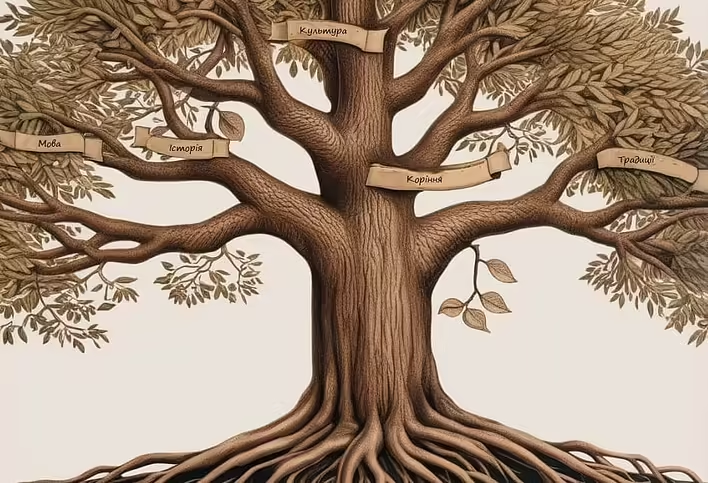
Every language, like a living organism, constantly changes, evolves, and adapts to new conditions. The Ukrainian language is no exception. It has been enriched and continues to be enriched by borrowings from other languages that came with trade, wars, cultural exchanges, and other historical events. Today I want to tell you about the history of borrowed words in the Ukrainian language, starting from German influences and ending with modern Anglicisms.
German Borrowings. The Influence of the Hanseatic League and the Austro-Hungarian Empire
The German language began to influence Ukrainian as early as the Middle Ages, when the Hanseatic League actively traded with Kievan Rus. It was then that the first German borrowings appeared, particularly terms related to trade and crafts. For example, the word "кірка" (from the German "Kirche" – church) emerged during that period.
The further influence of the German language occurred during the time of the Austro-Hungarian Empire, when Western Ukraine was under its rule. Military terms, administrative concepts, and everyday words entered the Ukrainian language thanks to close ties with the German-speaking population. Words like "пальто", "шпиталь", "бухгалтерія" are all examples of German borrowings.
Polish Borrowings. Shared History and Cultural Ties
Polish borrowings in the Ukrainian language appeared during various historical periods, but they were particularly active during the time of the Polish-Lithuanian Commonwealth. Shared history, cultural exchanges, and close proximity contributed to the penetration of Polish words into the Ukrainian language. For example, the words "цікавий", "вихователь", "книжка" have Polish origins.
Russian Borrowings. Imperial and Soviet Influence
Russian borrowings appeared during Ukraine's time as part of the Russian Empire and the Soviet Union. During this period, active Russification took place, and many words related to administration, science, and technology entered the Ukrainian language. For example, the words "директор", "кабінет", "регіон" have Russian roots.
French and Italian Borrowings. Fashion and Culture
French and Italian words entered the Ukrainian language mainly through cultural influence. French fashion, cuisine, and art brought such words as "ресторан", "меню", "фасад". Italian words appeared along with music, art, and architecture: "фортепіано", "арія", "балкон".
English Borrowings. Modern Global Influence
Today, the English language has the greatest influence on Ukrainian due to globalization, the internet, and pop culture. Computers, technology, music, films – all of this brings new Anglicisms into our language. Words like "комп’ютер", "менеджмент", "маркетинг", "чекати" have become familiar to the modern Ukrainian.
Borrowings from the English language often undergo adaptation to Ukrainian grammar and phonetics, making them more organic for use. For example, the word "лайкати" (from the English "like") has already become part of the everyday language of young people.
Let's look at more examples of borrowed words in the Ukrainian language, breaking them down by their languages of origin:
- Шлагбаум – from the German "Schlagbaum" (barrier).
- Батальйон – from the German "Bataillon" (military unit).
- Цайтнот – from the German "Zeitnot" (lack of time).
- Шніцель – from the German "Schnitzel" (meat dish).
- Ліхтар – from the Polish "latarni" (lamp).
- Гурток – from the Polish "kółko" (club, circle).
- Бляхар – from the Polish "blacharz" (metal worker).
- Шарлатан – from the Polish "szarlatan" (fraud).
- Реверанс – from the French "révérence" (bow).
- Кавалер – from the French "cavalier" (knight).
- Бюст – from the French "buste" (sculpture of the head and chest).
- Фарфор – from the Italian "porcellana" (ceramics).
- Сонет – from the Italian "sonetto" (poem).
- Комп’ютер – from the English "computer" (computing machine).
- Файл – from the English "file" (document).
- Чат – from the English "chat" (conversation on the internet).
- Кава – from the Turkish "kahve" (coffee).
- Чай – from the Turkish "çay" (tea).
- Ковбаса – from the Turkish "kavurma" (meat product).
- Яничар – from the Turkish "yeniçeri" (soldier).
- Ікона – from the Greek "εἰκών" (image).
- Бібліотека – from the Greek "βιβλιοθήκη" (place for storing books).
- Філософія – from the Greek "φιλοσοφία" (love of wisdom).
- Академія – from the Greek "ἀκαδημία" (educational institution).
- Альбом – from the Latin "album" (book for records).
- Доктор – from the Latin "doctor" (teacher, physician).
- Магніт – from the Latin "magnes" (magnetic stone).
- Університет – from the Latin "universitas" (totality).
- Алгебра – from the Arabic "الجبر" (restoration).
- Азимут – from the Arabic "السَّمْت" (path, direction).
- Алхімія – from the Arabic "الخيمياء" (chemistry).
- Сахар – from the Arabic "سكر" (sugar).
The Ukrainian language, like any other, has always been in a process of change and enrichment. Borrowings from various languages have helped it develop and adapt to new conditions. From German traders to modern English technologies, these words have become an integral part of our linguistic heritage. And who knows, perhaps tomorrow we will hear new interesting borrowings that will become part of our daily communication.
Like it?React
🧵
This post doesn't have any additions from the author yet.