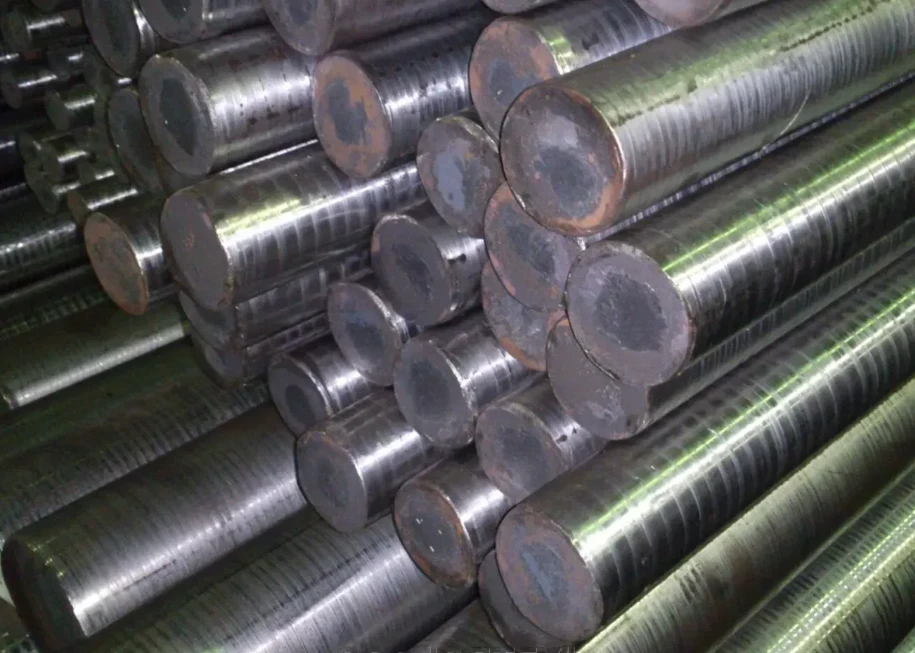
The 40X round after heat treatment allows achieving an optimal combination of strength, elasticity, and plasticity of the material. Forgings made from this alloy, hardened in oil at a temperature of +860°C and subsequently tempered in the range of +500 – +800°C, demonstrate excellent operational characteristics.
Hardening of steel rod 40X
It is advisable to order round 40X after hardening to increase its hardness and wear resistance. The process includes heating the metal to a temperature of 840-880°C followed by rapid cooling in water or oil.
As a result of this process, martensite is formed in the steel structure – a very hard and strong metastable microstructure. The hardened 40X round has significantly better mechanical properties of steel; however, it makes it more brittle, so tempering is mandatory after hardening.
The hardening process of products made from steel rod 40X includes the following stages:
The workpiece is placed in an electric furnace, where the holding time depends on the diameter of the rod (from a few minutes to over 20 minutes for large cross-sections) to ensure the necessary characteristics of austenitization, i.e., heating the steel to a temperature above the critical point, at which its structure transforms into austenite.
The heated product is quickly immersed in an oil bath for rapid cooling to fix the necessary internal structural changes.
A properly executed hardening procedure involves uniform heating of the metal rolling, with the heating color changing from cherry to bright yellow depending on the temperature, which serves only as a visual guide for process control.
It is recommended to buy hardened steel round 40X for parts where strength and a long service life of the finished product under constant load are priority indicators.
Tempering and normalization of steel rod 40X
It is worth buying round 40X, which after hardening was tempered to reduce brittleness and increase the plasticity of the steel. As a result of such manipulations, the internal stresses of the metal are relieved, improving the impact toughness and other mechanical properties of the steel.
There are three main types of tempering:
low-temperature tempering (150-250°C) – used to reduce internal stresses and increase toughness; this tempering minimally reduces the hardness of the steel;
medium-temperature tempering (350-500°C) – used to improve the balance between hardness and plasticity, helps stabilize the structure of martensite and reduce its brittleness;
high-temperature tempering (500–650°C) – leads to a noticeable reduction in hardness while simultaneously increasing the impact toughness and plasticity of the metal; this method is often used for producing parts that are frequently subjected to impact loads.
Normalization is another important heat treatment process that affects not only the price of round 40X but also aims to improve the structures and mechanical properties of the steel. During normalization, the metal is heated to a high temperature, held, and then cooled in air. This process ensures a uniform distribution of carbon and alloying elements in the steel structure, improving its strength and forming a more uniform structure.
Tempering and normalization of steel are critically important heat treatment processes, as these methods of influencing steel ensure high quality of final products and improve their reliability and durability in operation.
Share this post
Cite post
Select and copy the required citation standard:
This post doesn't have any additions from the author yet.