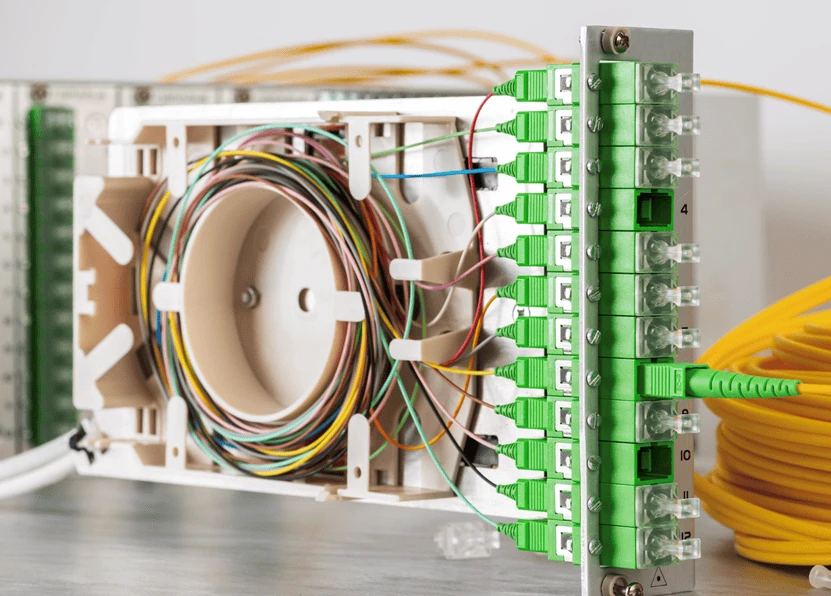
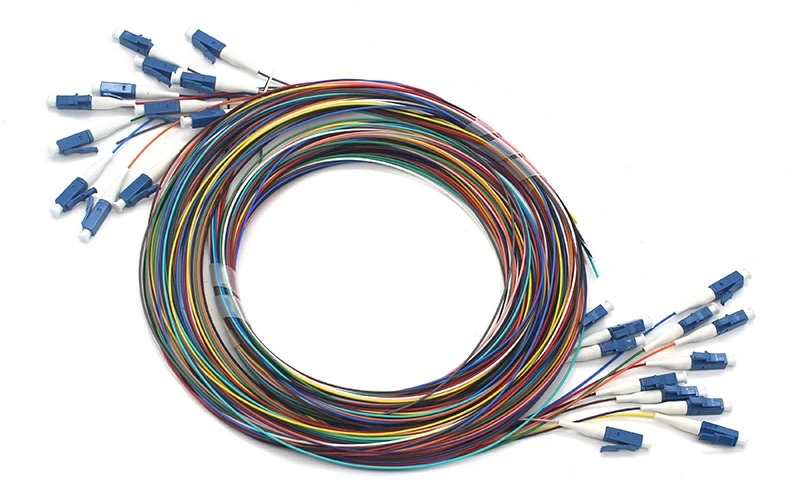
A pigtail is a patch cord that has a connector of a certain type at one end. Pigtails are used for terminating cables, which can be done by fusion splicing or mechanical splicing. The most suitable modification of patch cords should be chosen considering the specific operating conditions of the network, the active equipment used, and some individual parameters.
Pigtails are classified as passive optical components and are optical connectors - devices designed to connect various components of the linear path at the points of input or output of radiation. The online store A-Radio offers various types of pigtails, but customers need to determine their specific choice.
What types of connectors exist
There are several main options:
SC – inexpensive and easy to connect, but less reliable than FC;
LC – compact, with a latch, provides a more reliable connection;
FC – excellent connection quality, used where reliability is important;
ST - a popular type, used in medicine and manufacturing.
Application area of pigtails
Patch cords are used for terminating optical outputs – this most often refers to splicing optical cable at the connection node. Therefore, the most common application area for pigtails is optical cross-connects.
Optical patch cords can also be used during emergency recovery work on the network. Thus, using a pigtail, it is possible to restore a broken or defective output of passive optical equipment, such as an optical splitter, circulator, or WDM spectral multiplexing multiplexer.
Also, using pigtails purchased at https://a-radio.com.ua/vch-kabeli-pigteyly/, passive optical devices can be re-terminated when there is no possibility or equipment for a factory change of the optical connector.
In some cases, a set of optical patch cords can be used as a temporary connecting cord – a patch cord.
What is important to know about polishing
To reduce back reflection from the fiber to the light source and to avoid transition between the fiber and air, polishing of the ferrule, which is the optical part of the connector, is used in pigtails. There are two main types of polishing: UPC and APC.
In UPC polishing (Ultra Physical Contact), the ends of the optical connector tips have a convex rather than flat polish to prevent transition between glass and air, thus reducing signal attenuation. Also, during assembly, the ferrules are compressed with a certain force, ensuring a flat contact between the glass.
In APC polishing (Angled Physical Contact), the front surface of the connector is polished at an 8° angle, in addition to physical contact, to minimize back-reflected light that interferes with sensitive transmitters. Due to the angle, light diffracts in the cladding and does not return to the fiber.
It is important to prefer products from well-known manufacturers who have been working in this field for quite some time and offer high-quality products at quite affordable prices.
Quality cords are characterized by:
minimal insertion losses.
stability of parameters throughout the life cycle.
high-quality UPC/APC polishing.
a large number of switching cycles.
resistance to mechanical and temperature influences.
affordable price of the optical pigtail.
Buying a pigtail from a verified online store not only guarantees its quality but also provides convenience, as the buyer receives delivery. This significantly saves time, as there is no need to travel to the store for the product. In most online stores, wholesale orders can also be placed.