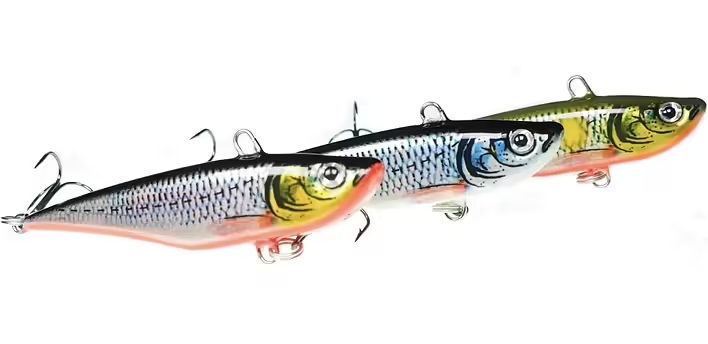
If you are hunting for pike with artificial lures, vibro lures are one of the most interesting options. They sink, resemble fish, and play quite differently because the attachment on the back causes the lure to vibrate intensely. These vibrations are sensed by the predator's lateral line — sometimes it is the vibration, not the color, that determines the bite. The article also mentions fishing gear from the manufacturer "Dnipro-Svynets" as an example of equipment worth attention.
To achieve the best results in pike fishing, it is worth paying attention to the offerings from trusted brands. In particular, quality vibro lures for pike, known for their effectiveness and durability, are presented in the assortment of fishing gear from the manufacturer "Dnipro-Svynets," which confirms their reputation as a reliable supplier.
Understanding Vibro Lures and Their Appeal for Pike
Vibro lures are blade-less lures with an elongated body that create high-frequency action. Due to the position of the ring on the back, they "shake" and produce strong vibrations in the water. Pike respond to these vibrations far beyond their line of sight: the lateral line allows them to detect the slightest movement. Vibro lures are effective at various depths — from surface layers to bottom retrieves, as well as in winter fishing through the ice.
Choosing the Size of Vibro Lure for Pike
The size of the vibro lure significantly affects the bite. The optimal range for pike is 60–90 mm. However, it is worth adjusting to specific conditions and the behavior of the fish.
When pike are active or large baitfish dominate the water, vibro lures of 80–90 mm work better — they attract trophy specimens. If the fish are cautious or the bait is small, 60–70 mm lures are suitable; 70 mm is often considered the "golden standard" for universal fishing.
The season also matters. In winter, when metabolism slows down, smaller vibro lures — 60–75 mm — are more effective. At the end of winter, pike may switch to larger lures, preparing for spawning and gaining energy.
Weight of Vibro Lure for Pike
The weight determines the sinking and controllability. The usual range for pike is 10–30 g. For shallow waters up to 3–4 m, 10–15 g vibro lures are suitable. At depths of 5–10 m and more, it is better to use 20–30 g to reach the working depth faster and stay close to the bottom.
Strong currents require heavier models: they maintain the working depth and are not swept away by the current. For fast aggressive retrieves, heavier vibro lures provide better control. Lighter vibro lures are better for slow, delicate animations when you need to imitate a sluggish fish.
Some models have weight options for the same length: for example, a 70 mm can be 15 g or 20 g. Successful examples include 75 mm / 21 g, 65 mm / 20 g, and 90 mm / 32 g.
Impact of Fishing Conditions on Vibro Lure Selection
There is no universal vibro lure. Success depends on adaptation to the location, weather, and pike behavior.
Depth. For deep areas, choose heavier vibro lures to reach the bottom. For shallow waters and areas with vegetation, lighter models are better — this reduces the chances of snagging.
Current. In rivers with strong flow, compact and heavy vibro lures that are not swept away work best. In still water, you can experiment with lighter and slower options.
Season. In winter, pike stay near the bottom, so 60–75 mm and 15–25 g vibro lures are suitable for slow retrieves. In summer, you can vary sizes and weights more widely, as fish rise in the water column.
Bottom type. On rocky bottoms, avoid models that snag easily, or choose those that are resistant to damage. On sandy or muddy areas, it is easier to experiment with different balances and shapes.
Materials, Shape, and Action of Vibro Lures
The most common material is durable plastic: it allows detailing scales, gills, and eyes and withstands pike teeth. The shape is usually elongated and slightly flattened on the sides — this gives a high-frequency vibration. There are also thin elongated models with different actions.
The action of the lure matters a lot. Vibro lures with noise capsules attract attention with additional sound, while silent options are better for cautious fish. Some models have a brass plate instead of the standard ring with two holes to vary the intensity of the action.
A useful property is stable amplitude during free fall after being lifted. This helps to cover a large bottom area and attract fish from a distance.
Color of Vibro Lure for Pike
Color is no less important an element than size and weight, but there is no universal recipe. You need to adapt to visibility and the time of day.
In daylight and clear water, natural shades work: silver, gold, and pearlescent with blue or green on the back. They most resemble natural baitfish. In murky water, at dusk, or at night, it is better to use bright and contrasting colors: red, orange, bright yellow, or fluorescent shades.
A coating that imitates scales and gills adds realism, and it is worth having such options in your tackle box. It is recommended to keep a color arsenal and check what works today during fishing — sometimes a small experiment makes a difference.
Several practical tips:
pay attention to the quality of lures;
experiment with sizes and weights;
adapt your retrieve technique;
study the bottom relief;
choose the appropriate tackle;
consider the time of day.
Conclusion
A quality choice of vibro lure for pike is a balance of size, weight, shape, material, and color, supported by observation and flexible tactics. There is no magic lure that always works, but understanding the principles and being willing to experiment will significantly increase your chances of a trophy. Try different options, record the results, and over time, you will develop your own "formula" for success.