Moving to the Netherlands becomes not only a new stage of life for many Ukrainians but also a serious challenge. Even in a comfortable and safe country, one has to face cultural shock — a state where familiar rules no longer work, and new ones have not yet become clear. This is a completely normal process, but it is worth preparing for it. And one of the things that really shortens this adaptation period is language knowledge.
In the first weeks after moving, the language barrier is most felt. Although many Dutch people speak English well, this is often not enough for everyday comfort. Government services, letters from the municipality, doctor's appointments, or even instructions in stores — all of this is mostly in Dutch. That is why most people choose Dutch language courses for Ukrainians right from the start: it is not just about learning but also about feeling in control of one's life in a new country. Systematic language learning under the guidance of teachers helps to overcome the language barrier faster, avoid typical mistakes, and feel more confident in everyday situations. Moreover, this approach provides a clear structure and motivation, which is especially important at the initial stage.
Besides the language, one of the first surprises is the communication style. Dutch people are known for their straightforwardness. They say what they think without hints or "softening" their statements. Ukrainians, used to more veiled communication and polite hints, may perceive the frank remarks of the Dutch as rudeness. Without a basic understanding of the language, such conversations can seem even sharper than they actually are. However, as you begin to better understand the nuances, idioms, and intonations of the language, the perception changes — and this straightforwardness no longer seems rude but rather honest.
Another aspect that surprises newcomers is planning. In the Netherlands, life is scheduled weeks, and sometimes even months, in advance. A spontaneous visit to a neighbor or acquaintance is almost impossible here. Every meeting must be entered into the calendar. For the Ukrainian mentality, where spontaneity is part of sincerity, this approach may seem cold. However, it is this order that allows the Dutch to perfectly balance work and personal life.
An important part of adaptation is understanding social norms. For example, personal space and independence are highly valued here. People respect each other's boundaries, do not ask unnecessary questions, and do not impose themselves. But at the same time, it is the language that helps to properly feel these boundaries: to understand how to politely decline, how to support small talk, or how not to break unspoken communication rules.
It is also worth mentioning the work culture. In the Netherlands, there is a horizontal hierarchy: even with a manager, one can communicate as equals. Initiative is encouraged, and every employee's opinion matters. However, without knowledge of the language, this "equal dialogue" may remain inaccessible. English helps, but it is often Dutch that opens up more opportunities for career growth and integration into the team.
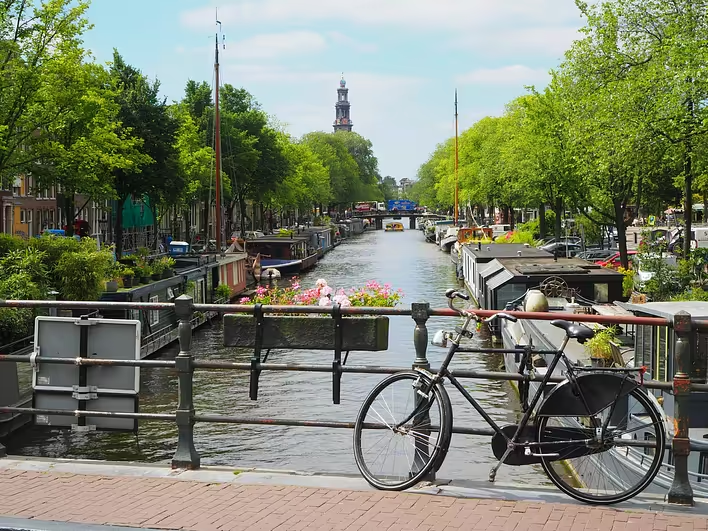
To ease the transition period, experts strongly advise not to isolate oneself exclusively within the circle of compatriots. Constant practice is the best teacher, so Dutch language courses should be a priority from the very first days of stay. Active participation in community life, visiting local libraries, volunteering, or simply regular bike rides help to feel like part of society. Learning a language is not just about grammar; it is about the ability to understand colleagues' humor, read announcements in stores, or simply greet the mail carrier. The Netherlands is a country of rules, but at the same time, it is a country of great freedom and tolerance. By accepting these rules and mastering the language, you open up a space where everyone can be themselves, and cultural differences gradually become not an obstacle but an interesting experience that enriches the personality.
Over time, most Ukrainians find their rhythm of life in the Netherlands. What initially seems strange or uncomfortable gradually becomes clear and even comfortable. And almost always, the key to this is indeed the language: it helps not only to solve everyday issues but also to feel like part of society. The cultural shock fades, and along with it comes a new level of confidence — when the country ceases to be "foreign" and simply becomes a place where you live.