A beautiful lawn starts not with a lawn mower and not even with watering, but with the right choice of grass. It often seems that it is enough to buy any mixture labeled "lawn grass," sow the area, and in a few weeks there will be a level green carpet. In practice, it is much more complicated: different grasses cope with shade, heat, trampling, low mowing, lack of water, and frost differently. That is why a dense decorative mixture is better suited for one area, a sports mixture for another, and for a third, a hardy grass that will survive even with minimal care.
To choose grass for the lawn, you first need to answer a few simple questions: where will the lawn be, how much sun does the area receive, how often will it be walked on, is there an opportunity to regularly water and mow, what is the soil like in the area, and what appearance do you expect from the lawn. There is no ideal universal variety, but there are successful combinations of grasses that can be tailored to specific conditions.
Main Types of Lawn Grasses
Most often, not one variety is used for lawns, but a mixture of several types of grasses. This is done for stability: one grass germinates quickly, another forms a dense sod, a third tolerates drought better, and a fourth withstands shade. If one crop temporarily weakens due to weather or load, others support the overall appearance of the lawn.
Perennial Ryegrass
Perennial ryegrass is one of the most popular grasses in lawn mixtures. Its main advantage is rapid germination. Under favorable conditions, the first shoots can appear in just 5–7 days, which is why ryegrass is often added to mixtures where a green cover is needed quickly.
This grass withstands trampling well, quickly recovers from damage, and is suitable for sports, play, and cottage lawns. If children, pets, or the lawn are often used for relaxation, ryegrass will be a useful component. At the same time, it has its weaknesses: it does not always tolerate severe frosts, prolonged drought, and can gradually disappear from the lawn without proper care.
Ryegrass works best not on its own but in mixtures with fescue and bentgrass. It provides a quick start, while the slower grasses eventually form a more durable foundation.
Meadow Fescue
Meadow fescue is one of the most valuable species for a quality, durable lawn. It grows slower than ryegrass but forms a dense sod and recovers well thanks to underground shoots. If small gaps appear in the lawn, fescue can gradually fill them in.
This grass has a rich green color, tolerates regular mowing, trampling, and winter well. That is why it is often used in sports and ornamental lawns. However, fescue is more demanding in terms of conditions: it needs fertile soil, enough light, regular watering, and fertilization. In deep shade or very dry areas, it will feel worse.
If you want a dense, beautiful, and durable lawn and are ready to care for it, meadow fescue should be one of the main components of the mixture.
Red Fescue
Red fescue is a versatile grass for decorative and residential lawns. It has fine leaves, creates a soft neat cover, and is well-suited for areas where aesthetics are important. It is often used in mixtures for gardens, private yards, areas around the house, and decorative lawns.
One of the main advantages of red fescue is its ability to grow in poorer soils and tolerate shade better than many other lawn grasses. It is also quite drought-resistant, especially compared to fescue. A lawn with a high proportion of fescue does not always withstand very active trampling, but it looks delicate, even, and natural.
Red fescue is a good choice for those who want a beautiful lawn without overly complicated care. It is especially appropriate in mixtures for partial shade.
Reed Fescue
Reed fescue has coarser leaves than red fescue, but its strong point is endurance. It tolerates heat, drought, compacted soil, and moderate trampling well. Thanks to its deeper root system, this grass can draw moisture from lower soil layers, making it better able to survive during periods of water scarcity.
It is often used for lawns in sunny areas, in regions with hot summers, or where there is no opportunity for frequent watering. It is suitable for cottages, large homesteads, roadsides, slopes, and practical lawns where resilience and hardiness are more important than perfect silkiness.
The downside of reed fescue is its less delicate texture. If a very fine decorative lawn is needed, its proportion in the mixture should be moderate. But for dry and challenging conditions, it is one of the best options.
Fine and Spreading Bentgrass
Bentgrass is a grass for very dense, low-mowed, and decorative lawns. It is often associated with golf courses and ornamental lawns. It can create an extraordinarily delicate, dense, and even cover that looks almost velvety.
However, bentgrass requires careful maintenance. It needs regular mowing, watering, fertilization, aeration, and disease control. Without care, such a lawn quickly loses its appearance. For a regular cottage plot, bentgrass is not always practical, but for a decorative lawn that is systematically cared for, it can yield very beautiful results.
Timothy Grass
Timothy grass sometimes appears in lawn or meadow mixtures. It is hardy, tolerates cool climates and moist soils well, but it is not always suitable for a classic low decorative lawn. Its leaves are coarser, and its growth is higher, so it is more appropriate in natural, meadow, large, or less formal lawns.
If the goal is not a perfectly trimmed carpet, but a natural green area with less intensive care, timothy grass can be part of the mixture. For an ornamental lawn near the house, it is better not to make it a main component.
конюшина
White Clover and Microclover
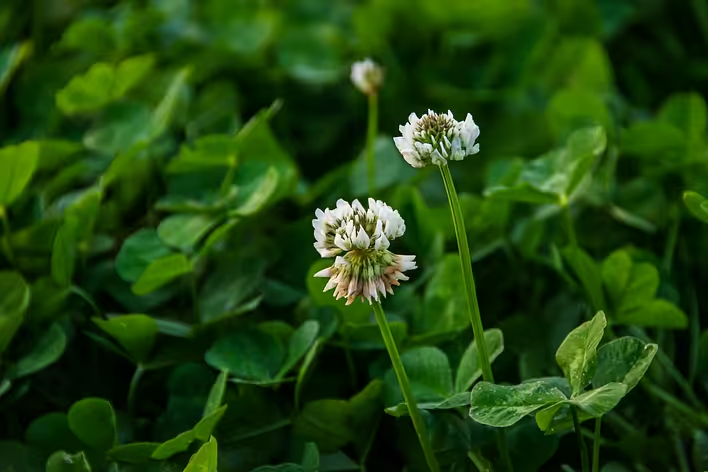
Clover is not a grass, but it is often added to lawns or used as an alternative to classic grass. It tolerates poor soils well, remains green during drought, attracts pollinators, and can enrich the soil with nitrogen. Microclover has smaller leaves, lower growth, and combines better with lawn grasses.
A lawn with clover requires less nitrogen fertilizer and can look fresh even when regular grass turns yellow. But there are nuances: clover blooms, attracts bees, can be slippery after rain, and has a different appearance than a classic grass lawn. If a perfectly uniform decorative carpet is needed, it is better to avoid it. However, if you want a more natural and less demanding lawn, microclover can be a very successful addition.
How to Choose Grass Based on Site Conditions
For sunny areas, mixtures with meadow fescue, perennial ryegrass, and red fescue are best. If the summer is hot and watering is limited, it is worth adding reed fescue. It will make the lawn more resilient, even if the cover will look a bit coarser.
For partial shade, it is better to choose mixtures with a high proportion of red fescue. It tolerates lack of sunlight better and can grow where fescue weakens. Ryegrass can also be included in shady mixtures, but it should not be the base if the area is shaded for most of the day.
For active use — children's games, pets, frequent walking — grasses that recover quickly are needed. Here, perennial ryegrass and meadow fescue work well. Ryegrass quickly covers damage, while fescue forms a strong sod over time. For more challenging conditions, reed fescue can be added.
For a decorative lawn near the house, fine leaves, uniform color, and density are important. In this case, look for mixtures with meadow fescue, red fescue, and a small proportion of ryegrass. If care will be very meticulous, mixtures with bentgrass can be considered, but this is already an option for those who are ready to devote a lot of attention to the lawn.
For a cottage or large area where there will not be weekly perfect care, it is better to choose hardy mixtures. Here, red fescue, reed fescue, ryegrass, and optionally microclover are appropriate. Such a lawn may be less formal but will better tolerate irregular watering, missed mowing, and imperfect soil.
Examples of Successful Grass Mixtures
For a universal lawn near the house, you can choose a mixture of approximately 40% red fescue, 30% perennial ryegrass, and 30% meadow fescue. Such a lawn will be sufficiently decorative, relatively resilient, and not too complicated to care for.
For a sports or play lawn, a mixture of 40% perennial ryegrass, 40% meadow fescue, and 20% red fescue will work. It germinates quickly, tolerates load well, and has recovery ability. If the area is very hot or dry, part of the red fescue can be replaced with reed fescue.
For a shady lawn, it is worth choosing a mixture of 60–70% red fescue, 20–30% perennial ryegrass, and a small proportion of meadow fescue. In deep shade, even such a mixture will not create a perfect carpet, but in partial shade, it will work much better than a standard sunny mixture.
For a dry area, a good option would be a mixture of 50–60% reed fescue, 20–30% red fescue, and 10–20% perennial ryegrass. Such a lawn will be more resilient to heat and water scarcity. It may look a bit coarser, but it will endure challenging conditions much better.
For a decorative ornamental lawn, you can consider a mixture of 50% meadow fescue, 40% red fescue, and 10% perennial ryegrass. Ryegrass will provide quick shoots, while fescue and red fescue will form a dense neat cover. Such a lawn requires regular watering, fertilization, mowing, and care.
For a natural lawn, you can mix red fescue, reed fescue, ryegrass, and 5–10% microclover. Such a lawn will look less formal but will be more resilient, beneficial for the soil, and less dependent on fertilizers.
What to Consider When Buying Seeds
When choosing seeds, it is important to look not only at the name of the mixture but also at its composition. Labels like "universal," "sport," or "elite" can vary greatly depending on the manufacturer. A good mixture should clearly specify the types of grasses and their percentages. If the composition is not indicated or is written very generally, it is better to look for another option.
It is also worth paying attention to the expiration date, seed purity, the manufacturer's reputation, and the purpose of the mixture. For the Ukrainian climate, cold-resistant grasses of the temperate zone usually work better: meadow fescue, red fescue, and perennial ryegrass. Very cheap mixtures may contain many forage grasses that grow quickly but do not provide a beautiful dense lawn.
It is also important to consider that even the best seeds will not save poorly prepared soil. Before sowing, the area must be cleared of weeds, leveled, loosened, and if necessary, a fertile layer, sand, or compost should be added, and after sowing, regular moisture should be ensured. The first weeks after sowing are especially important: if the seeds dry out, the shoots will be uneven.