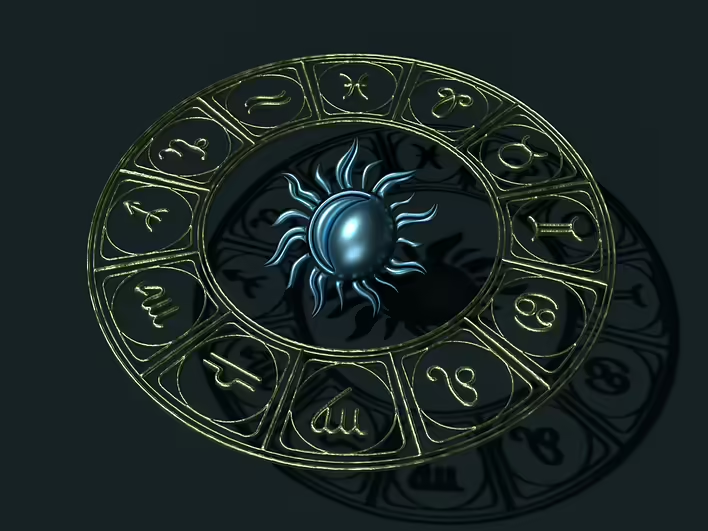
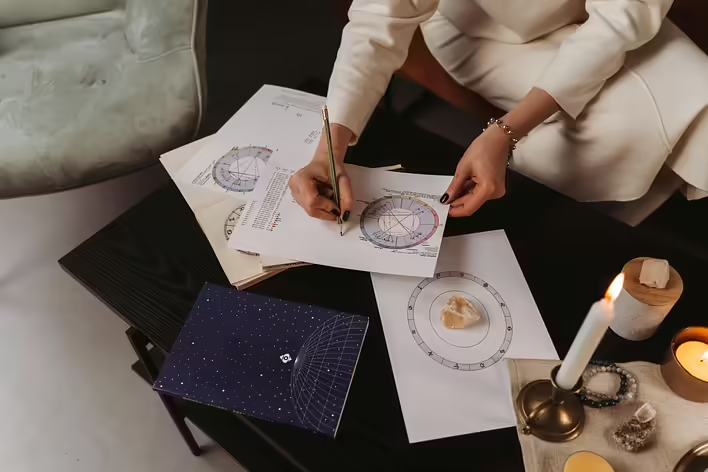
Astrology, which suggests that the position of celestial bodies influences a person's personality and fate, has existed for thousands of years. Through it, people have tried to explain the incomprehensible, predict the future, and find answers to important life questions. However, in the modern world, where scientific knowledge prevails, its status is a subject of debate.
Scientific Perspective
From the standpoint of modern science, astrology does not hold up to scrutiny. Science requires evidence that supports a causal relationship. In the case of astrology, the positioning of stars and planets at the time of birth has no physical influence on the formation of personality or events in life. For example, the gravitational influence of the planet Jupiter at the time of birth is much less than the gravitational influence of the midwife delivering the baby. Scientific theories must be testable and predictable. Astrology, despite attempts, has failed to provide consistent and verified predictions. Numerous scientific studies that sought to find a connection between zodiac signs and personality traits, career success, or relationship compatibility found no correlations.
In 2017, 186 leading scientists and Nobel laureates signed a document stating that there is no scientific evidence supporting the truth of astrology. They characterized it as a pseudoscience.
Psychological Aspects
Since there is no scientific evidence, belief in astrology is a subjective choice. It is more of a psychological phenomenon than a physical one. Its popularity can be explained by psychological effects such as the Barnum effect and the self-fulfilling prophecy. For many, astrology is a way of self-discovery, a tool for understanding oneself and others.
Here are a few psychological effects that explain its popularity:
Barnum Effect (Forer Effect)
This is the tendency of people to perceive general and vague statements as an accurate description of their personality. Horoscopes and descriptions of zodiac signs often contain universal phrases that apply to most people (“You love being appreciated,” “Sometimes you can be indecisive”).
Self-Fulfilling Prophecy Effect
When a person believes in something (for example, that they are a “stubborn Taurus”), they subconsciously begin to behave according to that belief, which only reinforces their faith.
Simplification of Complexity
The human mind seeks order and explanations in chaos. Astrology provides a simple system for classifying people and events, reducing the feeling of uncertainty.
What People Think About It
Supporters believe that astrology helps them better understand themselves, find common ground with others, and navigate life. They may see in it the wisdom of ancestors and seek patterns that cannot be explained by logic.
Skeptics view astrology as a pseudoscience, considering it dangerous if people make important decisions based on it. They emphasize that psychological, social, and biological factors are much more important.
Many people regard astrology as entertainment. They may read horoscopes but do not take them seriously, viewing it as a light and unburdensome way to pass the time.
The Evolution of Astrology and Its Connection to Astronomy
Historically, astrology and astronomy were closely related. In ancient times, they were considered one science about the movement of celestial bodies. Even prominent astronomers of the past, such as Johannes Kepler, practiced astrology to fund their research. However, with the development of the scientific method, these disciplines diverged. Astronomy focused on objective observations, mathematical calculations, and tested hypotheses, while astrology remained in the realm of symbolic interpretations, not subject to scientific verification.
Astrology as a Cultural Phenomenon
Besides the most well-known zodiac astrology in the Western world, there are many other traditions. For example, Chinese astrology is based on cycles of years, each associated with one of 12 animals. Depending on the year of birth, certain personality traits and predictions are attributed to a person. This system differs from the Western one in that it focuses not on the month but on the year of birth. Another important tradition is Vedic astrology (Jyotish), which has Indian origins. It uses a different system of calculations and star positions, leading to differences in the determination of zodiac signs. This diversity shows that the idea of cosmic influence is universal, but its interpretation depends on culture.
Relevance in the Modern World
Despite the lack of scientific evidence, astrology is very popular today. Daily horoscopes, astrological memes, and natal chart apps have become commonplace. Astrology has ceased to be merely a tool for “serious predictions”; it has transformed into a form of social interaction. Now, discussions about horoscopes, comparing zodiac sign compatibility, or jokes about the characteristics of certain signs have become part of our everyday communication.
Discussion Questions:
Do you think something that is not scientifically proven can still have a positive impact on a person's life?