This content has been automatically translated from Ukrainian.
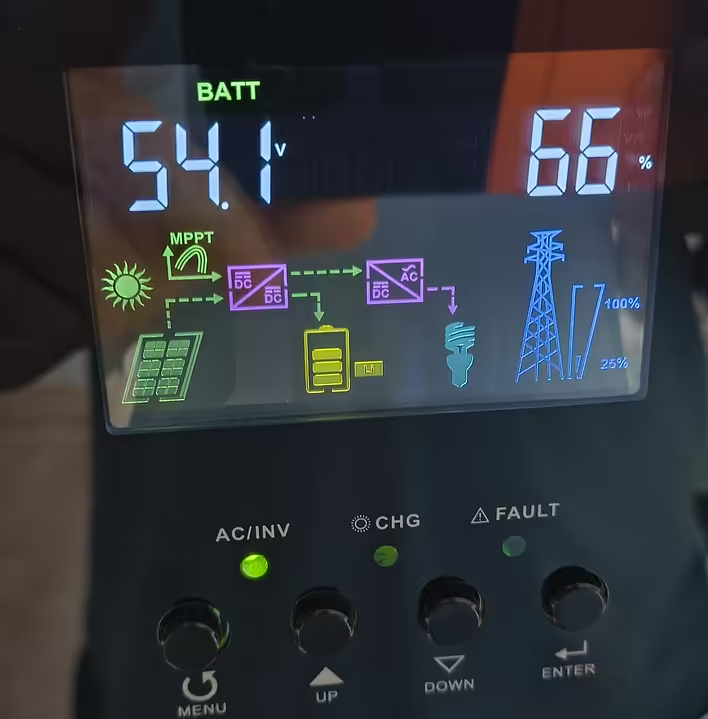
For my KS5200PS, I got another station - Must HBP19-5548 VPM. In fact, this adds another +5 kWh for energy storage.
It seemed simple, just bought another station - and continue living your life.
But no. Along with the additional 5 kWh, I got a few more tasks that now need to be solved somehow.
Why not just an inverter + battery?
I will immediately answer the obvious question.
Why didn't I take a regular inverter and a separate battery?
First of all, you can't properly combine two "all-in-one" stations into one system. And from the perspective of future scalability, it's not the best option at all.
But the main answer is - money.
Must HBP19-5548 VPM is currently cheaper than the combination of an inverter + battery that could be properly scaled in the future. And even if you just compare a 5 kW inverter + 5 kWh battery - a separate system turns out to be more expensive.
And I'm not even mentioning the automation, protection, panel, cables, and all that wonderful set of things that start to appear when you buy not a "box," but assemble a system from components.
And secondly - form factor.
I don't like these constructions: an inverter on the wall, a panel with automatics underneath, a battery nearby, and a web of cables between all this.
In an "all-in-one" format, I simply like it more.
So I took the simpler route: I switched the connection from KS5200PS to Must.
And because of this, by the way, I paused my daily blog post about electricity consumption. I need to understand how everything works now first.
And here came the first nuance
In KS5200PS, I used the SUB mode.
But the Must HBP19-5548 VPM doesn't have such a mode.
There are SBU, SOL, and UTI.
Currently, Must is operating in SBU mode. And for daily electricity savings, this is, frankly, a very pleasant mode.
The sun charges the battery, the battery powers the house, and the grid is used when the battery has already dropped to a specified level.
This means less money is spent on electricity from the grid.
But there is one problem.
I not only need to save. I also need to have a reserve for a blackout.
And preferably, at the moment when the grid disappears, the battery should be charged to the maximum.
In my case, the grid can appear completely randomly. For example, a blackout, then electricity is supplied for an hour or two - and then it's off again.
So I want to use those one or two hours as effectively as possible: saw the grid → charged the battery → back to living off the battery.
It seems logical.
But there is no direct mode in Must that would do just that.
However, there are several settings that seem to allow you to slightly trick the system and effectively simulate SUB.
I'm currently experimenting with this.
Must has already operated in SBU for the first day. Now I'm looking to see what happens with different charging settings and switching between the grid and the battery.
If I manage to set it up properly - I will write separately about what exactly I set and how it behaves in real conditions.
And now about the second station
Because the adventures certainly don't end here.
The plan is as follows:
- buy the necessary cables;
- buy automation and protection;
- think through the connection scheme;
- understand how to properly put the second station into operation;
So I just wanted an additional 5 kWh battery.
And as a result, I got two stations, AVR, automation, and yet another home electrical quest.
Well, at least it won't be boring.
Depending on the results of the experiments - I will figure out which station is a priority, which is a backup, and in what modes they will operate.
Like it?React
🧵
This post doesn't have any additions from the author yet.
![[Personal Experience] How I Dealt with the E03 Error on KS 5200PS](https://cdn.tseivo.com/qbmx9gef6wz0p8kf2q49chgeyyyu)