This content has been automatically translated from Ukrainian.
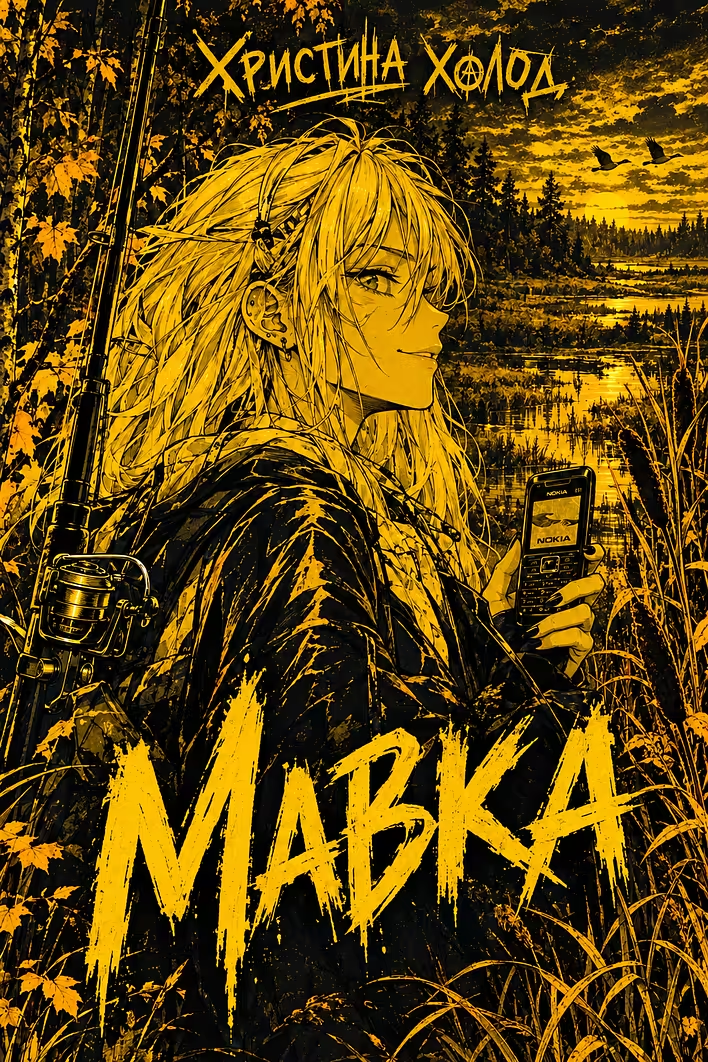
Hello, my dear ones! I'm here again, and I've once again broken my solemn promise not to read Kristina Kholod. Yes, I'm weak.The description was like this: "Robinson dreamed of returning home. She is already home. Somewhere between the swamp and the sky, between radio noise and silence, lives a story about freedom. It sounds like an old song that no one remembers. But it is alive. And it waits for you."How can one resist that? I believed it would be something deep, atmospheric, perhaps even philosophical. But it turned out... well, you get it.
This is not a book. It is a collection of unrelated anecdotes, notes from a mad forester, and survival instructions for sociopaths. The plot consists of two crooked lines that not only do not intersect — they are not even in the same plane. The first line: the heroine wanders through the forest, looking for mushrooms, not finding them, eating everything that is not nailed down, and stealing from peasants. Or she finds pears, wild garlic, ramsons, water lilies, burdock, dandelion root coffee, black nightshade, and raspberry leaf tea. In other words, I read not a novel, but a menu. And not from a restaurant, but from a forest hideout.The second line: the heroine does something completely incompatible with the first — she either shoots down a Russian satellite accidentally because she wanted to send a message to aliens, or she writes HTML games on an old phone, or she flashes a Nokia Lumia to Android, or she brews mash, or listens to The Doors, or organizes radio broadcasts.And all this against the backdrop of a supposed nymph wandering somewhere in the forest with a monument to Bandera. How could all this end up in one book? It's like if you took a cookbook, a textbook on radio electronics, a collection of mystical stories, and the memoirs of a hermit, cut them into pieces, and glued them together with tape.How? Why? Where is the conflict? There is no conflict. There is no forester chasing her through the thickets. There are no wolves wanting to eat her. There aren't even cops looking for that same naked woman in a fox mask who steals beets. All conflicts resolve themselves. She just goes and does whatever she wants. And this is called a plot?
And then there’s this nymph. Oh, that’s a separate song. The heroine constantly says that she is an atheist, that nymphs do not exist, that it’s all women’s tales. But rumors about the nymph circulate throughout the village. And interestingly, the nymph grows. At first, she is two meters, then three, then four, and by the end, she is already ten. And she drags either a portrait of Shevchenko, or a monument to Bandera, or the heads of Lesya Ukrainka and Ivan Franko. Is this a metaphor? Is this social satire? Or is it just the hallucinations of drunken old men on the radio? I still don’t understand. And the main thing is, the heroine does not consider herself a nymph. Although it is obvious that all these rumors are about her. She is naked, in a mask, rummaging through the forest. But no, she stubbornly denies it. And it’s not funny, it’s just annoying.
There were good moments too. A memory of 2003, when she was little and looked at Mars through her grandfather's binoculars. That was sincere. The thought that she might be in a coma after falling off a skateboard is also not bad. But it leads nowhere. It just appeared and disappeared. Like the story about the fern flower. Cool, but why? In the universe of the book, there is no mystique. There is nothing supernatural. But then where does this nymph come from? If she doesn’t exist, then why do they talk about her? And if she does exist, then why doesn’t the heroine meet her? I broke my brain trying to read this.
And yes, there is atmosphere here. Radio, night broadcasts, old men on the waves, noise, Morse code. That works. But everything else is some kind of absurdity. The heroine either poisons fish with euphorbia, catches a duck in a bag, eats dandelion cheese, or suddenly remembers space. I don’t understand, is this a parody? Is this satire? Is this a madwoman's diary? If it’s a diary, then why is it so torn? If it’s a novel, then where is the plot?
But you know what? The ending is fine. She found a mushroom. Big, white, delicious. And I even thought that this book is good. Yes, good. Despite all this nonsense, it is good. The heroine survives, she is happy, she is free. And that is probably the main thing. But I still don’t understand why it was necessary to mix cooking, radio hooliganism, cybercrime, and folklore. It’s like borscht with candies. Both seem tasty, but together — disgusting.
If you like Stalker, you might enjoy this. The atmosphere is there. But I warned you. This is not a book, it’s a set of scenes. And if you are waiting for a story, you won’t find it. You will find a lot of food, a lot of radio, a lot of a naked woman in a fox mask. And no conflict. Well, except for the conflict between the heroine and the mushrooms.And so, Kristina, if you are reading this: please, next time don’t write a two-hundred-page book about how the heroine looks for socks.I already know that she will have them on her head instead of a hat.
Like it?React
🧵
This post doesn't have any additions from the author yet.