Once, I was invited to my girlfriend's sister's wedding as a witness. We had a pretty good time, had fun during the witness presentation, and the groom even made sure that "The Imperial March" from "Star Wars" played for my entrance. Interestingly, people there constantly referred to me as an IT guy; please never call people in Ukraine that, it’s very annoying + it’s a Russism, the correct term is — IT specialist. There was also a sense of a different perception of me as a person, a kind of peculiar curiosity, obviously shaped through the lens of stereotypes about IT specialists as such. So, by the end of the day, the bride's grandmother approached me and said:
— Igor, I never thought you were so cheerful, when they said you were an IT guy, I thought you were like they say a computer worm, but you turned out to be a normal guy, so sociable!
This phrase impressed me a lot, and I remembered it long enough to tell you.
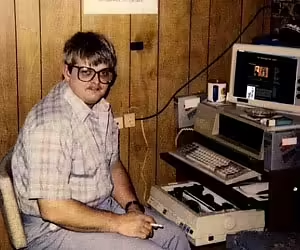
That is, even now, some people's perception of this profession is based somewhere on the image of this guy:
Of course, you (most likely) don’t think so, but I would like to tell you a bit about what types of these IT specialists exist and who, besides the guys in glasses in front of a screen with a waterfall from the movie "The Matrix", can also call themselves IT specialists.
IT is, first of all, an ecosystem where the ability to think, communicate, and learn is important.
In our world of consumer users, IT specialists create digital products that will be bought, that are convenient and pleasant to use, that meet certain needs or solve specific problems. Thus, the cycle of creating these products consists of a fairly wide range of activities.
Besides classical development, some specialists engage in strategic planning, marketing, analytics, design and visuals, operational processes, finance, system administration, hiring processes, legal issues, testing, security, and in companies where reputation and positive perception of their brand are important, there are roles such as brand awareness or brand employer managers, event specialists, etc., etc. If all these people work in one IT ecosystem and have common goals, it is logical that they are all IT specialists.
I would also like to outline for you what modern IT looks like in my view, but here it is worth making a certain distinction between the Ukrainian and foreign industries, as well as dividing it into product and outsourcing.
When we talk about American and European companies, their approach to hiring, attitude towards work, and treatment of employees, although it varies from company to company, is generally more strictly regulated than ours. They ask for diplomas that confirm the necessary competencies for the position. There, a Junior is someone with 5–7 years of relevant work experience. How to gain it? They themselves don’t know 😁
People work in small businesses or mini-startups, go through internships — and then, perhaps, at 25–28 years old, they become Junior specialists. Probably, in non-technical specialties, it’s better, but the trend is similar. In addition, some technologies develop so quickly that last year’s are no longer working properly — and one has to learn new ones. It’s a constant race against time. Just consider these job postings for AI specialists with 10 years of experience when the general masses only learned what Chat GPT is just 3–4 years ago)
As for Ukraine, we are indeed a country of opportunities. Here, with a few pet projects and internships under your belt, you can get a Junior level role in a decent company. These technology races still exist, but you don’t even necessarily need to obtain a higher education diploma to start working. Given the overall quality of education, it’s no surprise that employers are more interested in what you can actually do and what skills you can apply in your work, rather than your theoretical knowledge about the profession 🤭
Product or outsourcing? In my opinion, this choice will significantly impact your future career. Here’s how I see it:
In outsourcing, what is the main thing? A satisfied client and the corresponding profit for the company. Usually, there are quite few opportunities to push your ideas and bring creativity into what you create. Often, the product is simply handed over, and then the team takes on the next project. For some, this is absolutely fine: work is work, the main thing is to get paid.
In outsourcing, it’s important for everyone how quickly you perform your work, and in larger outsourcing, how well you do it. I am not in a position to say this for all outsourcing IT specialists, as I am sure there are those where values align with mine. However, a significant percentage of outsourcers set time trackers on work laptops to monitor your time; they do not hire people who might potentially suggest any changes in work, any creative ideas, because this could potentially affect work speed. Such companies will try to pay you less, reduce payment for your minimal mistakes to earn more. Unfortunately.
There is another path. It’s harder to get on. Often, it requires more knowledge and expertise, but I believe it’s worth it. Of course, I’m talking about product companies. Again, what I will say next does not necessarily apply to everyone, but this is a personal observation. In product companies, people mainly engage in creativity based on their experience and skills. Of course, there is management, the global strategy of the company and the product. However, often the corporate culture is aimed at ensuring that as many team members as possible are heard. There is more room for maneuver here; to implement more ideas if they positively impact the product. Creative approaches and leadership are valued here. Because this company is also the client.
Considering the above, you can already draw certain conclusions about what to choose for yourself, but I highly recommend not to take this as the ultimate truth, but only as one of the opinions. In any case, IT has always been about solving problems and meeting user needs. Which path to take? It depends on what is important to you. If you have a passion for creativity and bringing your own ideas to life, then product is definitely for you. But if you’re okay with always having clear tasks and completing assigned work without deviating from the specifications, then outsourcing will be a good option.
So who is this IT specialist, what should they be able to do?
An IT specialist should be able to communicate, solve problems, find solutions, think comprehensively, be able to perceive constructive feedback and give it correctly on their own. It’s important to be able not to conflict in crisis situations, which can be a challenging task.
Before taking on any task, it’s important to ask "what for?". It’s important to understand why certain things are done, how relevant they are for the product and for the business as a whole. Whoever, however many times they repeat this to you, knowing English is very important, it’s a 100% must-have. Even more important is the ability to learn.
In addition to all this, you need to keep an eye on trends. Not only on TikTok but also on technological trends. For example, there has been an explosion, an AI frenzy. Everyone is trying to stuff more AI into their apps and websites, often even without understanding the need and how it works. However, a new skill that every IT specialist should develop is the ability to work with AI, formulate correct queries, and, preferably, have a basic understanding of how it is structured.
A moment of seriousness: AI, by definition, has not yet been invented. It’s marketing nonsense.
Of course, depending on your direction, there are also a number of technical skills. For example, my role at my main job is Software Engineer (Cocoa). This is about developing macOS and iOS applications. In addition to what has been mentioned above, my responsibilities include writing code in Swift and Objective-C, writing unit tests, writing technical documentation, reviewing other developers' code, participating in various planning sessions, interacting with other teams as needed, CI/CD (Continuous Integration/Continuous Delivery), as well as communicating and assisting the support team. So, for an engineer, writing code is probably only about 30% of the job.
In conclusion, IT is much closer than it seems. I hope that by sharing a bit about my experience, I was able to inspire you with some ideas and conclusions about this industry.
Make decisions thoughtfully and independently. Even if the choice turns out to be wrong, your experience will not go anywhere. It will definitely help you more than once in the future. And may the force be with you!