FMV (Full Motion Video) games are a genre of video games that use pre-recorded video scenes with real actors or computer graphics. These video scenes are integrated into the gameplay, creating the illusion of active participation in a movie or interactive story.
FMV games emerged in the 1980s when technological advancements allowed the use of video recordings in video games. An early example of such games is "Dragon's Lair," which used laser discs to play back animation. The player had to press buttons in a timely manner to continue the story, and incorrect actions led to failure.
The main characteristic of FMV games is the emphasis on video and story rather than traditional gameplay. Players often interact with the game through choices of actions or dialogue lines, which affect the development of the plot and the game's ending. One of the defining moments for this genre was the release of games on CD-ROM media in the 1990s, which allowed for the use of more extensive and high-quality video materials.
The popularity of FMV games peaked in the mid-1990s with projects like "Phantasmagoria" and "Night Trap." However, due to the technological limitations of the time, video quality was often low, and gameplay was limited, leading to criticism and the gradual decline of the genre.
Despite this, modern games sometimes use elements of FMV. Contemporary technologies allow for the creation of high-quality videos and their more organic integration into gameplay. A revival of interest in this genre has occurred thanks to indie games that experiment with new forms of storytelling and interactivity.
FMV games remain an interesting example of the evolution of video games and their pursuit of interactive cinema. They demonstrate how technological capabilities can influence storytelling and the player experience.It should be understood that an FMV game will not be considered a conditional The Witcher 3 where we see inserts of dialogues and other scenes. Full Motion Video is about a fully constructed game based on video (depending on the chosen action option).
Interactive Content and Full Motion Video Games
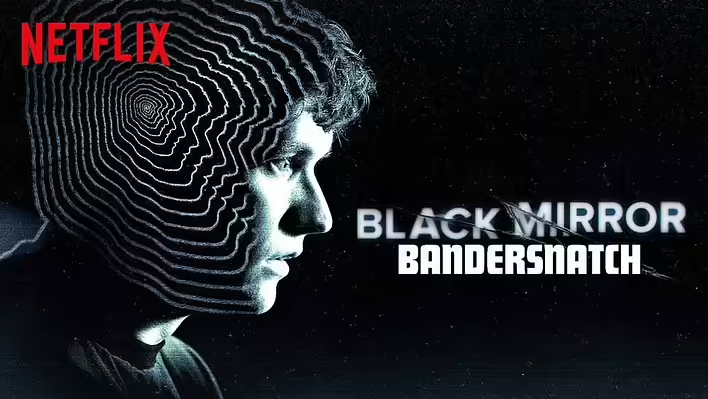
Netflix has several interactive series where viewers can make choices that affect the plot's development. The most famous example is "Black Mirror: Bandersnatch."
Black Mirror: Bandersnatch
Black Mirror: Bandersnatch is an interactive film released in 2018 as part of the "Black Mirror" series. Viewers can make choices at various points in the film, leading to different plot lines and endings. This allows for a personalized viewing experience that resembles gameplay in FMV games.
Other examples of interactive projects on Netflix:
"You vs. Wild" – An interactive series featuring Bear Grylls, where viewers choose what decisions he should make in various survival situations.
"Minecraft: Story Mode" – An interactive adaptation of the video game by Telltale Games, where viewers can make choices that affect the plot.
"Carmen Sandiego: To Steal or Not to Steal" – An interactive cartoon where viewers help Carmen Sandiego complete various missions by making choices along her path.
These interactive Netflix projects resemble FMV games in their format, where video recordings are integrated with viewer choices that affect the plot's development. But how does interactive content differ from an FMV game? There are actually several fundamental differences.
Differences Between FMV Games and Interactive Content
FMV games typically run on gaming consoles or computers as standalone games. Players interact with the game through a controller or keyboard and mouse, performing actions that affect the game's world plot. FMV games have more extensive gameplay elements, such as puzzles, exploration, combat scenes, and other forms of interaction. Players often control character movements and interact with the game world. FMV uses video with real actors or computer graphics but also includes interactive elements that may require more complex technical implementation and development.
Games are aimed at gamers looking for an interactive experience with a higher degree of interaction and immersion in the game world (high level of imersion).
Netflix interactive series are streamed through the service on any device that supports Netflix. Viewers make choices using a remote control, touchscreen, or other input methods. The content primarily focuses on choosing plot directions. Viewer choices affect the story's development, but interaction is limited to selecting from provided options.
They are created like regular videos with additional interactive capabilities that allow viewers to make choices. Netflix uses technology that allows for seamless switching between different video scenes based on viewer choices.
Series and films (even if interactive) are designed for a broad audience of the streaming service, including those who typically do not play games. They offer a more passive experience with the ability to make choices that affect the plot.
Examples of modern FMV games
The Bunker (ґеймплей)
"Her Story" (2015) – An interactive detective game where the player reviews video recordings of a woman's interrogations, accused of her husband's disappearance. The game requires searching for keywords in the video database to piece together the full picture of events.
"Late Shift" (2016) – A crime thriller where the player influences the plot through dialogue choices and actions of the protagonist, who becomes embroiled in a robbery. The game has multiple different endings depending on the player's decisions.
"The Bunker" (2016) – A psychological horror game where the player controls a character living in an underground bunker after a nuclear apocalypse. The game uses real footage with actors and allows interaction with the environment.
"Telling Lies" (2019) – A spiritual successor to "Her Story," where the player reviews recordings of conversations between several characters to uncover a mystery. The game offers a nonlinear plot and requires analyzing video recordings to understand the connections between events.
"Erica" (2019) – An interactive thriller that uses real-time technology to integrate video and gameplay. The player influences the plot through choices of actions and dialogues, uncovering the protagonist's past secrets.
Old-school cult FMV games
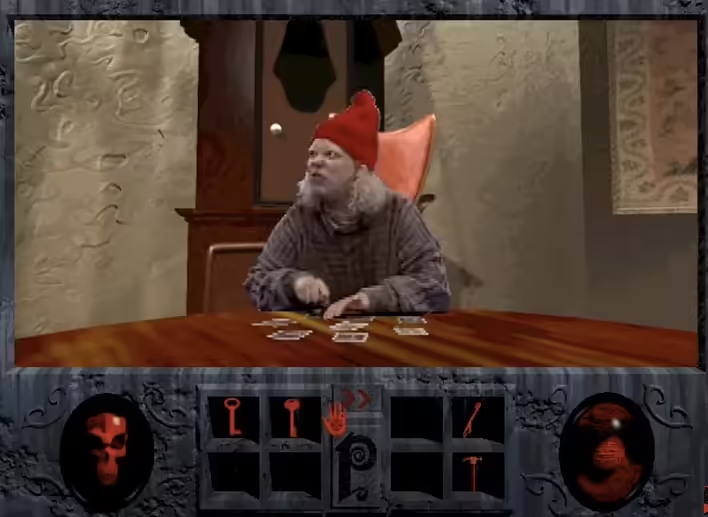
Phantasmagoria (ґеймплей)
Dragon's Lair (1983) – One of the first FMV games created by Don Bluth. It used animation and laser discs, allowing players to control the actions of a knight named Dirk during his adventures.
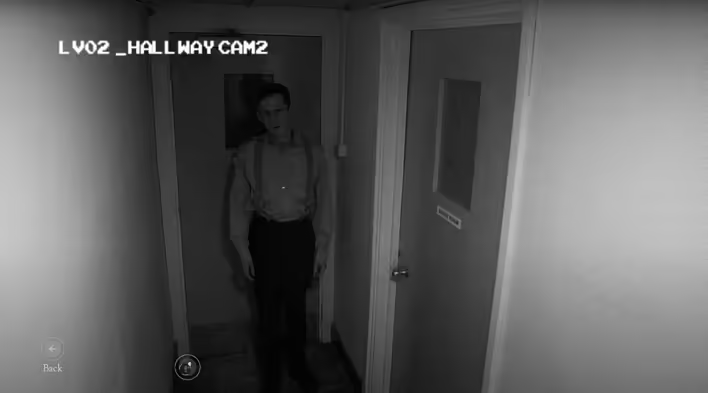
Night Trap (1992) – A game that became controversial due to its themes and visual style. The player had to monitor video cameras in a house and activate traps to protect girls from vampires.
Sewer Shark (1992) – One of the first FMV titles for the Sega CD console. The player controlled a flying vehicle that navigated through sewer tunnels, avoiding obstacles and destroying enemies.
The 7th Guest (1993) – A psychological thriller game from Trilobyte. It combined video with actors and 3D graphics, offering players puzzles to solve in a mysterious mansion.
Phantasmagoria (1995) – A psychological horror from Sierra On-Line, created by Roberta Williams. The game told the story of a woman who discovers her house has a dark history and featured realistic scenes of violence and horror.
Gabriel Knight 2: The Beast Within (1995) – A sequel in the series of games from Sierra On-Line. It used real actors and had a complex plot about werewolves and ancient mysteries.
Tex Murphy: Under a Killing Moon (1994) – A game in the science fiction and noir genre, where the player controlled a private detective in a post-apocalyptic world. It combined video with actors and 3D graphics.
Wing Commander III: Heart of the Tiger (1994) – Part of the popular space simulation series from Origin Systems. It featured video with famous actors like Mark Hamill and had an engaging plot.
Gameplay reviews of any of these games can easily be found on YouTube. So if you want to dive a little deeper into the study of FMV content, there is plenty of material online.