This content has been automatically translated from Ukrainian.
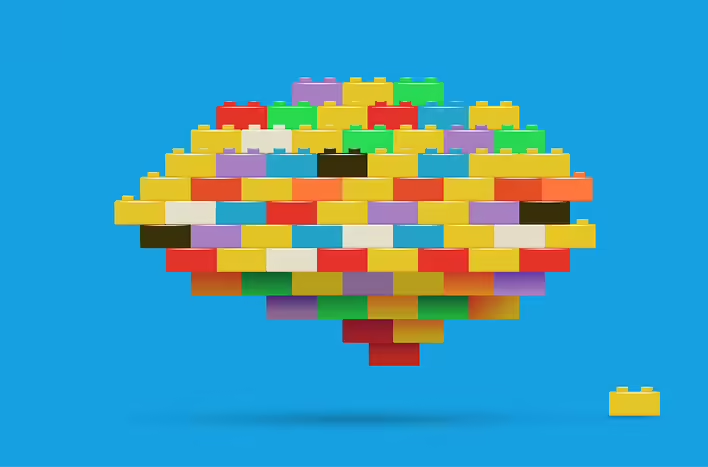
The brain is not just a sponge of neurons, but a system of layers, each of which performs its own function. In cognitive sciences, the term "brain stack" is not a widely accepted or formal term. It is rather a metaphor or popularizing image used by journalists, popular scientists, futurists, or authors who explain complex things in simple words (for example, in books about neurointerfaces, transhumanism, or artificial intelligence).
In the brain, there are:
- Physical level — neurons, electrical impulses, biochemistry.
- Sensory level — vision, hearing, touch, etc.
- Emotional level — limbic system, instincts, fear, joy.
- Cognitive level — thinking, language, logic.
- Reflective level — self-awareness, self-concept.
All of this together — like a stack in IT: from low-level signals to the "interface" through which you think about your own thoughts (metacognition).
AI also has a stack, only it's software.
In AI, during a response, a temporary context stack is formed:
- tokens (words, signs),
- conversation history,
- intermediate representations ("I've talked about this before"),
- logic of response formation,
- text generation — one word ahead.
But there is a difference:AI does not have true emotional memory or embodied experience. In the brain — emotions can overwrite logic. In AI — everything is linear and deterministic (for now ¯\_(ツ)_/¯).
So, when you are tired and can't focus — the top layer of your brain stack hangs, like a bug in RAM. You can "restart": rest, eat, change your focus.
The term "brain stack" was first seen in a book about design patterns by a refactoring guru (google it). The book can be purchased online in digital format. It is available in EPUB, PDF, etc.
Like it?React
🧵
This post doesn't have any additions from the author yet.