This content has been automatically translated from Ukrainian.
Imagine a world without wars, crime, unemployment, and chaos. Every person has their place, everyone lives by the same rules, and the state promises security and prosperity.
At first glance, this sounds like a dream come true. But what if this order comes at the cost of freedom? If books are banned, thoughts are controlled, and any dissent is considered a crime?
This contrast is the foundation of dystopia—a genre that shows how the desire to create a perfect society can turn into a real nightmare.
Unlike ordinary fiction, dystopia almost never attempts to literally predict the future. Its main task is to warn the reader. It takes existing trends in the modern world to extremes and poses the question: what will happen if society fails to notice the danger in time?
What is dystopia
Dystopia is a literary, cinematic, and philosophical genre that depicts a society where the attempt to build a perfect world has resulted in the loss of freedom, humanity, or the right to choose.
In such works, the state or another system often appears almost flawless. Crime is nearly absent, everyone is provided with housing and jobs, and life is governed by strict rules.
However, behind this apparent harmony lies another reality. Individuality gradually disappears, freedom becomes undesirable, and any dissent is perceived as a threat to the existing order.
That is why dystopia is often referred to as the "dark mirror of utopia."
Why dystopia grew out of utopia
To understand dystopia, one must first look at its opposite—utopia.
Even ancient philosophers tried to imagine a state where justice and harmony prevail. Later, the English thinker Thomas More coined the term "utopia," describing a fictional island with a supposedly perfect social structure.
For several centuries, utopian works were predominantly inspirational. They showed what life could be like without wars, inequality, or poverty.
However, the 20th century forced writers to view this idea in a completely different light.
The 20th century that changed the genre
By the beginning of the last century, many people sincerely believed that the development of science, industry, and technology would inevitably make human life better.
Yet reality turned out to be much more complex.
The First World War, totalitarian regimes, the Holocaust, mass repressions, the Second World War, and the emergence of nuclear weapons showed that even the greatest achievements of science can be used not only for progress but also for the oppression of people.
It was then that a new thought emerged.
The danger lies not in the very desire for order or development. It arises when, for the sake of the "common good," society begins to sacrifice the freedom of the individual.
This gradually formed the classical dystopia—a genre that does not offer an ideal future but warns of its possible consequences.
One of the first major works of this new direction was the novel "We" by Yevgeny Zamyatin, written in 1920.
In it, people live in a state where almost everything is subordinated to mathematical logic. Personal life is nearly absent, citizens have numbers instead of names, and transparent houses symbolize the complete lack of privacy.
Zamyatin was one of the first to show that absolute order can turn out to be not a blessing but a form of total control.
A few decades later, George Orwell's novel "1984" appeared.
It introduced the world to the image of Big Brother, the concept of Newspeak, and the idea of constant surveillance of citizens. Orwell demonstrated that the most dangerous dictatorship is one that controls not only people's actions but also their thoughts.
A completely different perspective was offered by Aldous Huxley in his novel "Brave New World."
Unlike Orwell, his society almost never uses open violence. People are not intimidated—they are made so satisfied with life that they willingly give up their freedom.
That is why today literary scholars often compare these two novels. While Orwell warned of a dictatorship of fear, Huxley warned of a dictatorship of comfort.
Main features of dystopia
Despite the variety of plots, most dystopias share common traits. These are what make the genre easily recognizable, whether it is a novel, film, series, or video game.
The state or system controls almost everything
At the center of dystopia is almost always an extremely powerful authority. This can be a totalitarian state, a powerful corporation, artificial intelligence, or even society itself, which voluntarily upholds strict rules.
Control is not limited to laws. It extends to education, culture, information, personal life, and even people's thoughts.
That is why the heroes of dystopias often fear not only punishment but also the very fact of dissent.
Freedom is exchanged for comfort
Another characteristic feature of the genre is the voluntary renunciation of freedom.
In many works, people do not protest against the existing order. On the contrary, they consider it correct, as it provides security, stability, or material wealth.
This idea makes dystopias so unsettling. The most dangerous dictatorship turns out to be not one imposed by force, but one that people gradually begin to perceive as normal.
The main character begins to doubt
Almost every classic dystopia is built on a similar principle.
Initially, the main character lives by the rules of the world around them and hardly questions them. However, gradually they notice contradictions, learn hidden truths, or meet someone who makes them see life differently.
It is from this moment that the conflict between individuality and the system begins.
In most classic works, this struggle ends tragically or ambiguously. This is how authors show how difficult it is to resist a power that controls almost all spheres of life.
21st-century dystopia
If the writers of the last century feared dictatorship and totalitarianism the most, modern authors increasingly turn to other threats.
Digital technologies, artificial intelligence, large arrays of personal data, social media algorithms, biotechnology, and genetic intervention come to the forefront.
These themes are explored in the series "Black Mirror," where almost every story shows how technologies created to ease life can lead to unexpected and dangerous consequences.
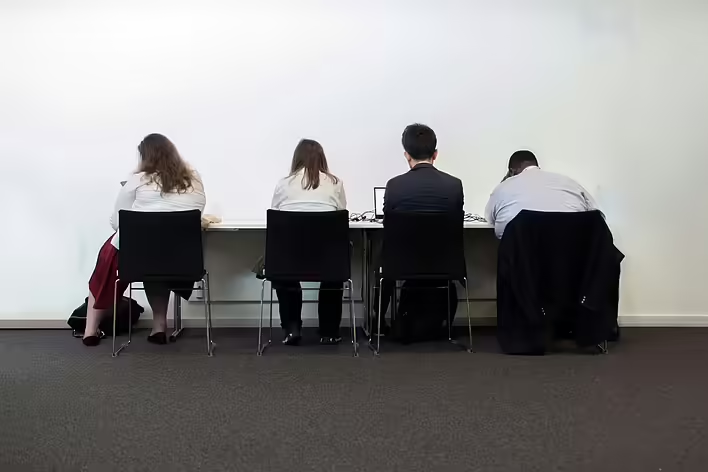
Another vivid example is the series "Severance." In it, employees of a corporation undergo surgical separation of their work and personal memories. This fantastic idea prompts reflection on how far modern society is willing to go for the sake of productivity and efficiency.
Many modern dystopias no longer frighten with brutal dictators. They pose much more complex questions: can we voluntarily give up our freedom in exchange for comfort, security, or technological progress?
Why dystopias remain popular
The interest in this genre has not waned for over a hundred years.
One reason is that dystopias help to make sense of the present. They do not so much predict the future as show what the trends that seem ordinary today can lead to.
That is why Orwell's and Huxley's novels regularly return to bestseller lists during periods of political crises, social upheavals, or rapid technological changes.
Moreover, dystopia almost always poses universal questions. Where is the line between security and freedom? Can everyone be made happy? And does the state or another system have the right to decide what is right for a person?
These questions make the genre relevant regardless of the time.
Like it?React
🧵
This post doesn't have any additions from the author yet.