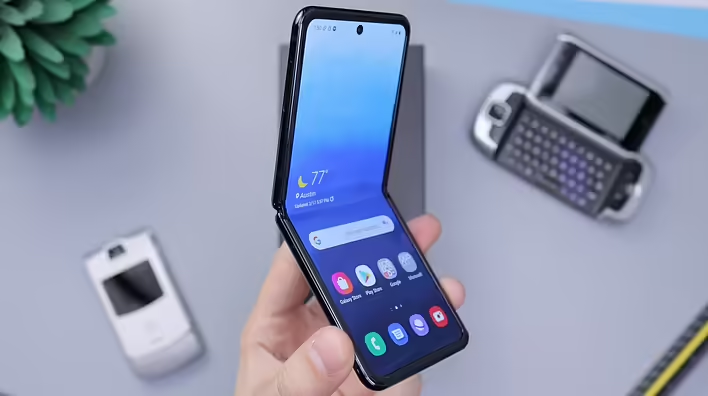
The history of mobile phones spans several decades, but the real revolution of recent years has been devices with flexible displays. The first concepts appeared back in the 2010s, but it was only recently that manufacturers managed to transition from prototypes to mass production. Samsung, Huawei, and Motorola were the first to introduce commercial models of foldable smartphones that can transform from a compact phone into a tablet.
It is worth noting that flexible displays are not the only direction in the development of mobile devices. Traditional form factors continue to exist alongside them. Some consumers even pay attention to feature phones due to their reliability and long battery life. A wide range of such devices can be found at https://www.smsmarket.ua/knopkovi-telefony/. However, it is foldable smartphones that have the potential to change the conventional perception of mobile gadgets.
The Modern Landscape of Flexible Technologies
There are already two main form factors of foldable smartphones on the market:
- book devices (Galaxy Z Fold, Huawei Mate X);
- clamshell devices (Galaxy Z Flip, Motorola Razr);
- experimental form factors (folding in three places).
In the last three years, manufacturers have made significant progress in enhancing the reliability of flexible displays. While the first models raised justified doubts about durability, modern devices can withstand hundreds of thousands of folding-unfolding cycles without noticeable damage.
Barriers to Mass Adoption
Despite technological progress, there are several obstacles preventing foldable smartphones from becoming a mass product:
- High price — flagship models cost between $1500 and $2000.
- Limited durability compared to regular smartphones.
- Screen protection issues and non-standard sizes for accessories.
- Lack of optimized software for all applications.
Comparison of Major Foldable Smartphones of 2025
The foldable smartphone market is rapidly evolving, and 2025 has brought a number of innovations. Flagships from leading manufacturers demonstrate that the technology has reached a new level of maturity. Samsung continues to dominate with the most balanced offering, but competitors are quickly catching up to the leader. Particularly impressive is the progress of Google and Xiaomi, which have managed to offer unique advantages in their models. Motorola has focused on compactness and elegant design.
|
Model |
Form Factor |
Unfolded Screen Diagonal |
Price |
Features |
|
Samsung Galaxy Z Fold 7 |
Book |
7.8" |
$1899 |
IPX8 water resistance, S Pen |
|
Motorola Razr 50 Ultra |
Clamshell |
6.9" |
$1299 |
The thinnest foldable smartphone |
|
Google Pixel Fold 2 |
Book |
7.6" |
$1799 |
Best camera among foldables |
|
Xiaomi Mix Fold 3 |
Book |
8.0" |
$1599 |
Largest screen and fast charging |
Real Benefits for Users
Foldable smartphones offer users unique capabilities that are not available with classic monoblocks:
- significantly larger screen real estate without increasing dimensions when folded;
- convenience for multitasking and parallel use of multiple applications;
- new usage scenarios (laptop mode, enhanced photography).
Manufacturers are actively working on optimizing software to fully leverage the advantages of flexible displays.
The Future of Technology: On the Brink of Change
Analytical agencies predict a 30-40% annual growth in the foldable smartphone market over the next five years. Key factors will be price reductions and improvements in the production technologies of flexible displays.
Manufacturers have already announced plans to release budget models of foldable smartphones priced up to $1000 within the next 12-18 months. This could be a turning point for mass adoption.
A New Era of Mobility
In conclusion, the foldable smartphone market is on the brink of significant changes. The technology has evolved from raw prototypes to commercially viable products, but it has not yet become mainstream.
The main barriers remain price and certain compromises in design, but the situation is changing rapidly. It is expected that within the next 2-3 years, we will see significant price reductions and improvements in technical specifications, making foldable smartphones accessible to a larger number of users.
Flexible displays are not just a temporary trend but a new stage in the evolution of mobile devices, which has every chance of becoming dominant in the premium segment by 2027.
This post doesn't have any additions from the author yet.