
This content has been automatically translated from Ukrainian.
The Korean edition of ETNews reports on Apple's ambitious plans for a radical redesign of the iPhone for the 20th anniversary of the legendary smartphone. The company is developing a device with a completely bezel-less display that will wrap around all four edges of the body.
Revolutionary Display Technology
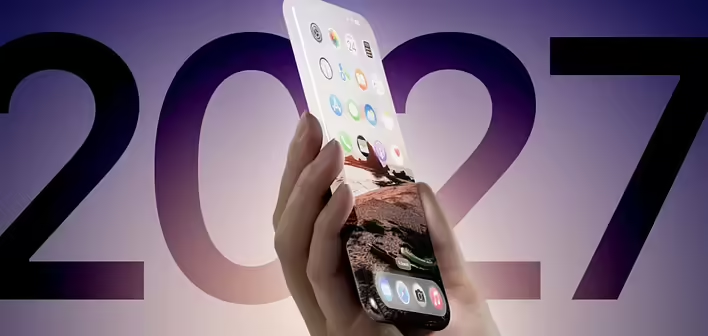
Unlike modern smartphones with only curved side edges, the new iPhone will feature a screen that smoothly transitions across the top, bottom, and side edges. This will create the effect of a solid glass monolith without traditional bezels.
Bloomberg confirms the information, adding details about a "mostly glass curved iPhone with no cutouts." The publication Information also refers to sources claiming a truly bezel-less display in at least one model in 2027.
The Path to a Bezel-less Future
While we wait for interim updates, including iPhone 17 Pro, Apple is already laying the groundwork for a revolutionary leap. Each new generation of iPhone will gradually bring the company closer to the goal of completely eliminating bezels and cutouts. Counterpoint Research Vice President Ross Young confirms that this process will be gradual and will span several years. According to The Information, the iPhone 18 Pro will feature under-display Face ID, leaving only a tiny hole for the front camera.
Technical Challenges
Implementing such a design requires solving complex engineering tasks. Apple will need to place all sensors, cameras, and speakers under the display. LG Innotek is already working on under-display cameras with a multi-lens "free-form" system to minimize distortions.
The company is also developing a new OLED driver chip based on a 16nm process instead of the current 28nm, which will significantly improve energy efficiency. Additionally, the use of silicon batteries is being considered to increase energy density.
Structural and Software Challenges
The curvature of the screen on all sides creates new points of stress, potentially reducing the device's durability. It also poses challenges for placing sensors (e.g., the IR camera that is part of Face ID), proximity and ambient light sensors, cameras, and speakers.
The proposed design will require changes in the way users interact with the device. In the absence of bezels, it will likely be necessary to implement new algorithms for recognizing accidental palm touches, as well as potentially changing the gesture navigation system.
Negotiations with Samsung Display and LG Display about implementing advanced technologies will begin soon. If Apple overcomes all technical hurdles, the iPhone 2027 could become the most significant design update since the iPhone X.
This revolutionary approach will be a worthy way to celebrate two decades of Apple's most influential product.
Like it?React
🧵
This post doesn't have any additions from the author yet.