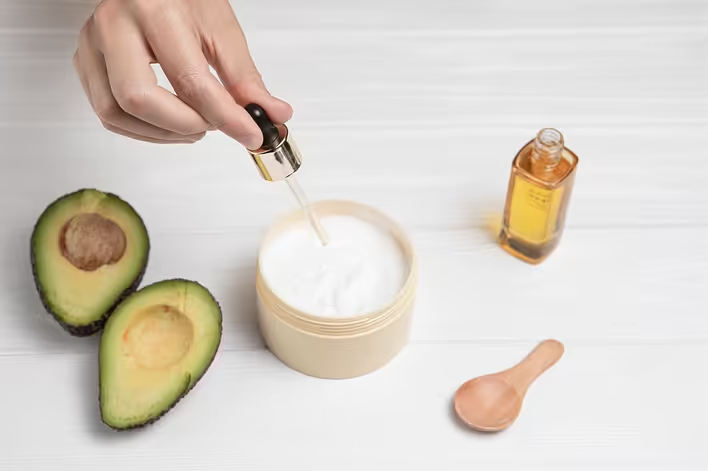
Sometimes it seems: the more assets, the better the result. Another serum, another cream, another layer "for reliability." But the skin does not like chaos. It values logic, moderation, and consistency. Overloading with care can have the opposite effect — dullness, breakouts, irritation. You can find a smart balance of original Korean cosmetic products at https://cosmic.net.ua/ua/shop/brand/lebelage
The Role of Serum and Cream in Care
A serum is a concentrate. It contains a high percentage of active ingredients and works specifically: moisturizing, brightening, combating pigmentation or age-related changes. Its task is to address a specific problem.
A cream is protection and support. It "locks in" moisture, restores the barrier, and creates a comfortable environment for the active ingredients to work. If the serum is the strategy, then the cream is the daily support.
It is important to understand: a cream does not replace a serum, and a serum does not replace a cream. They perform different functions, and together they work more effectively than separately.
The Principle of Sequential Application of Textures to Maintain Lightness and Comfort
The main rule is from lighter to denser. First cleansing, then toner (if needed), then serum, and only after it is fully absorbed — cream.
The serum has a thinner texture, so it penetrates deeper. The cream creates a barrier that retains the active ingredients inside. If you switch their places, effectiveness decreases.
It is also not advisable to apply several serums with different actives at once without pauses or logic of combination. The skin finds it hard to "process" an excess of formulas, especially if they contain acids, retinol, or high concentrations of vitamin C.
Signs of Skin Overload and How to Avoid Them in Daily Care
Overloaded skin loses its natural balance. There is a feeling of stickiness, excessive shine, or, conversely, tightness. Small breakouts, redness, and sensitivity to familiar products may occur.
You can understand that the skin is overloaded with care by its behavior. It always "speaks" when it has had enough.
The most noticeable signal is a feeling of heaviness. After applying products, the face feels as if covered with a film, with stickiness that does not disappear even after 20-30 minutes. The skin cannot breathe, and makeup starts to "slide."
The second marker is sudden small breakouts or subcutaneous bumps without any change in lifestyle or diet. Often, this is a reaction not to a specific ingredient, but to an excess of layers and actives.
A paradox may also occur: simultaneously oily shine and a feeling of tightness. This means that the barrier is overloaded and trying to compensate for stress.
Another sign is increased sensitivity. Products that previously worked well start to sting. The skin turns red more quickly, reacting to temperature or water.
Sometimes overload manifests as dullness. Despite a large number of products, the face looks "tired." This is a signal that the cells cannot renew themselves properly due to excessive stimulation.
How to check? Do a "detox care" for 3-5 days: gentle cleansing, one moisturizing serum or cream, and SPF. If the skin stabilizes quickly, it means there were indeed too many products before.
To avoid overload, it is important not to change several new products at once and not to combine aggressive actives in one routine. If you use retinol in the evening, in the morning, limit yourself to moisturizing and SPF. If you add an acid serum, do not introduce another potent ingredient at the same time.
Balance of Actives for Daily Use
Daily care should be predictable and stable. One active serum at a time and a cream that supports the barrier is sufficient. It is better to alternate actives by days rather than layering them.
The Korean approach to care emphasizes a gentle, cumulative effect.
The right combination is when after application, the skin feels comfortable, not heavy. When there is no feeling of a "mask" on the face. When care works quietly and steadily.
And remember: less is more, but systematically. The skin values not the number of layers, but a smart approach.