This content has been automatically translated from Ukrainian.
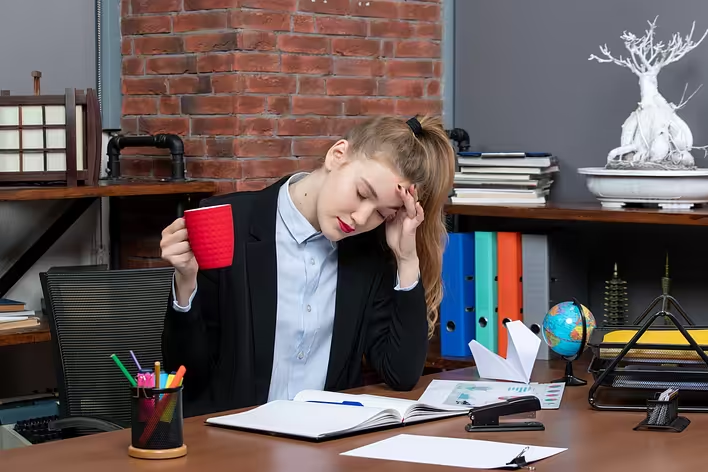
Sometimes, just one bad night is enough for the next day to be harder than usual. After a lack of sleep, it's more difficult to gather your thoughts, even simple tasks take longer, and familiar activities suddenly require much more internal effort. This is most noticeable where attention, quick reactions, and focus are needed: during work, studying, or while on the road.
On such days, many people want to find a quick way to "trick" fatigue, but it's impossible to completely eliminate the effects of sleep deprivation in just a few minutes. At the same time, there are simple actions that can genuinely help you not to fall apart, slightly maintain concentration, and prevent drowsiness from taking over early in the morning. The key here is not to try to squeeze the maximum out of yourself, but to treat your body carefully and wisely.
Why it's so hard after a lack of sleep
When a person sleeps too little, the body doesn't have enough time to recover properly overnight. As a result, heaviness, distraction, lethargy, and the feeling that the brain is working with a delay appear during the day. Drowsiness especially hits quickly in silence, warmth, during monotonous tasks, or when you have to stare at a screen for a long time.
The problem is not just the desire to lie down. Against a backdrop of fatigue, attention worsens, it's harder to keep a thought, it's easier to miss an important detail, and ordinary decisions start to take longer. That's why sleep deprivation should not be underestimated, especially if the day involves responsibility, travel, or a lot of mental work.
What helps to stay awake
Add light
One of the simplest ways to wake up a bit is not to sit in semi-darkness. Open the curtains, move closer to the window, turn on brighter lighting, or step outside for at least a few minutes. When there's more light around, it's easier for the body to maintain a daytime rhythm, and the feeling of drowsiness becomes less intrusive.
Don't sit still
If you feel like you’re starting to "drift," the worst thing to do is to stay in the same position and wait for it to pass on its own. It's much more beneficial to get up, walk around the room, go down or up the stairs, do a few bends, or simply give your body some movement. A short burst of activity often brings back more clarity than passively sitting with a cup of coffee in hand. It's especially helpful to stand up every time you feel like you're no longer reading the text but just staring at the screen. Therefore, even a short-term digital detox and active movement can help prevent you from falling asleep.
Change the environment
Sometimes, strong drowsiness is intensified not only by lack of sleep but also by the atmosphere itself: stuffiness, silence, monotony, a screen in front of your eyes, and the feeling that nothing is changing. In such cases, even a simple action helps: move to another room, open a window, wash your face with cool water, take a break, or briefly talk to someone. For the brain, this is a new signal that temporarily pulls it out of a "hanging" state.
What to eat and drink to feel less sleepy
Don't overeat
After a sleepless night, many people either feel like skipping meals altogether or, conversely, dive into something very heavy and filling. Both options are not the best. If you want to get through the day more or less steadily, it's better to choose light foods in small portions, without feeling heavy after each meal.The most effective are simple foods that provide energy without a sharp spike and a similarly sharp drop: yogurt, eggs, nuts, fruits, vegetables, cereals, whole grain bread, cheese, or other calm options. On the other hand, fast carbohydrates, fatty foods, or alcohol usually don't help but only make the state even heavier.
Don't forget about water
Even mild dehydration can worsen lethargy. When a person has slept little, the body is already working under strain, so hydration is especially important that day. It's not necessary to constantly drink a lot, but it's better to have water nearby and not to remember it only in the evening.
Caffeine is not an unlimited resource
Coffee or tea can indeed help a bit if you need to gather yourself, but they don't eliminate true fatigue. If you drink caffeine chaotically, cup after cup, you might end up feeling not energized but shaky, irritable, with a racing heart, and even worse sleep the following night. Therefore, it's better not to turn coffee into the only way to "get through" the day until evening.
What to do to avoid falling asleep at work or studying
Simplify the day
After a lack of sleep, you shouldn't expect heroic feats from yourself. A tired brain switches between tasks poorly, so on days after short sleep, it's useful to cut out the excess and focus on the most important. It's better to do less but attentively than to scatter yourself across ten tasks and ultimately not accomplish anything properly.
A good approach is to determine a few priority tasks in the morning and start with them. Secondary tasks can be postponed, simplified, or completed later when your state becomes more stable.
Work in short bursts
When you really want to sleep, long hours without a break almost always end with a person physically sitting at the desk but hardly processing information anymore. Therefore, it's much more effective to divide work or study into small blocks. For example, work for 20-30 minutes, then get up, walk around, change your position, look away from the screen, and only then return to the task.
This rhythm doesn't make you perfectly alert, but it helps you not to "fall" into a sleepy state for longer. This works especially well during reading, preparing for classes, working with documents, or studying on the computer.
"Switch" types of activity
If you feel that the text is no longer being perceived, don't torture yourself for another half hour with the same task. It's better to change the format: after reading, switch to notes, after theory — to short practice, after sitting work — to a bit of physical activity. The brain holds up much better when the day doesn't consist of one continuous monotonous action.
A short nap can really save you
If you have the opportunity to lie down for a short while during the day, it can be more beneficial than another cup of coffee. We're talking about a short rest of 15-20 minutes, not a full daytime sleep for several hours. A little nap often helps to refresh a bit and get through the most challenging part of the day without a sharp drop in productivity.
Sleep and productivity
The quality of sleep directly affects how a person works, thinks, and reacts to stress. If the night was too short, it's noticeable during the day that it's harder to maintain attention, decisions take longer, it's easier to get irritated over trifles, and familiar tasks suddenly start to require more time.
Sleep deprivation harms not only speed but also the quality of work. When the head is tired, inaccuracies, forgetfulness, careless actions, and feelings of internal exhaustion occur more frequently. That's why normal sleep is not something secondary, but one of the basic conditions for stable performance, clear thinking, and normal endurance throughout the day.
What is especially important while driving
The road is not a place to test your limits after a sleepless night. If a person feels drowsy while driving, the risk increases very quickly, even if it seems that "a little more can be endured." The most dangerous part is that drowsiness often creeps up gradually: first, the eyelids become heavy, then the gaze begins to wander, reactions slow down, and a few minutes of the journey can literally fall out of memory.
In such a state, it's not wise to rely on loud music, cold air from the window, or conversations "to stay alert." If it becomes hard to maintain attention, you need to stop and rest. In cases of severe fatigue, the smartest thing is not to push through but to take a break or postpone the journey altogether.
What to avoid
After a lack of sleep, it's easy to succumb to the desire to "rescue" yourself with everything at once: sweets, energy drinks, another cup of coffee, heavy food, or continuous work without any breaks. But such decisions usually provide a short and unstable effect. The rise is followed by a new drop, and the body becomes even more exhausted.
It's equally dangerous to pretend that strong drowsiness can simply be ignored. If your eyes are already drooping, thoughts are muddled, and simple actions start to require too much effort, this is not a moment for self-discipline, but a signal to slow down and take care of yourself.
How to recover in the evening
After such a day, the best solution is not to stretch exhaustion into the night unnecessarily. If possible, it's worth making the evening calmer: dim the lights, postpone unnecessary tasks, avoid spending too much time on your phone, ventilate the room, and give yourself a chance to fall asleep properly.
No daytime intake can replace what a regular full night’s rest provides. Sleep is what restores clarity in the mind, reduces fatigue, and helps you not to feel like your energy ran out early in the morning the next day. If the desire to sleep during the day arises constantly, even when you seem to be getting enough rest, it's already a reason not to look for new tricks but to pay attention to your health and routine.
Conclusion
When you haven't slept well, it's important not to try to "defeat" your body but to help it get through the day with the least losses. More light, a bit of movement, water, light food, short breaks, changing activities, and caution with caffeine can indeed support your state for a few hours. But the best way to stop nodding off is not to look for the perfect stimulant, but to give yourself a proper sleep, which is the main foundation of alertness, attention, and productivity.
Like it?React
🧵
This post doesn't have any additions from the author yet.