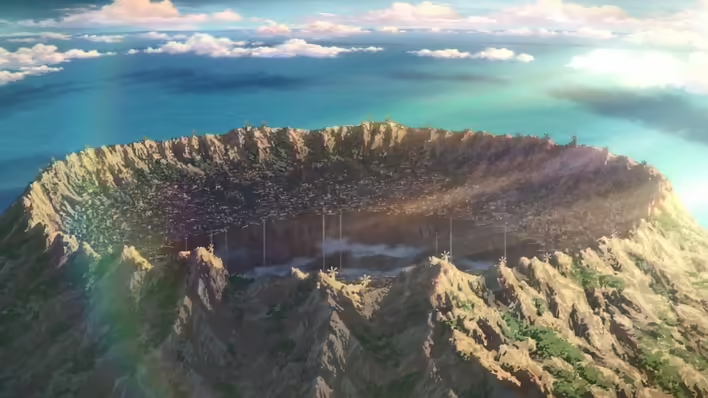
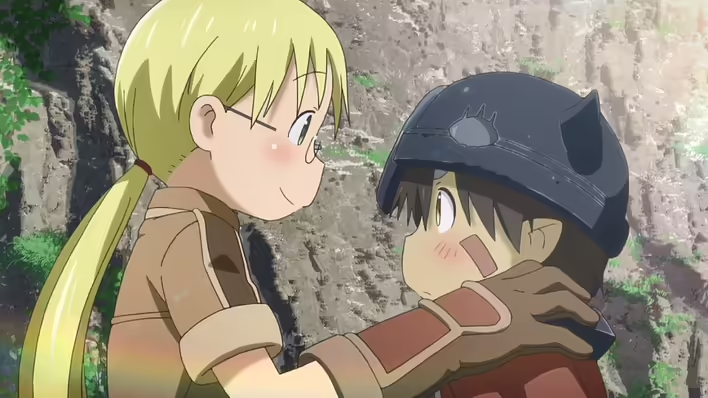
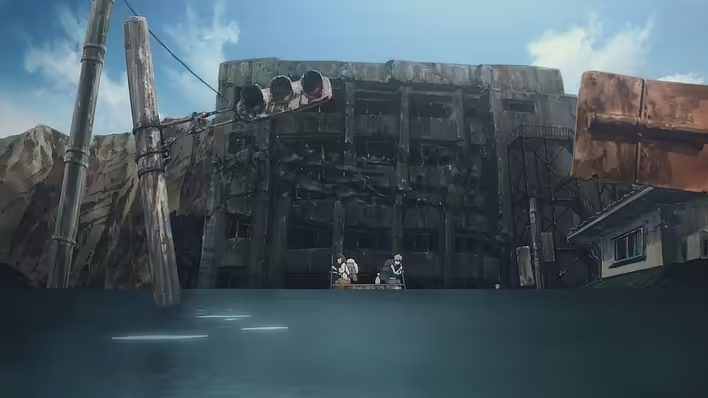
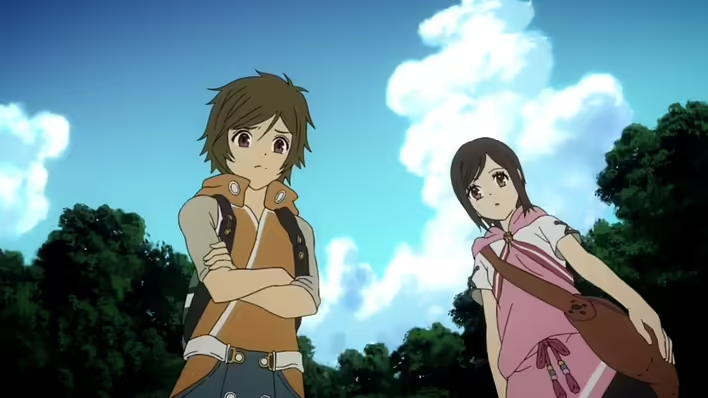
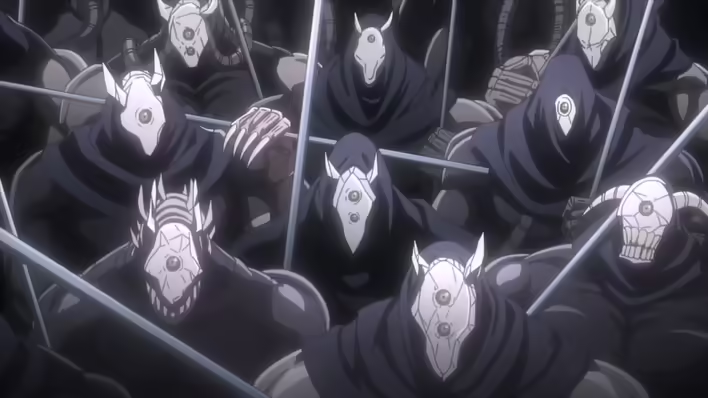
Made in Abyss is a dark fantasy disguised as a children's adventure. At the center of the story is an orphan girl named Riko, who lives on the edge of a gigantic Abyss — a mysterious chasm filled with ancient artifacts, dangerous creatures, and secrets. Her mother was a legendary explorer of the Abyss and disappeared into its depths. After discovering a message that may be from her, Riko sets off down into the Abyss with a mysterious robot boy named Reg.
The deeper the heroes descend, the darker and more dangerous the world becomes. The anime explores themes of loss, sacrifice, suffering, and the thirst for truth, while maintaining incredible visual beauty. Despite the childlike character design, the series contains shocking and brutal scenes.
Made in Abyss stands out with its unique world, strong emotional impact, and unforgettable atmosphere.
Viewing Order:
Made in Abyss (Season 1, 2017) — 13 episodes
Made in Abyss: Dawn of the Deep Soul (2020) — full sequel, must watch after Season 1
Made in Abyss: Retsujitsu no Ougonkyou (The Golden City of the Scorching Sun, Season 2, 2022) — 12 episodes
There are also two compilation films that can be skipped if you have already watched the first season
- Made in Abyss: Tabidachi no Yoake (Journey’s Dawn) — compilation film of the first 8 episodes - Made in Abyss: Hōrō Suru Tasogare (Wandering Twilight) — compilation film of episodes 9–13
Now about the original manga:
Author: Akihito Tsukushi (Akihito Tsukushi)
Publisher:Takeshobo
Publication Start: 2012, ongoing
Genres: adventure, dark fantasy, drama, psychology
The manga has a significantly darker and more detailed atmosphere than the adaptation. The anime closely follows the manga's plot, but the printed version has progressed further. The story deepens moral dilemmas, psychological trauma, and showcases the cruelty and mysteries of the Abyss in greater detail.
Note: the manga is not recommended for children, despite its style, due to heavy themes and brutal scenes.
2. Heavenly Delusion
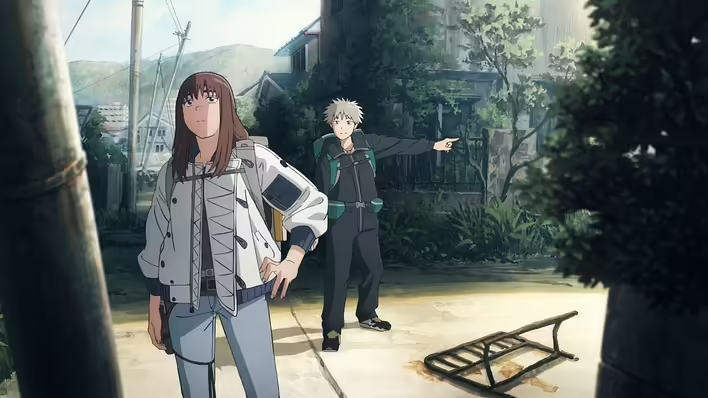
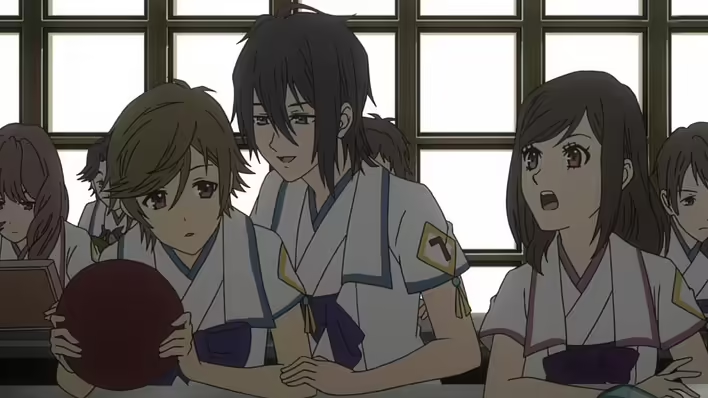
Heavenly Delusion is a post-apocalyptic science fiction anime with deep philosophical themes, complex world-building, and psychological tension. The story unfolds in two parallel plotlines: one follows Maru and Kiruko as they travel through the ruins of Japan in search of "Heaven," while the other follows children living in a closed institution under the care of adults, as if in an ideal world.
Over time, these lines begin to intertwine, revealing shocking truths about the heroes' origins, the catastrophe that destroyed the world, and the nature of the so-called "Heaven." The anime addresses complex themes — identity, humanity, transhumanism, sexuality, and loss.
Visually, the series combines picturesque ruins and science fiction motifs with realistic battle animation. The adaptation has received critical acclaim for its depth, unconventional narrative, and boldness in addressing taboo topics.
Anime:
Heavenly Delusion (Season 1, 2023) — 13 episodes
Studio: Production I.G
Director: Hirokazu Asano
Currently, there is only one season that fully adapts about 6 volumes of the manga. A continuation has not been officially announced but is expected.
Original Manga:
Author: Masaki Nakanishi (under the pseudonym Masakazu Ishiguro)
The manga is deeper than the anime and contains more violent and provocative scenes. The plot is presented in a complex structure, forcing the reader to gather pieces of information gradually. The illustrations balance between minimalism and detail, while the themes oscillate between humanism and despair.
Note: the manga has age restrictions of 18+ due to violence, nudity, and heavy themes, particularly related to corporeality and identity.
3. From the New World
From the New World is a philosophical science fiction anime dystopia that immerses the viewer in a future world where humans have developed psychic abilities — telekinesis. The action takes place a thousand years after catastrophic events that nearly destroyed human civilization. The main character, a girl named Saki, and her friends live in what appears to be a perfect village, but they soon begin to realize that behind this harmony lie cruel rules, control, and dark secrets.
The anime reveals the gradual loss of innocence of the heroes, addressing themes of memory, morality, genocide, evolution, and social engineering. The plot has deep psychological tension, unfolds over several years, and shows the characters' maturation. The story becomes increasingly grim, leading to an emotional and philosophical conclusion. From the New World is a rare example of anime that combines a deep plot, social critique, and haunting beauty into a cohesive whole.
Anime:
From the New World (Shinsekai Yori) — Season 1, 2012–2013
Number of Episodes: 25
Studio:A-1 Pictures
Director:Masaashi Ishihara
There is only one season that covers the entire story.
Original (novel, not manga):
Type: Novel
Author:Yusuke Kishi
Published: 2008
Title:Shin Sekai Yori (From the New World)
The plot of the anime is an adaptation of this novel, which has received numerous literary awards in Japan. The novel itself is significantly more detailed, with a deeper analysis of political and social structures, as well as some scenes that were simplified or omitted in the anime.
Manga Adaptation:
Author:Yusuke Kishi (story), Toru Oikawa (art)
Publication: 2012–2014
Volumes: 7
The manga adapts the same story but has a slightly different visual style and pacing.
Note: the anime contains scenes of violence, morally complex dilemmas, sexual undertones, and psychological tension. Not recommended for children, despite its visually "soft" style.
4. The Promised Neverland
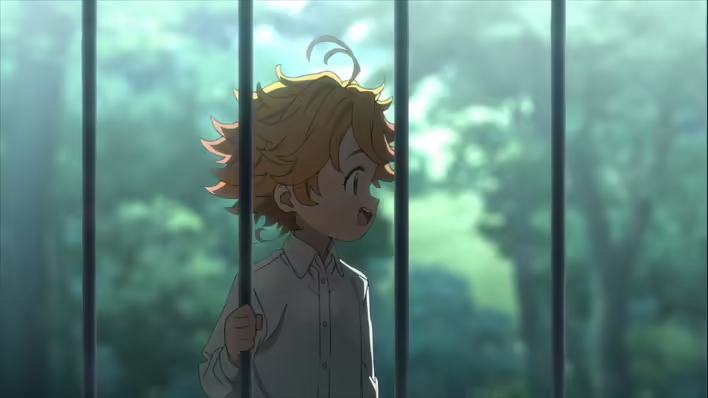
The Promised Neverland is a psychological thriller with elements of drama that tells the story of children who grew up in a cozy orphanage under the watchful eye of a caring "mother." Emma, Ray, and Norman — the smartest among the orphans — happily live in this isolated world, adhering to strict rules. But one day they accidentally learn a shocking truth that changes their lives forever.
Their perfect world turns out to be a trap, and from then on begins a tense game of wits, where the children must stay one step ahead. The anime explores themes of trust, survival, friendship, and moral choice. The story is filled with mysteries, tension, and unexpected twists that keep the viewer in constant anxiety. It is a deep and moving anime about the struggle for freedom and hope.
However, there is a significant difference in quality between the two seasons, which has sparked controversy among fans. Be prepared that you may not like the second season as much as the first. But the story is fully complete, so it is worth watching.
Anime — Seasons:
The Promised Neverland (Season 1) — 2019, 12 episodes
Covers the "Grace Field House" and "Escape" arcs (volumes 1–5 of the manga)
Highly praised for its tension, intrigue, and strong direction
The Promised Neverland Season 2 — 2021, 11 episodes
Deviates from the manga: the second half of the story is completely rewritten
Skips many important arcs and characters
Received sharply negative reviews for its rushed and simplified conclusion
Viewing Order:
Season 1 — must watch
Season 2 — optional, or you can switch to reading the manga after volume 5
Manga:
Author: Kaiu Shirai (story), Posuka Demizu (art)
Publisher:Shueisha
Magazine:Weekly Shōnen Jump
Publication: 2016–2020
Number of Volumes: 20
Number of Chapters: 181
The manga is significantly more complete than the anime and includes many plot arcs that were completely cut or simplified in Season 2. It provides a more detailed depiction of the worlds beyond the orphanage, other farms, rebels, the demonic society, and the origins of the agreements between humans and demons.
Interesting Facts:
Initially, The Promised Neverland was conceived as a short series, but due to its success, the plot was expanded.
Posuka Demizu's art has been recognized for its emotional expressiveness and the contrast between the bright style and horrific content.
There are several light novels and art books that complement the world of the manga.
5. Attack on Titan
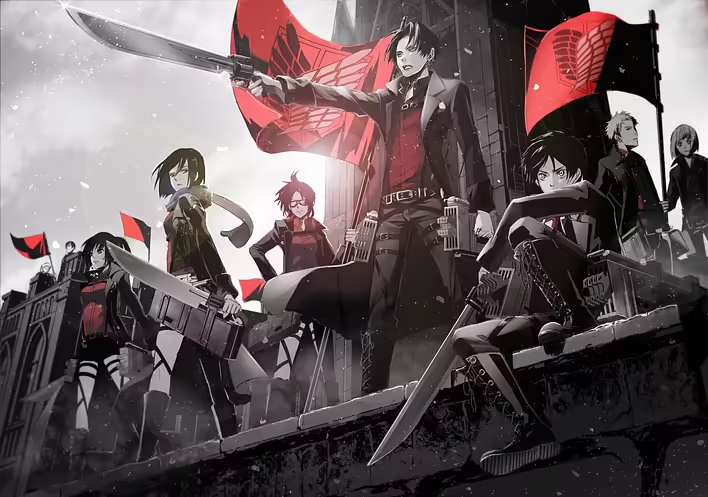
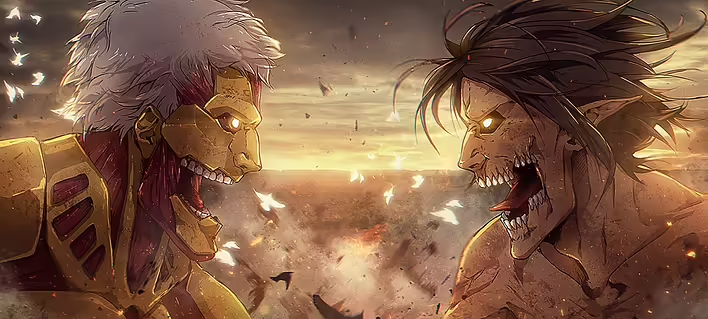
Attack on Titan is an epic dark fantasy about humanity fighting for survival behind the walls of giant fortifications that protect them from terrifying creatures — titans. The main character, Eren Yeager, along with his friends Mikasa and Armin, joins the military corps after a tragic event that changes his life.
Over time, they learn that deeper secrets lie behind the titan invasions, altering their understanding of the world, enemies, and themselves. The anime masterfully combines large-scale battles, drama, political intrigue, and philosophical reflections on freedom, power, and human nature.
The series is known for its tension, shocking twists, and deep world-building. It is not just an action story about monsters but a complex narrative with moral dilemmas and a constant sense of impending threat.
Anime (and Viewing Order):
Season 1 (2013, 25 episodes)
Season 2 (2017, 12 episodes)
Season 3 Part 1 (2018, 12 episodes)
Season 3 Part 2 (2019, 10 episodes)
Final Season Part 1 (2020–2021, 16 episodes)
Final Season Part 2 (2022, 12 episodes)
Final Season Part 3: Part 1 (2023.03, special episode ~60 min)
Final Season Part 3: Part 2 (2023.11, final special episode ~85 min)
Movies (optional):
Most of them are compilations of seasons with some new scenes:
Chronicle (2020) — a brief summary of all the first three seasons
Other films — overview (Movie 1–3) and not mandatory to watch
There are no original plot feature films but there are OVA episodes that expand the universe:
No Regrets — Levi's backstory
Lost Girls — stories of Mikasa and Annie
Ilse’s Notebook and others — mini-stories about scouting and daily life
Manga:
Author: Hajime Isayama (Hajime Isayama)
Publication: 2009–2021
Number of Chapters: 139 (34 volumes)
Genres: dark fantasy, thriller, drama, post-apocalypse
The manga is the original source of the plot and concludes somewhat differently than some expected. The ending sparked widespread discussion among fans, as it raises complex themes of responsibility, cycles of violence, and the cost of freedom. It is worth reading even after watching the anime, especially for those who want more nuance and context.
Interesting Facts:
The author, Isayama, was inspired by Norse mythology and the UFC.
Initially, the manga was refused publication — too dark for Shōnen.
Anime studio changes: the first 3 seasons — Wit Studio, the final ones — MAPPA.
Levi became one of the most popular characters in anime history.