Formula 1 — is the pinnacle of car racing, where speed, technology and strategy merge into one. It is a sport that impresses not only with the power of cars, but also with the passion of millions of fans, dramatic stories and legendary personalities. Formula 1 — is not just a race, it is a global show that attracts weekly viewers from all over the world.
The history of Formula 1: from the grand prix to the global phenomenon
Formula 1 as the World Championship officially started in 1950 <TAG1> the first stage was held at Silverstone Circuit in Great Britain. But the very idea of the "Grand Prix" race existed since the beginning of the 20th century. Formula 1 quickly turned into an arena for the best drivers, engineers and manufacturers.
In the 60–80s, the sport experienced an explosion of popularity thanks to heroes like Jim Clark, Nicky Lauda, Ayrton Senna and Alain Prost. They fought not only for victories, but also for life — safety on the track was then at a very low level.
In the 21st century, Formula 1 has become a high-tech industry, with billions in budgets, strict regulations and global reach. Currently, races are broadcast in more than 180 countries, and — teams are international technical giants leading a real "technology race".
How does Formula 1 work?
Each season consists of approximately 20–24 stages, which are held on various tracks around the world: from Monaco to Japan, from the USA to Saudi Arabia.
Ten teams (designers) participate in the championship, each of which fields two cars and two drivers. Points are awarded both for individual results of pilots (personal standings) and for team results (constructors' cup).
Key figures and legends
Ayrton Senna <TAG1> is a three-time champion from Brazil, considered the most charismatic and talented driver of all time.
Michael Schumacher <TAG1> seven-time champion, symbol of dominance Ferrari in the early 2000s.
Lewis Hamilton <TAG1> is also a seven-time champion, record holder for the number of victories, a modern sports icon.
Max Verstappen <TAG1> is a new superstar from the Netherlands, dominating the 2020s Red Bull car.
Technologies that change the future
Formula 1 — cars are masterpieces of engineering. They are equipped with hybrid engines with a capacity of more than 1000 horsepower, capable of accelerating to 100 km/h in 2 seconds. The entire car weighs less than 800 kg and costs tens of millions of dollars.
F1 actively affects the development of road cars: braking systems, suspension, aerodynamics, energy saving —, all this is first tested in Formula 1. Also, in sports, more and more attention to sustainable development — will be introduced from 2026 new, ecological power plants.
Formula 1 in culture
Thanks to its dramatic stories, Formula 1 has become popular not only among sports fans, but also in popular culture.
Movies:
Rush / Race (2013) — is an emotional drama about the rivalry between James Hunt and Nicky Lauda.
Senna (2010) — documentary about the life and death of Ayrton Senna.
Formula 1: Drive to Survive (Netflix, since 2019) — series that made F1 popular with new audiences, especially in the US.
Books:
"Total Competition" (Ros Brown and Adam Parr) — on motorsport strategies and team management.
"The Mechanic's Tale" (Steve Matchett) — an inside look at the life of a Formula 1 engineer.
"Life to the Limit" (Jenson Button) — autobiography of the 2009 world champion.
Interesting facts:
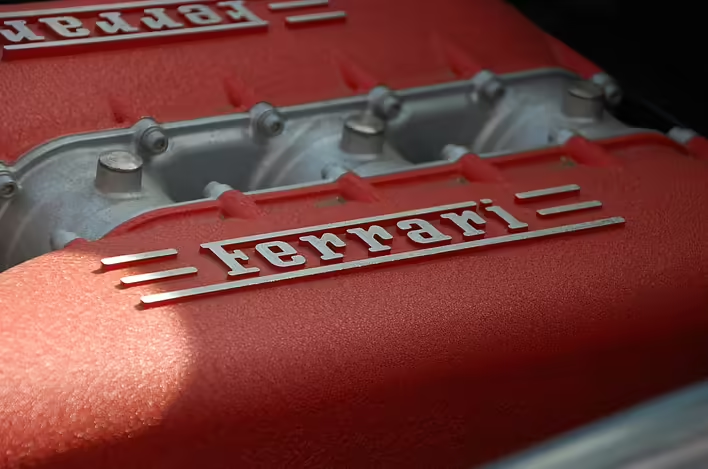
The most successful team is — Ferrari, with 16 constructors' cups.
Lewis Hamilton has the most wins (over 100).
The shortest race in the history of — Belgium 2021, lasted only two laps behind the safety car due to rain.
The top team's budget for the season could be over $400 million.
Formula 1 — is not just a race. It's drama, engineering, human endurance and the eternal desire to be the first. It evolves every season, but the main idea remains the same: the best compete with the best — at the highest speed.