The modern labor market is a field of constant transformations, where two main formats — remote work and office work — compete for dominance, adapting to new realities. We live in a time when terrible events are happening around us: pandemics, wars...; for us Ukrainians, the war with Russia presents new challenges every day. All of this has reshaped our perceptions of safety, comfort, and efficiency in the workplace.
Remote Work
Remote work has rapidly gained momentum during the COVID-19 pandemic. Its most significant advantage is the flexibility of schedule and work location. The ability to work from anywhere in the world allows individuals to tailor their workday to personal needs, travel, care for children, or combine work with studying (which is very relevant among students).
For Ukrainians during wartime, this is often the only opportunity to keep their jobs while staying safe and, for example, supporting their families from abroad.
The absence of daily commutes saves time and money that can be used for personal needs. Expenses for transportation, lunches away from home, and office attire disappear, which is a significant advantage in conditions of economic instability.
Another significant plus is the expansion of employment opportunities, as spatial limitations disappear, allowing young professionals to apply for positions in leading international companies, regardless of their physical location.
Working from home allows for the creation of a maximally comfortable and personalized work environment, choosing comfortable clothing, and taking breaks at one's own discretion.
And, of course, for Ukrainians during wartime, safety is a vital opportunity to continue professional activities while being in safer regions of the country or abroad, minimizing risks associated with shelling.
Remote work also has significant drawbacks. One of the most serious is social isolation and lack of communication, specifically the absence of face-to-face interaction with colleagues. This leads to feelings of loneliness and deprives opportunities for informal exchange of experiences and ideas. For young people just starting to build their professional careers, this becomes an obstacle to forming valuable connections.
A person must be self-organized and motivated, meaning they need to effectively plan their time and work moments while not succumbing to laziness.
By working remotely, young workers lack opportunities for quick learning and mentorship, which occur in the office through observation of experienced colleagues and easy access to feedback.
When working remotely, you depend on technical aspects, namely stable internet connection, quality equipment, and software; any technical failures complicate or make work impossible.
I think you would agree how difficult it is to concentrate on work at home without being distracted by external stimuli, especially if you do not have a separate workspace. Most likely, you will choose a comfortable place for yourself (for many, this is primarily the bed), which in turn tempts you to put off the computer and lie down to nap or scroll through social media. Let's agree, that's not a very work-oriented vibe.
Office Work
Despite the rapid rise in popularity of remote work, the office environment remains relevant.
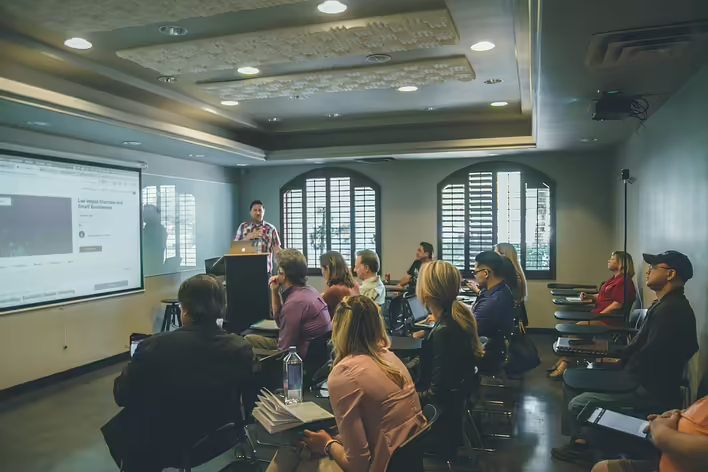
The office is not just a place to perform tasks, but also a space for live communication and team spirit. By interacting with colleagues, you socialize, which in turn fosters quick idea exchange, brainstorming, and building strong personal relationships.
The physical space of the office creates a psychological barrier between work and rest. Coming to the office and returning home allows you to "switch off" from work issues and fully relax.
The office provides access to resources and equipment. Companies provide employees with everything necessary: technology, software, and a comfortable workspace.
The office environment opens up opportunities for career growth and learning. In the office, it is easier to receive direct feedback, participate in internal training, workshops, and find mentors. Informal learning and experience exchange occur constantly.
Office work has its downsides.Time and expenses for commuting can be exhausting and take up a significant portion of personal time. In large cities, the issue of traffic jams is relevant, where people can spend a lot of time, especially during rush hour. In conditions of martial law, risks and the need to respond to air alerts are added.
It is worth noting the lesser flexibility. A fixed work schedule and the absence of the ability to work from anywhere can be inconvenient for those seeking more freedom and balance.
Some employees face potential distractions. Although there is a temptation to rest and do household chores while working remotely, for some office workers, distracting factors that reduce concentration and productivity can include office noise, frequent meetings, and interruptions from colleagues.
Hybrid Model: A Compromise for the Future
It is clear that neither format is ideal. This is why the hybrid work model is gaining popularity, which combines the advantages of remote and office employment. It allows employees to spend part of their working time in the office and the other part working remotely.
For young Ukrainians, the hybrid model is becoming an optimal solution. This approach fosters adaptability and resilience, allowing companies and their employees to function effectively even in challenging and unpredictable conditions.