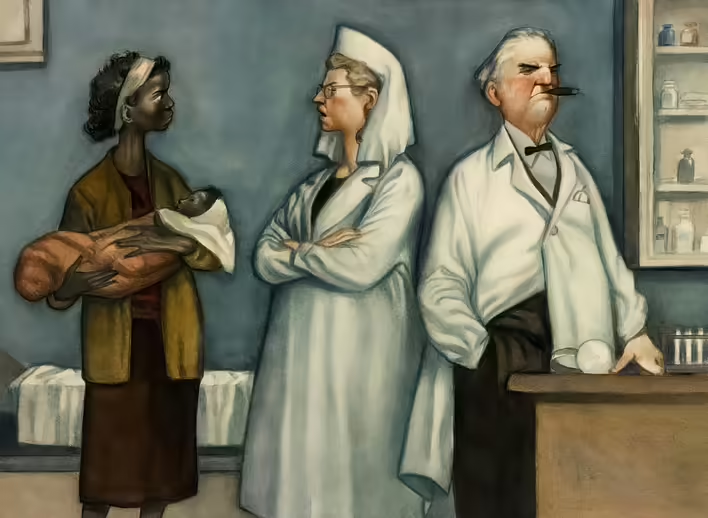
Eugenics(from the Greek “eugenes” — “well-born”, “noble”) — is a scientifically unfounded and deeply immoral theory that emerged in the late 19th century. Its proponents believed that humanity could be “improved” through so-called “selective breeding,” allegedly accumulating desirable traits and eliminating undesirable ones. These ideas were based on a distorted understanding of genetics, claiming that complex human qualities such as intelligence, behavior, or susceptibility to diseases are passed down simply through heredity.
Historically, eugenics had two main branches:
Positive eugenics
aimed at encouraging the reproduction of people with desirable, “valuable” traits for society (high intelligence, physical and mental health).
Negative eugenics
focused on preventing the reproduction of people with undesirable or “harmful” traits, such as hereditary diseases, mental disorders, intellectual disabilities, physical defects, and addictions.
Origins and Global Spread
The term “eugenics” was introduced in 1883 by English statistician Francis Galton (a cousin of Charles Darwin). He defined it as “the study of factors under social control that can improve or impair the racial qualities of future generations.” Galton's ideas about the heredity of health, disease, and intelligence formed the basis of eugenic thought.
By the 1920s, eugenics had become a global movement, supported by governments, elites, and the general public in countries such as Germany, the USA, the UK, Italy, Canada, and Mexico. It was actively promoted by statisticians, economists, anthropologists, sociologists, geneticists, and other specialists through scientific and popular literature.
Nazi Germany: The Apex of Eugenics Abuse
The most tragic application of eugenics occurred in Nazi Germany (1933–1945). The Nazi regime used eugenic ideas to “purify” the German people of those they deemed “unworthy of life.” This led to horrific consequences: mass murders under the “euthanasia” program, which claimed the lives of at least 70,000 adults and 5,200 children; forced sterilizations affecting at least 400,000 people; as well as the near-total destruction of the Jewish people during the Holocaust and attempts to eliminate other marginalized groups, such as Sinti and Roma, people with disabilities, and LGBTQ+ individuals.
Eugenics Today
Eugenics was completely discredited after World War II, but its practices and ideas unfortunately still manifest in various forms. In many countries, forced sterilization and institutionalization continued at least until the 1970s, and in some cases, their echoes can still be seen today.
Modern advances in genomic technologies raise new ethical dilemmas. The development of genomic screening and polygenic risk scores creates dangerous societal pressure regarding pregnancy termination if risks of genetic disorders, such as Down syndrome, are detected. However, it is important to distinguish between historical, coercive eugenics and modern medicine. Breakthroughs in genomic technologies allow for the detection of serious risks of genetic disorders in the fetus. In such cases, the decision to terminate a pregnancy is not eugenics but an informed choice by the parents. It is a deeply personal decision based on medical data, family circumstances, and humanitarian principles, rather than a desire to “improve the race” or state coercion.
The possibility of screening embryos for behavioral or intellectual traits during in vitro fertilization (IVF) and preimplantation genetic diagnosis currently raises discussions, as the line between preventing suffering and potential discrimination becomes thinner. We must ensure that medical advancements serve humanity and support the right to choose and a quality life, rather than for coercive “culling” based on any traits.