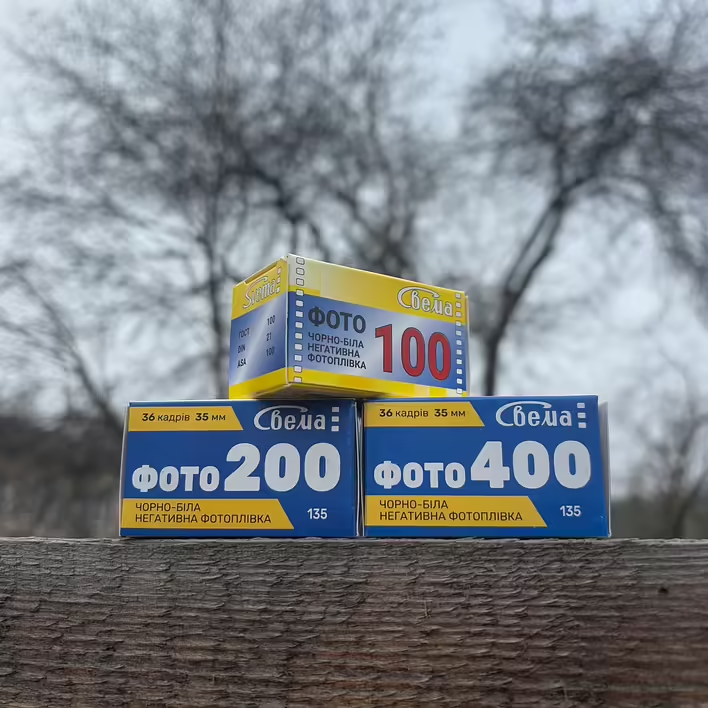
To photograph with a point-and-shoot camera - you need the camera itself (obviously) and film. It was during the selection of film that I realized I needed to understand a bit about what ISO, exposure, aperture, and shutter speed are. So let's figure it out together. Let's start with ISO.
ISO – one of the key parameters in photography that determines the sensitivity of the sensor or film to light. In the past, the designation ASA was used, but the principle remains the same.
What is ISO?
ISO (International Organization for Standardization) – is an international standard that defines the sensitivity of a digital camera sensor or film. The ISO standard for photography was introduced in 1974, combining previous systems ASA (American) and DIN (German). ISO allows photographers to easily adapt to different lighting conditions by changing the camera's sensitivity.
What is ASA?
ASA (American Standards Association) – is an old system for measuring film sensitivity that was used in the USA until the 1980s. It was similar to the modern ISO: for example, ASA 200 is approximately equal to ISO 200. Meanwhile, in Europe, the DIN system was used, which operated on a logarithmic scale.
Why switch to ISO?
The transition to ISO occurred for the unification of global standards. Before ISO, different countries used ASA, DIN, or other systems, complicating the international use of photographic equipment. Thanks to ISO, photographers worldwide received a single, understandable standard of sensitivity.
Unification is good. We can now see a similar transition to USB-C (Type-C) in all new gadgets.
What does the ISO value indicate?
In film photography, ISO (ASA) determines the chemical sensitivity of the film. A high value means that the film reacts faster to light, but the resulting images are grainier due to the structure of the light-sensitive elements.
What happens if the sensor ISO and film ISO differ?
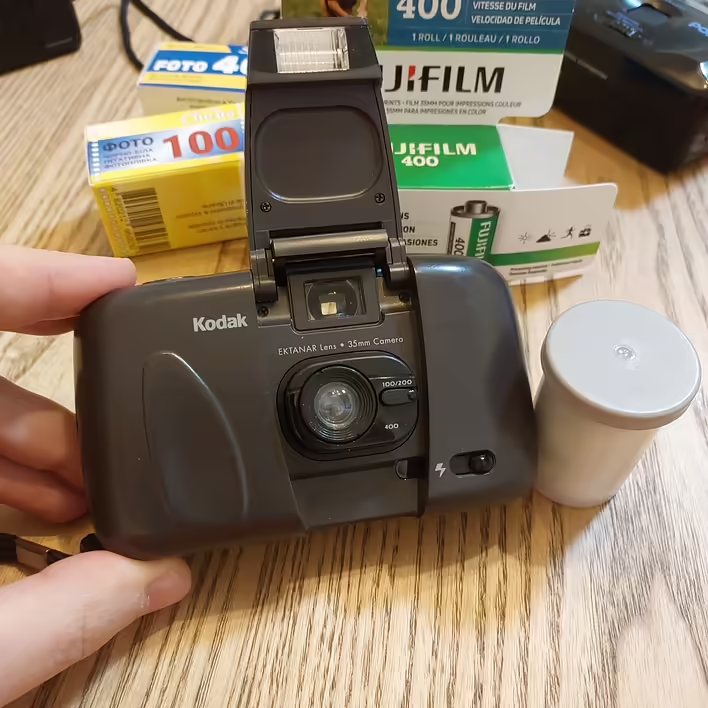
One of my cameras (Kodak Cameo) has an ISO switch. So we need to understand how this setting works.
Kodak Cameo
If ISO 200 is set on the camera and 200 film is used
The camera correctly exposes the frame according to the film's sensitivity. This results in a balanced exposure (what exposure is will be discussed below).
If ISO 400 is set on the camera, and 200 film is used
The camera "thinks" that the film is more sensitive than it actually is and adjusts the settings according to ISO 400. This will lead to underexposed frames (dark), as 200 film requires more light.
This film can be "pulled" during development/scanning but will increase graininess.
If the camera allows you to set the correct ISO manually — you should set what is indicated on the film. If not — you should understand how this will affect exposure and how it can be compensated during development.
Usually, "point-and-shoot" cameras have a fixed ISO, so the film should be chosen accordingly. And you need to photograph with the appropriate amount of light.
What do the numbers 100, 200, 400, etc. represent?
These values indicate how sensitive the sensor or film is to light. When ISO is doubled (for example, from 100 to 200), half the amount of light is needed to achieve a properly exposed image.
ISO 100-200 – for sunny weather
ISO 400 – for cloudy weather and shooting in the shade (indoors)
ISO 800+ – for shooting in low-light conditions, but with noticeable grain in the photo
What is exposure?
Exposure (Exposure) – is the amount of light that hits the sensor or film during shooting. It determines how bright or dark the image will be. Exposure is controlled by three parameters: ISO, aperture, and shutter speed.
Overexposed frame – too much light, the photo comes out very bright, with blown-out areas.
Underexposed frame – too little light, the photo comes out dark, losing details in the shadows.
What is aperture?
Aperture (Diaphragm) – is the opening in the lens through which light passes. It is measured in f-numbers (for example, f/2.8, f/5.6, f/11). A smaller number means a larger opening and more light:
Wide aperture (f/2.8, f/1.8) – more light, blurred background (good for portraits)
Narrow aperture (f/8, f/11, f/16) – less light, more depth of field (good for landscapes)
What is shutter speed?
Shutter speed (Shutter Speed) — is the time during which the camera allows light to hit the film or sensor. When you press the button on the camera, a special mechanism (shutter) opens, and light enters. The longer it stays open, the more light is captured.
A short shutter speed (for example, 1/1000 s) allows you to capture fast moments, like the movement of a car or an athlete. A long shutter speed (for example, 1 s or more) allows you to shoot in the dark or create effects like motion blur of water or light trails from cars.
These are the basic things you need to know (in my opinion) before buying your first film/camera. So I hope this post will be useful to someone.