Often while watching movies or series, you might notice characters, images, or events that you've seen somewhere before, or that are very similar to something you've already seen. This doesn't evoke a strong feeling of déjà vu, but still implies some subsequent steps or events in the plot. I often experience this too, and I always ask myself: is this already classic or is it a worn-out cliché? So I decided to delve deeper into these subtle cinematic materials.
But first, I suggest taking a test to spark your interest in this topic and check your knowledge of cinema. You can skip it and go to the main part of the reading.
Test: Classic or Cliché?
So, you need to answer which of the following techniques are respectable and classic, and which are worn-out movie clichés.At the end - the correct answers and your viewer level!
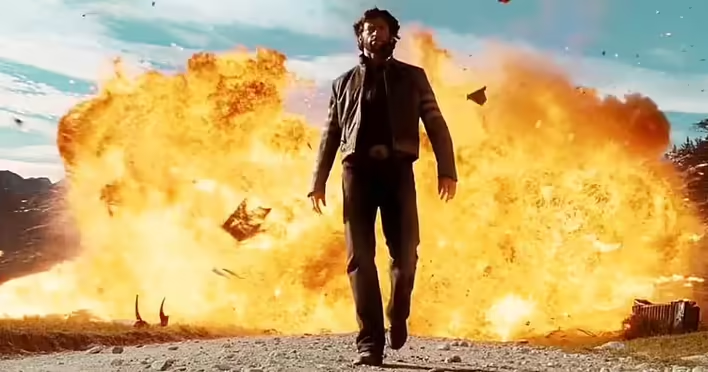
The hero walks away from an explosion without looking back.
A montage of training set to motivational music.
The heroine wakes up with perfect makeup and hairstyle.
A police officer goes on his last shift before retirement.
A silent glance between two characters instead of words.
The thief's hand emerging from the rubble at the end.
The camera gliding over the city in the first seconds of the film.
Unexpected rain at the moment of a love confession.
A father tells his son: “I’m proud of you.”
The phrase “I’ll be back.”
The antagonist reveals his entire plan before the final showdown.
It was all just a dream.
A funeral in the rain with black umbrellas.
The anti-hero helps at the last moment.
Correct answers:
Cliché. It looked cool the first time, now it’s a parody of itself.
Classic. From "Rocky" to "Kung Fu Panda" - an emblem of the genre.
Cliché. Reality is far from this "accidental" gloss.
Cliché. Too predictable. Just like the death that follows.
Classic. Silence in cinema can be more eloquent than words.
Cliché. Especially in the horror films of the 90s.
Classic. A visual introduction to the setting - an elegant solution.
Cliché. Too convenient.
Classic. An emotional point that no one tires of feeling.
Classic. Thanks to Arnold — and it’s already a cultural code.
Cliché. Too common, the hero always manages to use this monologue.
Cliché. A cheap trick that negates everything the viewer just experienced.
Cliché. Symbolic, but so often used that it has lost its freshness.
Classic. If built well — it works every time.
0–4 correct:Weekend Viewer
You’ve definitely seen something, but you still confuse “template” with “charm.” Start paying attention to recurring scenes — and you will never watch movies the same way again!
5–9 correct:Cinephile with Taste
You see the difference between tricks and traditions. You definitely won’t believe a hero who says “one more week until retirement.”
10–14 correct:“Film Detective / Screenwriter at Heart”
You see the structure, you see the clichés, you see the depth. Maybe it’s time for you to write scripts yourself?
What is a cliché?
Regardless of how many points you scored, we are still here to find out what a cliché is. This word comes from the French cliché, and was originally used in printing, as a print, or better said - a stamp. Which leads us to the meaning of the word cliché - a frequently repeated action, a fixed, stereotypical image or idea that has lost its originality due to excessive and thoughtless use. In cinema - these are worn-out moves, predictable dialogues or specific phrases, characters that evoke a sense of secondariness. In general, anything that triggers the phrase “This has been done before!” Those who know will understand.
Клішована прогулянка Росомахи після вибуху
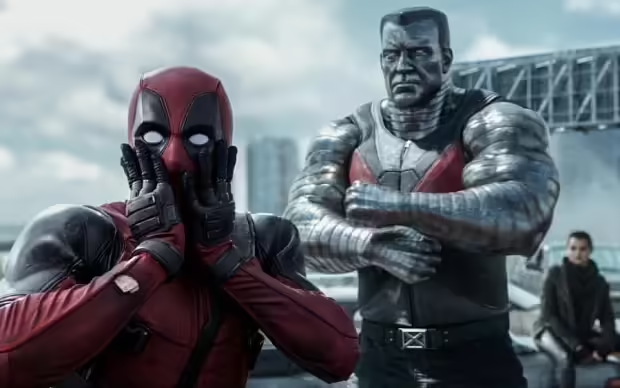
But to be fair, a cliché is not always bad. Clichéd moments in a movie or series can play quite an effective role when it’s necessary to quickly and without unnecessary words convey an idea or evoke emotions in viewers. And it can be presented fresh, rather than banally. Sometimes directors take clichés and reinterpret them. And then they become alive again, working tools. This often happens in postmodern or ironic cinema.
Дедпул - хороший приклад фільму, де автори висміюють кліше супергеройського кіно
Classics that became clichés
In contrast to the concept of “cliché,” classics in cinema are a respected recognition of certain standards, traditions, images, and plots that carry artistic value. These are ideas that had a significant impact on cinema in their time, developed this genre of art, and stood the test of time. Classic moves contain cognitive elements, but they carry deep meaning, unique execution, and strong impressions. In short: a cliché is something that is often thoughtlessly copied, while a classic is something that set standards for imitation.
Sometimes there are very thin lines between these concepts, and they can be hard to discern without diving into the context of a specific work. For understanding, in the test above there was such an example: unexpected rain at the moment of a love confession, which is a clichéd turn in many melodramas. It’s very convenient to use this “unexpected” rain in such scenes, as if forcing the viewer to believe in the characters' love. Can the heroes not understand that they love each other without the rain?
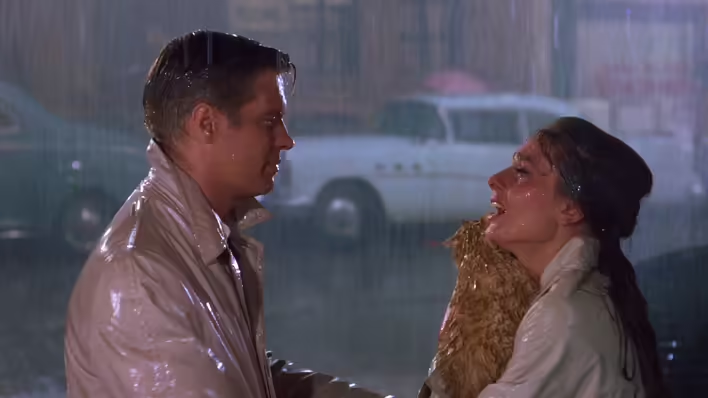
It’s sad to admit, but this cliché came from a classic that once deeply moved viewers:
“Breakfast at Tiffany’s” - the scene where the heroes find each other in the rain along with a lost cat — an emotional finale that works on the symbolism of cleansing, renewal, and love.
Сцена під дощем з класичного фільму "Сніданок у Тіффані"
“The Notebook” - the kissing scene in the rain - has become a benchmark in the romantic genre. It has even been copied in parodies.
These examples have indeed left a strong emotional mark, realized truthfully and stylishly. And most of such scenes are later thoughtlessly copied visually, expecting the effect. But it has become so predictable that it evokes no emotions in viewers, and sometimes even irritates. When a technique is repeated without reinterpretation, without a new idea, just “because it works”, it turns into a cliché. In modern cinema, it seems that everything can increasingly be explained by the phrase “because it works.” Secondariness and repetitiveness, sheer clichés, a commercial approach - this is what hinders art and the emergence of new classics in cinema.