This content has been automatically translated from Ukrainian.
What is slay?
Slay (from English slay) is a modern slang word used to express admiration for a person, their appearance, talent, or the result of their work. If someone says “you just slay”, “she slayed”, or “this look is pure slay”, it means that the person did something so well, impressively, or confidently that it evoked genuine admiration.
In simple terms, slay can be translated as:
- “that was incredible”;
- “you are simply unmatched”;
- “you overshadowed everyone”;
- “you did it perfectly.”
This word is most often found on TikTok, Instagram, X (Twitter), Discord, and other social media. It is used in comments, memes, and regular messaging to praise someone for a stylish look, a successful performance, beautiful makeup, dancing, singing, a witty joke, or any other action done at the highest level.
For example:
— Your new look is just slay.— She slayed at the concert today.— This makeup looks just slay.— Slay, queen!
In all these examples, the word slay is a sincere compliment. It means that the person handled something so well or looks so impressive that they deserve admiration.
Several derivative forms of this word have already appeared in the Ukrainian internet:
- slaynuty — to perform something brilliantly, to make a strong positive impression;
- slayнула / slayнув — handled something wonderfully;
- slay — the compliment itself or the characteristic of something very successful;
- slayovyi — very stylish, impressive, or fashionable (currently used less frequently).
These words do not yet belong to the literary Ukrainian language, but they have already become part of youth internet slang and are increasingly found in Ukrainian social media.
What does the word slay literally mean?
The modern meaning may surprise you, as the word slay originally had nothing to do with compliments.
In English, the verb to slay has existed for many centuries and literally means “to kill,” “to destroy,” or “to defeat an enemy”. It is in this sense that you can find it in historical novels, medieval legends, the Bible, and fantasy.
For example:
The knight slew the dragon. “The knight killed the dragon.”
Or:
The hero slew his enemy. “The hero defeated (killed) his enemy.”
At first glance, it is difficult to understand how a word meaning “to kill” could transform into one of the most popular compliments of modern internet culture.
The first steps towards this occurred long before the advent of social media. In English, there has long been a phrase:
You slay me.
Literally, it translates as “you kill me”, but it is almost never taken literally. It is an emotional hyperbole used to describe a very strong impression. Depending on the context, the phrase can mean “you make me laugh so hard”, “you simply amaze me”, “you’re something else!”, or “you’re killing me”.
This metaphor — such a strong impact on a person that it seems to “knock them off their feet” — became the first step towards the emergence of the modern slang meaning of slay.
Thus, the word slay began to be used not literally, but as an exaggeration: a person has such a strong influence on your emotions that they seem to “knock you off your feet.”
Later, this figurative meaning spread to admiration. If someone sang, danced, dressed, or performed so well that they literally “conquered” the audience, people began to say that they slay.
This is how the modern meaning of the word gradually formed — to do something so brilliantly that everyone around is left deeply impressed.
Similar metaphors exist in the Ukrainian language. We also say “tore the hall apart”, “that was a killer joke”, “it blows my mind”, or “that’s just bomb”, although we do not mean literal violence. The word slay underwent a similar linguistic evolution, but later it acquired another meaning that was finally formed within American pop culture. This will be discussed in the next section.
How did the word slay acquire its modern meaning?

Although the figurative meaning of the word slay has existed in the English language for a long time, the modern slang meaning was formed much later — in the second half of the 20th century.
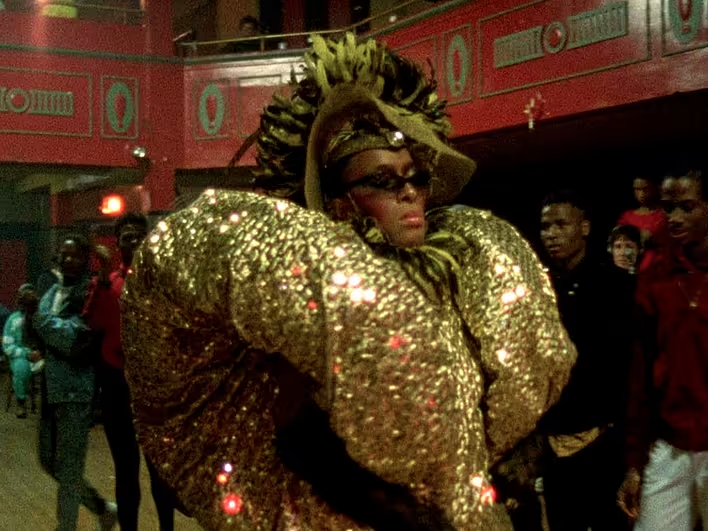
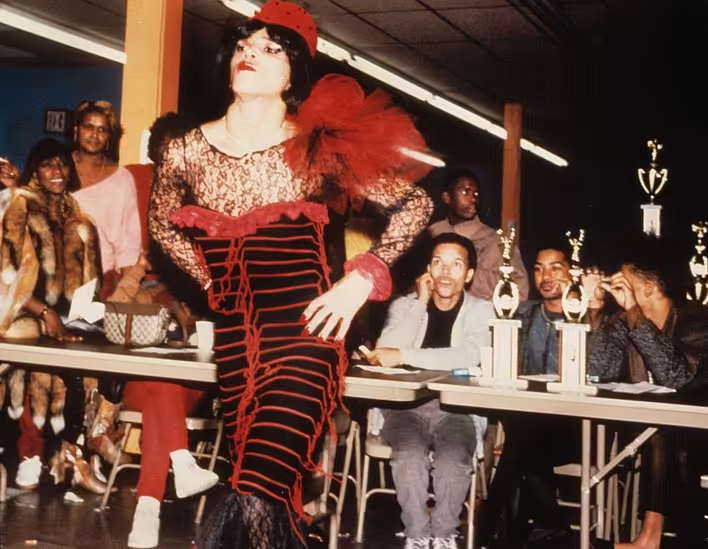
Its history is closely linked to ballroom culture — a subculture that emerged in New York in the 1970s and 1980s among African American and Latino LGBTQ+ communities.
Ballroom competitions resembled a combination of a fashion show, theatrical performance, dance, and creative contest. Participants would walk the runway, showcase looks, strut, compete in various categories, and try to impress the judges and audience so much that their performance would be remembered by all.
It was in this environment that the word slay began to be used as the highest form of praise.
If a participant looked flawless, had strong charisma, or performed so well that they literally “conquered” the audience, they could be told:
You slayed.
That is, not just “you performed well,” but “you surpassed everyone,” “you were the best today”.
In this sense, the word almost completely lost its connection to the literal “to kill.” It came to mean such a strong impression that it became hard to surpass anyone after you.
How did ballroom culture influence modern internet slang?

Ballroom culture gifted the English language not only the word slay.
Many expressions that today seem like a common part of TikTok or Instagram originated from there. For example:
- werk — perform impressively, show yourself;
- serve — demonstrate a look or style so well that everyone is impressed;
- yas or yaaas — a very emotional “yes!”, an exclamation of admiration;
- queen — a person who evokes respect and admiration;
- reading, shade — special forms of witty criticism that later became popular far beyond this community.
Today, most people use these words without even realizing where they come from.
From documentary film to TikTok
For many years, the word slay remained predominantly internal slang of the ballroom community.
The situation began to change in the late 1980s and early 1990s. A significant role in this was played by the documentary film Paris Is Burning, which showcased the life of the New York ballroom scene, its competitions, style, and linguistic features to a wider audience.
Later, elements of this culture began to appear more frequently in American pop music, television shows, and the fashion industry. This influence became particularly noticeable after the popularity of the show RuPaul's Drag Race, where the words slay, serve, yas queen, and dozens of other expressions were regularly heard in every season.
A significant contribution to the popularization was also made by Beyoncé. In her song Formation (2016), the phrase "I slay" appears, and subsequently, the word began to be used even more actively in media and social networks. It was after the mid-2010s that interest in it sharply increased.
After that, social media did their part. Initially, the word spread massively on Twitter, then on Instagram, and later became one of the most used compliments on TikTok.
Today, slay has almost lost its connection to a specific subculture. Millions of people around the world use it, often without even knowing that the modern meaning of this word was formed long before the advent of TikTok.
How is the word slay used today?

Today, slay is a universal compliment that can be heard in social media, messaging, comments, and even in everyday speech among English-speaking youth.
It is most often used when someone wants to emphasize that a person did something so well that it deserves admiration.
For example:
You slayed that performance. “You performed brilliantly.”She absolutely slayed in that dress. “She looked incredible in that dress.”You slay every single time. “You surpass yourself every time.”
Interestingly, the word is almost never translated literally even by native English speakers. For them, slay long ago came to mean not “to kill,” but to be unmatched, to do something perfectly, or to look so good that it evokes admiration.
That is why it can be found under photos, videos, musical performances, fashion shows, or even ordinary selfies.
What does Slay, Queen!

One of the most famous expressions has become:
Slay, Queen!
The literal translation would sound strange — “Kill, queen!”. In fact, this expression means something completely different.
It can be translated as:
- “You are simply a queen!”
- “Slay on!”
- “You are incredible!”
- “Keep it up!”
The word queen here is not related to a real queen. It is a term of address for a person who looks confident, stylish, or evokes admiration.
That is why under a photo in a new look, you can often see a short comment:
Slay, queen! 🔥
Essentially, it means: “You look absolutely fabulous.”
Why is you ate often written alongside the word slay?
If you have watched English-speaking TikTok or read comments on Instagram, you have probably noticed another strange expression:
You ate.
Literally, it translates as “you ate”, but it actually has a completely different meaning.
In modern slang, you ate means:
- you did wonderfully;
- you surpassed everyone;
- it was flawless.
In meaning, this expression almost completely coincides with the word slay.
For example:
You ate that performance.
This means not that the person ate something during the performance, but that they performed so well that they left no chance for others.
What does ate and left no crumbs mean?
This is another popular English meme that can often be seen alongside the word slay.
Literally, the phrase translates as:
“Ate and left no crumbs.”
It sounds strange, but again the meaning is metaphorical.
The phrase means that a person performed something so perfectly that nothing could be improved. They seem to have “taken it all” and left no chance for competitors.
For example:
She ate and left no crumbs.
In Ukrainian, this can be conveyed as:
- “She was simply unmatched.”
- “She surpassed everyone.”
- “It was a perfect performance.”
That is why under the video, you can see several identical comments:
Slay!You ate!She left no crumbs!
All of them mean roughly the same thing — the person did something so well that it evokes genuine admiration.
How did the word slay become “sley” in the Ukrainian language?
Like many other modern slang words, slay came into the Ukrainian language not through dictionaries or translations, but through the internet.
Initially, it was actively used by English-speaking users on Twitter (now X), Instagram, YouTube, and Tumblr. Later, the word began to appear massively on TikTok, where it was picked up by millions of users around the world.
The Ukrainian youth did not invent a separate equivalent, but simply adapted the English slay to Ukrainian pronunciation.
This is how sley emerged.
Then the word began to change according to the familiar models of word formation in the Ukrainian language. Similar changes have already occurred with many other Anglicisms: like, ban, check-in, ship, spoil.
Therefore, today you can find the following forms:
- slaynuty — to handle something brilliantly;
- slayнула / slayнув — did something very well;
- slay — a characteristic of something very stylish or successful;
- slayovyi — fashionable, impressive, something that evokes admiration.
Interestingly, the last two forms do not yet have established spelling rules. In social media, you can see various options: slayovyi, slaynyy, slaynyy, although the most common remains slayovyi.
Such changes are quite natural. Initially, the word enters the language almost unchanged, and only later do speakers begin to form new words from it according to their language rules.
How to use the word “slay” correctly?

In modern Ukrainian, slay is most often used as an exclamation of approval or a short compliment.
For example:
— New hairstyle? Just slay!— You really slayed today.— This look is absolute slay.— She slayed the presentation again.
Note that the word almost always describes not just a good result, but something truly impressive.
For example, if a student simply passed an exam, it is unlikely that anyone would write “you slayed”.
But if they delivered a brilliant speech, received applause, or answered so well that everyone was impressed, then this word sounds quite natural.
The same applies to appearance.
The phrase:
You slay today.
Usually means not just “you look good”, but “you look so stylish today that you attract everyone’s attention”.
That is why the word is especially popular in the fields of fashion, music, dance, cosplay, makeup, and social media, where people often showcase their looks and creativity.
Frequently Asked Questions
What does “slay” mean in simple terms?
Slay is modern youth slang that means “to be unmatched,” “to look incredible,” or “to handle something brilliantly”. This word is most often used as a compliment on social media.
What does “you slay” mean?
If someone wrote “you slay” to you, it means that the person admires you, your look, performance, or the result of your work. Simply put, it is an equivalent of phrases like “you are really cool”, “you look incredible”, or “you handled it wonderfully”.
What does “slaynuty” mean?
Slaynuty is a Ukrainian slang form derived from the English slay. It means to perform something brilliantly, to achieve success, or to make a strong positive impression.
For example:
“She slayed at the concert today.”
What does “Slay Queen” mean?
Slay, Queen! is a popular English compliment that can be translated as “You are incredible!”, “You are simply a queen!”, or “Slay on!”. It is often written under photos, videos, or performances to express admiration.
Is there a Ukrainian equivalent of the word “slay”?
There is no exact equivalent, as slay conveys not only praise but also emotional admiration.
Depending on the context, it can be translated as:
- unmatched;
- fabulous;
- incredible;
- you slayed;
- tore it apart;
- surpassed everyone;
- you look wonderful.
That is why the word slay is often used in the Ukrainian internet without translation.
Like it?React
🧵
This post doesn't have any additions from the author yet.