This content has been automatically translated from Ukrainian.
NPC is one of those terms that has long transcended the environment in which it originated. Initially, it was mainly used by tabletop role-playing game players, later the word became common in video games, and today NPCs can be found in memes, TikToks, and everyday conversations. Moreover, the phrase "he behaves like an NPC" no longer necessarily relates to games.
At the core of all these meanings remains one simple idea: an NPC is a character not controlled by a player.
What NPC means
NPC is an abbreviation for the English non-player character, literally meaning "a character not controlled by a player." In Ukrainian, the term неігровий персонаж or the abbreviation NPC — "en-pee-sea" — is usually used.
Sometimes the abbreviation is deciphered as non-playable character — "a character that cannot be played." For video games, this explanation often conveys the essence, however, historically the term originates from non-player character.
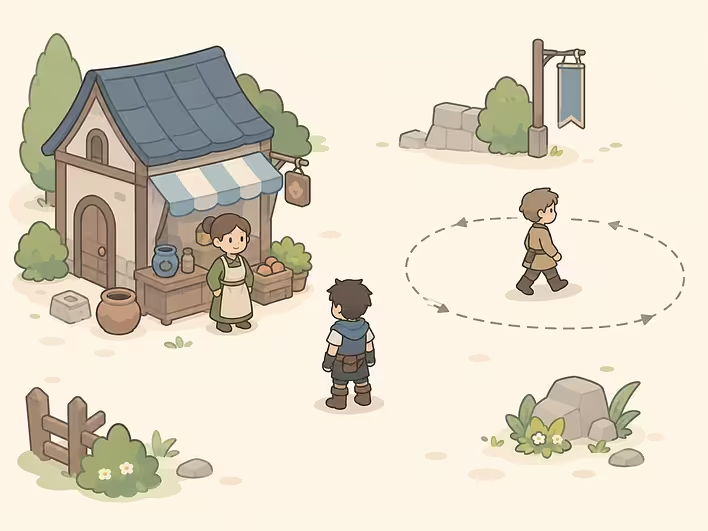
In a video game, an NPC can be a shopkeeper, a townsperson, a guard at the gates, a character who gives quests, a random passerby, or an important ally of the main character. The player does not control them directly: their behavior is determined by the game itself.
At the same time, NPCs are not necessarily secondary or primitive characters. Some non-player heroes have their own backstory, complex personalities, extensive dialogues, and can significantly influence the plot.
Where the term NPC comes from
NPCs appeared before the word itself began to be primarily associated with computer games.
Its history is linked to tabletop role-playing games that actively developed in the 1970s. One of the most famous early examples was Dungeons & Dragons. In such games, regular participants control their own heroes, while all other characters in the world — merchants, rulers, enemies, random travelers, or townsfolk — are controlled by the game master.
Without NPCs, the fictional world could hardly function. Someone has to tell the heroes about the danger, offer a job, sell equipment, engage in conflict with them, or simply create the feeling that life exists around them.
When role-playing games transitioned to computers, this same logic was preserved. Only instead of a game master, the behavior of NPCs began to be controlled by the program. Characters received scripted lines, routes, behavior scenarios, and reactions to certain player actions.
From this, the modern humorous image of an NPC as a being that lives according to a predetermined script eventually emerged.
How NPC differs from a player character
In role-playing games, there is another common abbreviation — PC, meaning player character.
A PC is a character controlled by a person. An NPC is a character whose control belongs to the game, the game master, or another system.
Conditionally, this can be imagined like this: you enter a tavern with your hero, approach the bartender, and receive a quest from him. Your hero is a PC, while the bartender is an NPC.
However, the boundary can sometimes be conditional. In some games, a non-player character may temporarily become controllable or join the team. Therefore, NPC primarily describes the role of a character in a specific gaming system, rather than their importance to the story.
Why NPCs often seem strange
Old video games had significantly fewer technical capabilities, so NPC behavior was often very simple. One character could stand by the same shop for hours, repeat a few lines, and hardly react to the strange events around.
This is where a large part of gamer humor comes from.
An NPC might walk the same route every day, stare at one point, suddenly crash into a wall, or repeat the same greeting every time a player approaches. In such moments, it is particularly noticeable that their behavior is not spontaneous — it is scripted in advance.
In modern games, this is attempted to be concealed much better. Characters receive daily routines, more complex reactions, memory of player actions, and extensive dialogues. However, the main principle remains the same: NPCs act within the rules set by the developers.
This very feature ultimately turned the term into a metaphor.
What NPC means in internet slang
When a person is called an NPC, it usually implies that they behave in a template-like, predictable manner or seem to act according to a ready-made script.
This can be a joke about a person who constantly repeats the same phrases, mechanically performs familiar actions, stands or moves oddly, or reacts to certain situations so predictably that it seems they have a limited set of programmed reactions.
For example, someone leaves their house at the same time every day, buys the same coffee, and says the same phrase to the barista. In a humorous context, this can easily be called "NPC behavior."
Or a person stands almost motionless in an unusual place for a long time, then suddenly moves in one direction — and someone is reminded of a video game character waiting for their script to activate.
In this sense, NPC is most often a harmless internet humorous metaphor.
NPC as an insult
In a certain context, the word NPC sounds much sharper.
Calling someone an NPC can imply that they lack their own opinion, repeat others' theses, and react to events according to ready-made templates.
This meaning became particularly widespread along with the meme NPC Wojak — a gray, emotionless character with a characteristic simplified face. In this meme, the idea of a game NPC was transferred to real people: they do not form their own opinions, but merely reproduce "recorded" lines from someone.
In the second half of the 2010s, this image was actively used in political and ideological debates in the English-speaking internet. NPC was used to refer to opponents who were considered too predictable or prone to mechanically repeating popular views.
Over time, the word significantly detached from its specific political context and became a broader internet slang term.
Therefore, the meaning heavily depends on the situation. The phrase "I'm walking like an NPC between the kitchen and the desk today" is ordinary self-irony. However, "you are all NPCs" in a debate sounds like a derogatory characterization.
What is an NPC moment
Another common expression is NPC moment, literally meaning "NPC moment."
This refers to a situation when a person accidentally does something that closely resembles the behavior of a character from a game.
For example, they went in one direction, suddenly turned around and went back, stood still in a strange place for a long time, repeated the same phrase several times, or performed some action so mechanically that it looked programmed.
In such usage, there is usually no serious negative subtext. It is rather a way to look at an ordinary life situation through the logic of video games.
What are NPC streams
The word NPC has acquired another meaning thanks to the format of NPC streaming, which became particularly noticeable on TikTok.
During such streams, the streamer deliberately behaves like a video game character: repeating short phrases, movements, or animations in response to certain gifts and actions from viewers.
Reactions are intentionally made cyclical and mechanical. A viewer sends a certain gift — the streamer reproduces the associated phrase or movement. This resembles a game NPC that reacts the same way every time to a given trigger.
This format became especially popular in 2023, although videos in which people imitated NPC behavior in real life had appeared on the internet earlier.
As a result, a rather funny cultural loop emerged: initially, games created NPCs meant to mimic human behavior, then people began comparing each other to NPCs, and eventually started deliberately copying non-player characters in front of the camera.
Like it?React
🧵
This post doesn't have any additions from the author yet.