Many romantic films and series have shown excessive persistence as proof of true love for decades. The hero calls again and again after rejection, accidentally meets the beloved near her home or work, bombards her with letters and gifts — and eventually wins her over. In real life, such behavior is far from always romantic. If a person repeatedly ignores someone else's personal boundaries and continues to impose their attention despite a clear refusal, this can already be considered stalking.
In recent years, this problem has been discussed more frequently. Social networks and digital technologies have played a significant role in this, greatly simplifying the opportunities for intrusive surveillance and unwanted communication. At the same time, psychologists emphasize: stalking existed long before the internet appeared — it's just that today it is easier to notice and describe.
Despite the similarity of names, the words “stalking” and “stalker” do not always mean the same thing.
What is stalking
Stalking is systematic unwanted harassment of a person that causes them discomfort, anxiety, or fear. Its main feature lies not in a single act, but in its repetitiveness. If after a clear refusal a person continues to call, send messages, seek meetings, or in any other way interfere in your life, this can already be a manifestation of stalking.
At the same time, it is important not to confuse it with ordinary persistence or misunderstanding. One message after a first date or an attempt to apologize does not yet indicate harassment. Stalking is discussed when a person consciously ignores requests to cease any contact and continues to impose their presence.
Where the concept comes from
The English word stalking originally meant “creeping up” or “tracking prey” during hunting. Over time, this term began to be used regarding intrusive harassment of people.
In the second half of the 20th century, psychologists and criminologists increasingly noted cases where, after a breakup or due to obsessive infatuation, one person began to literally live the life of another: calling dozens of times a day, waiting outside their home, sending letters or gifts, and sometimes even making threats. It was then that the word “stalking” acquired its modern meaning and became a separate term in psychology and law.
What forms can stalking take
Most people imagine harassment as a situation where a stranger follows someone down the street. In reality, this is just one of the possible forms.
Stalking often manifests through endless phone calls, messages, and emails. After blocking one account, the stalker creates a new one, writes from different numbers, or asks mutual acquaintances to pass on messages.
Another common form is cyberstalking. Social networks allow tracking the places a person visits, their social circle, photos, and even ordinary daily habits. Sometimes the stalker collects personal information, spreads false rumors, or tries to gain access to someone else's accounts.
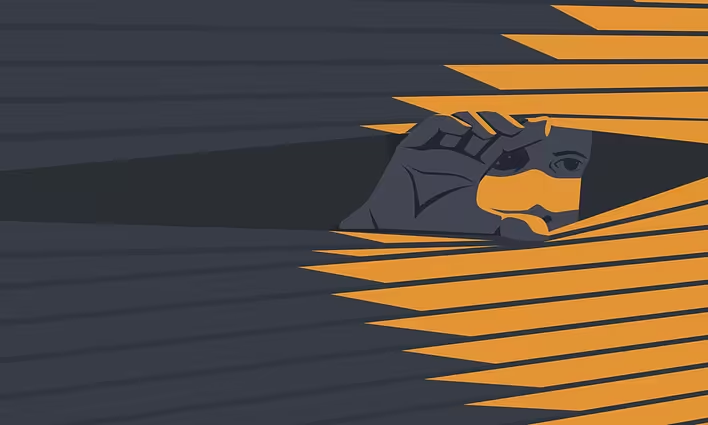
There are cases when a person deliberately appears near the victim's workplace, educational institution, or home, regularly organizes “accidental” meetings, or uses friends and relatives to obtain information about their life.
Why do people become stalkers
There is no universal reason. Most often, harassment begins after the end of a romantic relationship when one partner cannot come to terms with the breakup.
However, other situations also occur. Sometimes the stalker is almost unfamiliar with the person but creates an idealized image in their mind and convinces themselves that there is a special connection between them. In other cases, the motive becomes a desire to control another person, take revenge on them, or attract attention at any cost.
Experts note that such behavior may be associated with psychological problems, but not every stalker has a mental disorder. Often, the cause is unhealthy relationship patterns, an inability to accept rejection, or a pathological need for control.
How to understand that the situation has become dangerous
The main sign of stalking is not a single action, but its systematic nature. If after repeated requests to cease communication a person continues to call, send messages, wait for you outside work or home, or finds new ways to contact you after being blocked, this can no longer be considered a coincidence.
Particular concern should be raised by threats, attempts to control your life, spreading false information, surveillance, or unwanted gifts that you did not ask for.
What to do in case of stalking
The first rule is to clearly define your boundaries. If you do not wish to communicate, it is worth saying so directly, after which you should cease any discussions. Attempts to convince the stalker or explain your position often only sustain their interest.
It is equally important to keep all possible evidence: messages, emails, call recordings, photos, or videos. If the situation escalates, they may be needed for contacting law enforcement.
It is also recommended to review privacy settings on social networks, not to publicly disclose your location in real-time, and to warn close ones not to accidentally share your personal information with outsiders.
If the harassment is accompanied by threats or causes real fear for your safety, do not hesitate to contact the police. If necessary, the help of a psychologist can also be beneficial, as prolonged stalking often leads to chronic stress, anxiety, and emotional exhaustion.
Why stalking should not be romanticized
Modern culture is gradually abandoning the image of the “loving hero who simply does not give up.” Respect for personal boundaries is now considered an integral part of healthy relationships.
What may sometimes seem romantic in artistic works can cause serious psychological suffering in real life. Due to constant harassment, people change their routes, avoid familiar places, delete social media accounts, and even move to another city.
That is why more and more countries are improving legislation to combat stalking, and psychologists urge not to ignore the first signs of intrusive harassment.
Stalking is not a manifestation of great love and not a romantic way to win someone's affection. It is unwanted systematic harassment that violates a person's right to privacy, peace, and safety.
The sooner the problem can be recognized and any encouragement of such behavior can be stopped, the greater the chances of avoiding its development. Respect for personal boundaries, the ability to accept rejection, and a responsible attitude towards the privacy of others are the foundation of healthy human relationships both in real life and in the digital space.