This content has been automatically translated from Ukrainian.
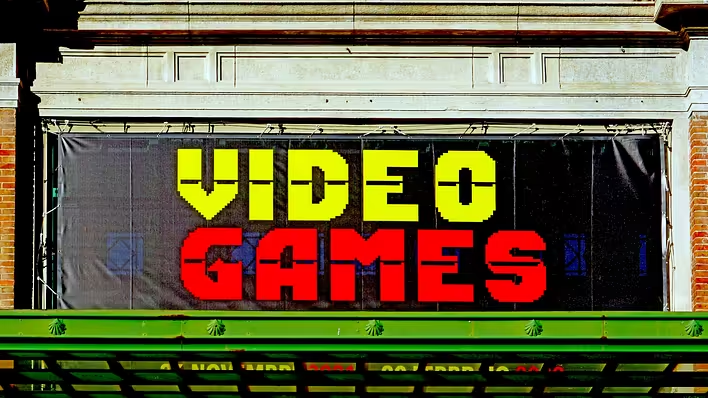
Online games have long transformed into an international space where players from different corners of the world can meet in a single match. To communicate quickly during the game, they use dozens of short English abbreviations. Just a few letters can mean good luck wishes, praise for an ally, a message about temporary absence, or even an acknowledgment of defeat.
For newcomers, such messages often look like an incomprehensible set of symbols. However, for experienced gamers, this is a familiar part of gaming slang and a kind of international way of communication.
One of the most well-known abbreviations is GG (Good Game). We have already detailed its origin and meaning in a separate article. Now let's look at other popular abbreviations that millions of players use daily in online game chats.
GL and GL HF
One of the first messages that often appears even before the match begins is GL.
This abbreviation stands for Good Luck, meaning “Good luck!”.
Even more frequently, you can see the extended version — GL HF, which is decoded as Good Luck, Have Fun. The closest Ukrainian equivalent is “Good luck and have a good game!” or “Good luck and enjoy the game!”.
This phrase has long become an element of gaming etiquette. It shows that the participants are set for fair competition and friendly communication.
WP — Well Played
After a successful game or a bright moment, you can often see WP in the chat.
This abbreviation stands for Well Played, meaning “Well played”.
It is used both for opponents and allies. For example, if someone skillfully won a difficult round, saved the team from defeat, or demonstrated a high level of skill.
Quite often, WP is combined with GG, forming the familiar phrase GG WP — “Good game, well played”.
NT — Nice Try
Not every brave attempt ends in victory.
That’s why in many team games, you can see the message NT.
It means Nice Try, or “Good attempt”.
This is usually how players support someone who just fell short of success. For example, if they were left alone against several opponents and almost won the round.
Even after a defeat, such a message helps maintain team spirit and shows that the player's efforts were noticed.
AFK — Away From Keyboard
The abbreviation AFK is known even to those who haven’t played online games for a long time.
It stands for Away From Keyboard — literally “away from the keyboard”.
Today, this phrase is used much more broadly. It can even be seen in mobile games, where there is no keyboard at all.
AFK means that the player temporarily cannot control their character or respond in chat. The reasons can vary: a phone call, internet issues, or the need to step away from the device for a moment.
In most team games, prolonged status as AFK is considered undesirable behavior, as the team is effectively left without one of the participants.
BRB and BBL
Two more popular abbreviations are BRB and BBL.
BRB means Be Right Back — “Be right back”.
It is used when someone needs to step away briefly but plans to return quickly.
BBL, on the other hand, stands for Be Back Later — “I’ll be back later”.
This is usually how someone informs that they are leaving the game or chat for a longer time.
GJ — Good Job
Another common abbreviation is GJ.
It means Good Job, or “Great job!” or “Well done!”.
This is how players usually praise an ally for a successful action: winning a shootout, timely use of an ability, smart team decision, or successfully completing a challenging task.
Despite its simplicity, these two letters help maintain a positive atmosphere in the team and motivate other players.
FF — Forfeit
One of the abbreviations that often raises questions among newcomers is FF.
It comes from the English word Forfeit and means “to surrender” or “to end the match early, acknowledging defeat”.
In many team games, especially in the MOBA genre, teams can vote to end the match early if there are almost no chances of winning left. This is when messages like “FF?” or “Go FF” often appear in the chat — a suggestion to stop playing and acknowledge defeat.
However, not everyone views such a decision the same way. Some consider it entirely logical if the outcome is already obvious, while others are convinced that it is worth fighting until the last minute.
DC — Disconnect
Another popular abbreviation is DC.
It stands for Disconnect and means that the player unexpectedly lost connection to the server or left the match.
The reasons can be internet problems, a computer or mobile device crash, technical malfunctions, or even a power outage.
In team games, the message “DC” helps quickly explain to allies why one of the participants has stopped moving or is no longer participating in the match.
EZ — Easy
Not all popular abbreviations have a positive meaning.
One of the most well-known is EZ, meaning Easy (“easy”).
It is usually written after a victory, hinting that the match posed no difficulty.
In most modern gaming communities, such a message is considered a display of disrespect towards opponents and an example of unsportsmanlike behavior. That’s why in some games, there are automatic filters or even humorous replacements for this word to reduce toxicity in chats.
Noob and Newbie — what’s the difference?
Many people believe that Noob and Newbie mean the same thing. In fact, there is a difference between them.
Newbie is a newcomer, a person who is just getting acquainted with the game. There is no negative connotation in this word.
Noob initially also meant an inexperienced player, but over time it has taken on a derogatory shade. Today, it can refer to someone who constantly makes elementary mistakes, does not strive to improve, or hinders their team.
However, among friends, this word is often used jokingly.
OP, Buff, and Nerf
If you read news about updates to popular online games, you have almost certainly come across the words OP, Buff, and Nerf.
OP is short for Overpowered, meaning “too strong.” This refers to a character, weapon, or ability that gives too great an advantage over others.
If developers decide to reduce the power of such a character or item, players say it has been nerfed (nerf).
Conversely, if the characteristics are improved after an update, the word buff is used, or it is said that the character has been buffed.
These terms have long become an integral part of gaming slang and regularly appear in update descriptions, reviews, and esports broadcasts.
Meta — the most effective way to play
Another term that is often heard among gamers is Meta.
In modern video games, this word refers to the most effective tactics, characters, gear builds, or combinations that work best in the current version of the game.
After a major update, the meta often changes. Some characters become stronger, others lose popularity, and players begin to search for new best strategies.
That’s why the word “meta” can be heard in almost every esports tournament or video analyzing updates.
Why are almost all abbreviations in English?
Most popular online games were created for an international audience, which is why English has become the universal means of communication among players.
Even if Ukrainians, Japanese, Germans, and Brazilians meet in one match, messages like GL HF, AFK, WP, NT, or GG will be understood by almost everyone.
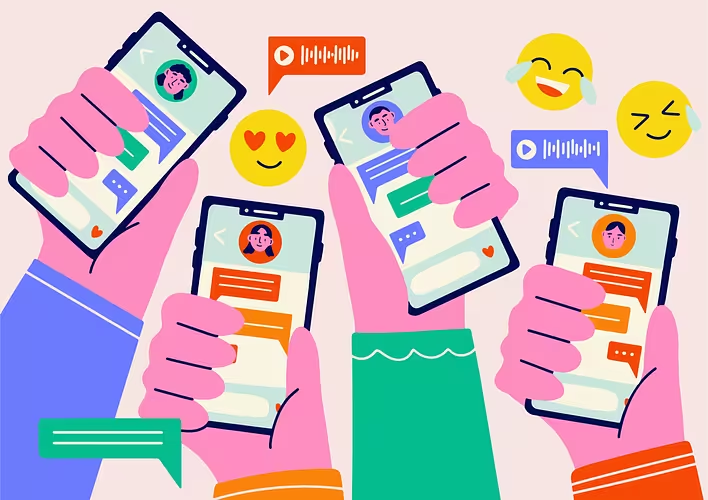
Over time, these abbreviations have become so firmly embedded in gaming culture that many people use them even in regular correspondence, messengers, and social networks.
Two letters that represent a whole culture
At first glance, gaming abbreviations may seem like an incomprehensible set of letters. In reality, each of them helps convey information quickly, support an ally, thank for a game, report a technical problem, or simply make communication more comfortable.
Over decades of online gaming development, these short abbreviations have transformed into a kind of international language for gamers. Regardless of genre, platform, or country, they are equally understood by millions of people.
And although new terms and memes appear every year, it is GG, GL HF, WP, AFK, NT, FF, and other classic abbreviations that remain the foundation of gaming etiquette and an inseparable part of online gaming culture.
Like it?React
🧵
This post doesn't have any additions from the author yet.