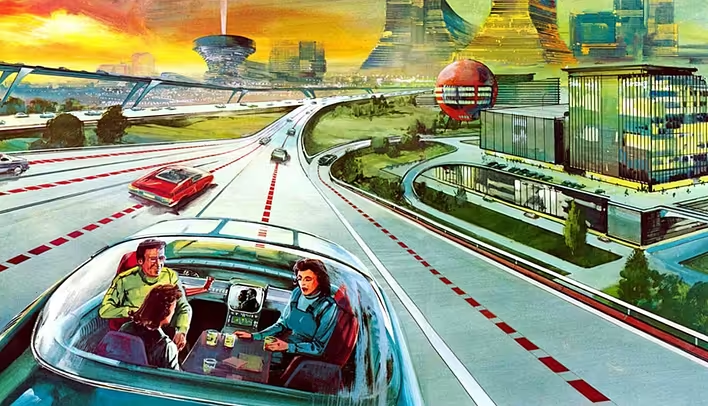
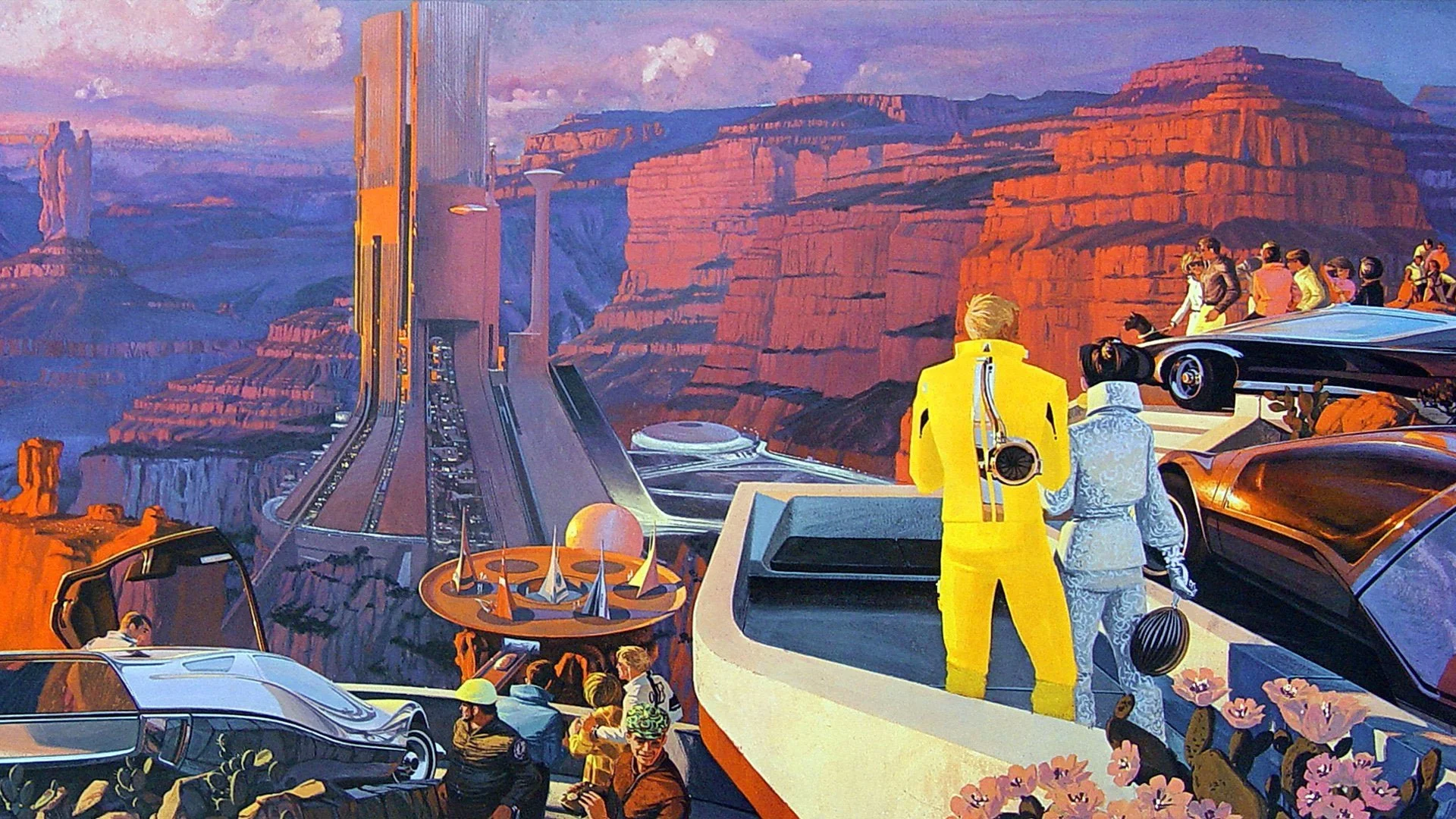
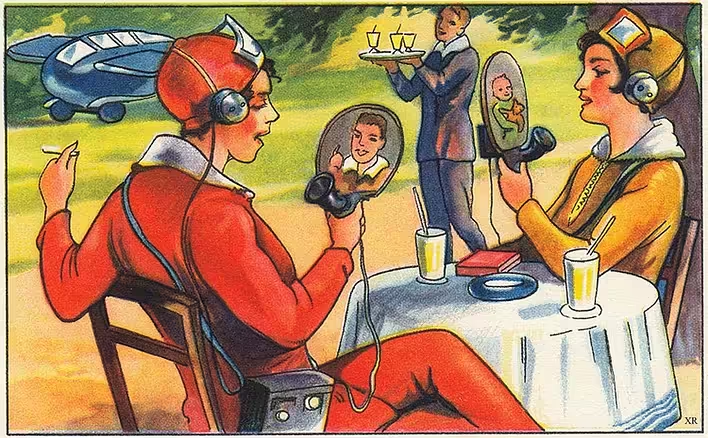
If a person from the early 20th century tried to depict the 21st century, they would most likely have illustrated flying cars, cities under transparent domes, robot butlers, and space hotels on the Moon.
Most of these predictions never came true. However, they have not lost their charm. On the contrary, today such images evoke particular fascination. They possess something simultaneously naive, bold, and remarkably beautiful.
This vision of the future is called retrofuturism.
It is not just an artistic style or a design movement. Retrofuturism allows us to look at tomorrow through the eyes of people who lived decades or even a hundred years ago and see what they dreamed of and what they expected from the development of humanity.
What is Retrofuturism
Retrofuturism is an artistic movement that combines ideas about the future characteristic of past eras with a modern view of history.
In simpler terms, it is “the future as seen in the past”.
Today, by examining old magazines, posters, books, or films, we can see how people envisioned the 21st century many decades ago. These images became the foundation of retrofuturism.
It is easily recognizable by the combination of vintage aesthetics with fantastic technologies: airships alongside spaceships, steam-powered mechanisms controlling robots, or atomic-age cars with the distinctive design of the 1950s.
How Retrofuturism Emerged
Despite its name, retrofuturism formed relatively recently.
The term itself began to be actively used only in the second half of the 20th century when it became clear that reality turned out to be nothing like what writers, artists, and engineers of previous generations had imagined.
However, the very images of the future appeared much earlier. They were particularly actively created in the late 19th and early 20th centuries — during a period of rapid development in science, technology, and industry.
Electricity, automobiles, airships, airplanes, radio, and later the beginning of the space age created a sense that humanity was on the brink of incredible discoveries.
It seemed that soon people would live on other planets, robots would do all the housework, and transportation would fly right above the cities.
Some of these predictions did indeed come true. Others remained beautiful fantasies.
That is why today we perceive them not as predictions but as peculiar historical documents that tell about the hopes, fears, and imaginations of people of their time.
Why the Future Almost Always Looked the Same
Interestingly, in different decades, people often imagined the coming world based on a similar principle.
At the end of the 19th century, many artists were convinced that all new machines would run on steam.
In the 1950s, almost all science fiction writers believed that the main source of energy would be atomic. That is why advertisements of that time featured atomic cars, atomic planes, and even household appliances that supposedly would run on nuclear energy.
In the 1960s, the main dream became space.
Many were confident that by the early 21st century, tourist flights to the Moon would become as common as today’s air travel.
To the modern reader, such predictions may seem naive, yet they perfectly illustrate which discoveries and technologies fascinated people of their time.
Retrofuturism in Literature
Writers were among the first to explore the future.
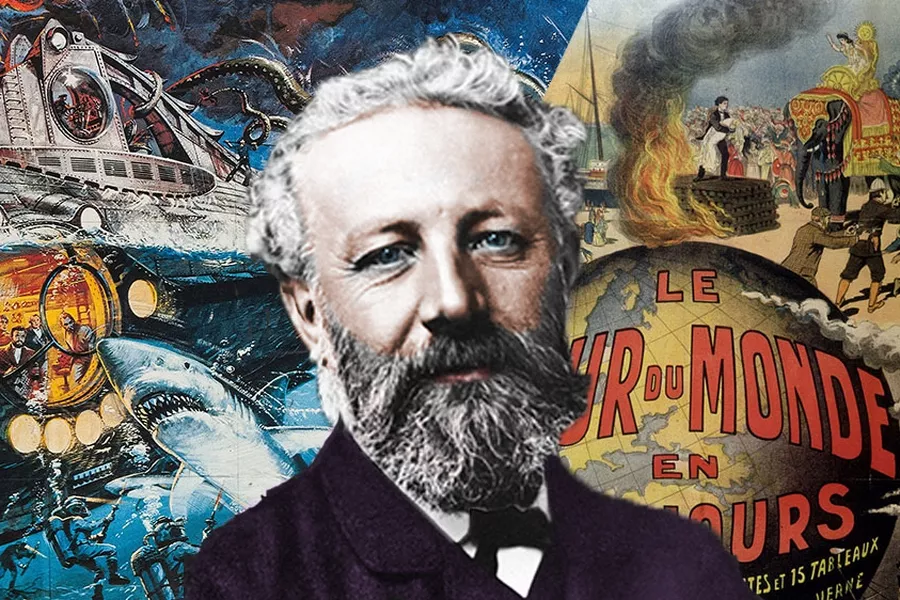
Jules Verne in the 19th century remarkably accurately predicted the emergence of submarines, flights to the Moon, and many other inventions.
Herbert Wells combined scientific ideas with reflections on the future of humanity in his novels, creating worlds that continue to inspire writers, directors, and artists today.
Interestingly, many classic works of utopia and dystopia can also be viewed through the lens of retrofuturism. They demonstrate the future as envisioned by their authors in their time. That is why today these books are interesting not only for their plots but also for how they reflect the scientific, social, and cultural ideas of past generations.
The Most Famous Directions of Retrofuturism
Retrofuturism is not a single style. Over time, several distinct directions formed around it, each showing the future as imagined in a specific historical era.
That is why some works resemble Victorian England with steam machines, others the atomic age of the 1950s, and others recreate futuristic computers of the magnetic tape era.
Its action usually unfolds in a world reminiscent of Victorian England in the 19th century. In it, technologies have reached incredible development but operate not on electricity or digital computers, but on steam engines, mechanical gears, and intricate clockwork mechanisms.
That is why in steampunk, one can see gigantic mechanical robots, steam airships, pilot goggles, bronze mechanisms, and whimsical inventions that look both vintage and futuristic.
This aesthetic was significantly influenced by the works of Jules Verne and Herbert Wells.
Жуль Верн
Dieselpunk
Dieselpunk takes us to the first half of the 20th century — approximately between the 1920s and 1950s.
It is easily recognizable by massive machinery, locomotives, airplanes, military aesthetics, art deco architecture, and industrial landscapes.
If steampunk romanticizes the steam era, then dieselpunk shows a world where technological progress is inextricably linked with internal combustion engines, heavy industry, and rapid engineering development.
Atompunk
After World War II, humanity became fascinated with atomic energy.
In the 1950s and 1960s, many were convinced that atomic energy would forever change people's lives. Artists and writers envisioned atomic cars, planes, household appliances, and even entire cities that would operate on compact nuclear reactors.
These fantasies became the basis of atompunk (Atompunk).
This direction is characterized by bright colors, smooth shapes, cosmic motifs, optimism, and almost limitless faith in science and technological progress.
Cassette Futurism
Unlike previous directions, cassette futurism (Cassette Futurism) depicts the future as imagined in the 1970s and 1980s.
Here, large computers, CRT monitors, magnetic tapes, button control panels, and endless rows of blinking indicators prevail.
Today, such technology seems outdated, but a few decades ago, it embodied the most modern technologies.
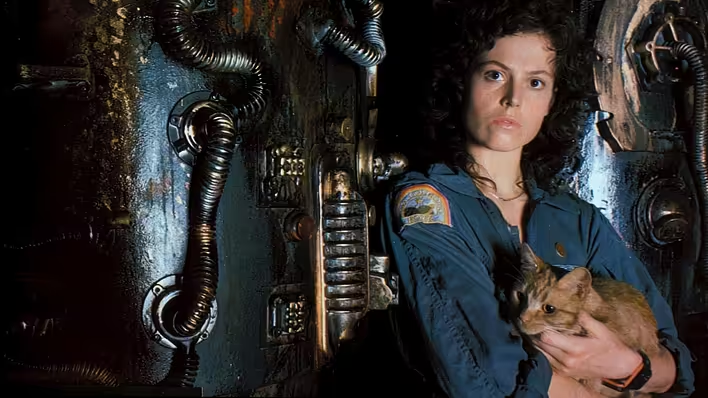
One of the most famous examples of this style is the film “Alien” from 1979. The spaceship is equipped with computers that now look primitive, although at the time they seemed to be the pinnacle of technological progress.
«Чужий» 1979
Retrofuturism in Film, Games, and Design
Today, this style can be found in almost all forms of art.
In cinema, bright examples include “Brazil” by Terry Gilliam, “Sky Captain and the World of Tomorrow”, “Tomorrowland”, as well as the aforementioned “Alien”, which became one of the best examples of cassette futurism.
In the world of video games, retrofuturistic aesthetics are used just as actively. The BioShock series combines art deco architecture with fantastic technologies, Fallout showcases a world that forever remains in the imaginations of the 1950s, and The Outer Worlds consciously mimics mid-20th-century space science fiction.
Today, this style can also be seen in graphic design, architecture, advertising, fashion, and digital art. It helps create a special atmosphere — nostalgia for a future that humanity never witnessed.
The Future That Remained in the Past
The paradox of retrofuturism is that it tells us not so much about the future as about the past. Through fantastic machines, cosmic cities, and incredible inventions, we see what different generations of people dreamed of and how they envisioned tomorrow.
That is why this style evokes both nostalgia and admiration. It reminds us that each era creates its own image of the future, which almost never coincides with reality.
Perhaps this is the main value of retrofuturism. It shows not what the world has become, but what people sincerely hoped to see it as. And although most of these fantasies never came true, they left behind a rich cultural legacy that still inspires writers, artists, directors, designers, and millions of science fiction fans around the world.