This content has been automatically translated from Ukrainian.
There are places where it seems as if time has stopped. Yellowed newspapers still lie on the tables, desks stand in school classrooms, and on the walls of hospitals, you can see informational posters that have not been taken down for decades. Trees grow through cracked windows, rusty mechanisms slowly decay, and nature gradually reclaims the space that once belonged to humans.
For most, these are just abandoned buildings that one wants to pass by as quickly as possible. However, for others, they become a kind of museum without guides and showcases. Each abandoned factory, mine, fortress, or estate holds its own story — the story of the people who worked, lived, studied, or simply spent part of their lives there.
It is the desire to see these places with one's own eyes that has become the basis for the unusual passion known today as urbex (from the English urban exploration). In the Ukrainian information space, the term urban stalking is also widely used.
Despite the similarity in names, urban stalking has nothing to do with obsessive stalking of people. In this case, the word “stalker” refers to an explorer of hard-to-access or abandoned places. The term itself has an interesting history and several different meanings, which we detailed in a separate article.
From the Romance of Ruins to Modern Urbex
Interest in abandoned places arose long before the term urban exploration appeared.
In the 18th and 19th centuries, European travelers ventured to the ruins of ancient cities, medieval castles, and abandoned monasteries. Such journeys were part of Romanticism — an artistic movement whose representatives were fascinated by the grandeur of the past, the beauty of ruins, and the transience of time. It was then that a special attitude towards abandoned structures emerged, viewing them as silent witnesses of history.
By the end of the 19th and into the 20th century, interest gradually shifted. After the industrial revolution, many factories, mines, power plants, and railway depots began to close in various countries. Instead of ancient ruins, industrial landscapes — vast production complexes that had lost their purpose — increasingly attracted researchers.
The modern urbex movement formed in the 1970s and 1980s. In the UK, France, Canada, and the USA, the first communities of enthusiasts emerged who systematically explored old factories, bunkers, sewers, abandoned hospitals, and other lesser-known sites. They were not interested in adrenaline rushes, but rather in the opportunity to peek behind the scenes of everyday urban life and see what is usually hidden from outsiders.
It was during this time that the term urban exploration, abbreviated as urbex, became widespread. Its participants referred to themselves not as adventure hunters, but as explorers of the urban environment. They photographed architecture, documented the condition of buildings, and sought to preserve the memory of places that could soon disappear forever.
The true flourishing of this passion occurred at the beginning of the 21st century. Digital cameras, themed forums, blogs, and later social networks allowed people from all over the world to share their discoveries. What was once a hobby of small communities gradually transformed into an international cultural phenomenon.
Why Abandoned Places Attract People
From the outside, urban stalking may seem primarily about seeking adrenaline. In reality, most researchers speak of something entirely different.
First and foremost, they are attracted by the opportunity to literally touch history. Unlike museums, where exhibits are carefully selected and labeled, abandoned buildings often remain as they were left by their last inhabitants or workers. Old calendars, work journals, furniture, children's toys, equipment, or even a cup left on a table can sometimes tell more about the past than official documents.
Equally important is the architecture. Many industrial structures from the 19th and 20th centuries were created with impressive scale. Huge workshops with glass roofs, decorative brickwork, metal structures, ancient staircases, or mosaics often amaze just as much as famous tourist attractions.
Photography holds a special place in urbex culture. Thanks to photographers, millions of people have seen the beauty of places that are usually hidden from the public eye. Nature gradually reclaiming man-made spaces creates stunning scenes: trees grow through theater floors, vines wrap around factory facades, and sunlight filtering through broken windows transforms abandoned interiors into almost fantastical sets.
There is also another reason that researchers often mention. Urban stalking reminds us how quickly the world changes. Factories, hospitals, train stations, or schools that were once symbols of progress can turn into ruins in just a few decades. Such places become monuments to human ambitions, economic changes, wars, and technological progress.
Perhaps that is why many are attracted not just to the abandoned buildings themselves, but to the stories they hold. Every school was once filled with children's voices, every factory produced goods, and every house was someone's home. Urban stalking allows one to feel this connection to the past, even if just for a moment, and to see history not through a museum exhibit, but as it has been left by time.
Urbex Culture: More Than Just a Hobby
Over the years, urbex has ceased to be just a way to spend a weekend unusually. An international community has formed around it with its own traditions, rules, and unwritten ethics.
For most supporters of this movement, the main value is not the search for thrills, but the opportunity to document a place as it is today. Many abandoned buildings are destroyed, rebuilt, or completely disappear each year, so photographs and videos often become the last evidence of their existence.
That is why among urbex enthusiasts, there has long been a rule considered the foundation of the entire culture:
“Take nothing but photographs. Leave nothing but footprints.”
This principle signifies respect for the place. A true explorer does not break doors, does not leave graffiti, does not break windows, and does not take found items as souvenirs. Their task is to see, document, and tell the story of the building, not to alter it.
This is what distinguishes urbex from vandalism. If damage, litter, or the disappearance of historical items occurs after a visit, it has nothing to do with the culture of urban exploration.
How Books, Movies, and Video Games Popularized Urban Stalking
Although the urban exploration movement arose independently of artistic culture, it was literature, cinema, and video games that made it known to a wider audience.
The novel “Roadside Picnic” had a significant influence, in which the Strugatsky brothers created the image of a stalker — a person who leads others through the dangerous and mysterious Zone. Later, director Andrei Tarkovsky reinterpreted this plot in the film “Stalker,” where the journey through abandoned territory became a philosophical parable about human desires, fears, and the search for meaning.
At the beginning of the 21st century, a new wave of popularity for the theme was brought by the S.T.A.L.K.E.R. video game series. It introduced millions of players to the atmosphere of abandoned factories, deserted villages, military sites, and the Chernobyl exclusion zone. Although the game world is fictional, many architectural objects were recreated based on real Ukrainian locations.
At the same time, it would be wrong to consider that these works initiated urbex. Rather, they helped many people see abandoned places in a new light and become interested in their history.
A huge role in the development of this passion was played by photography. The works of photographers who documented abandoned hospitals, theaters, hotels, power plants, and mines were regularly published in well-known global publications and drew attention to the issue of preserving architectural heritage.
The Most Famous Urbex Locations in the World
Although almost every country has abandoned buildings or industrial sites, some locations have long become true symbols of the global urbex culture. Their photographs regularly appear in documentaries, photo projects, and travel publications, and for many researchers, they remain places they want to see with their own eyes at least once in their lives.
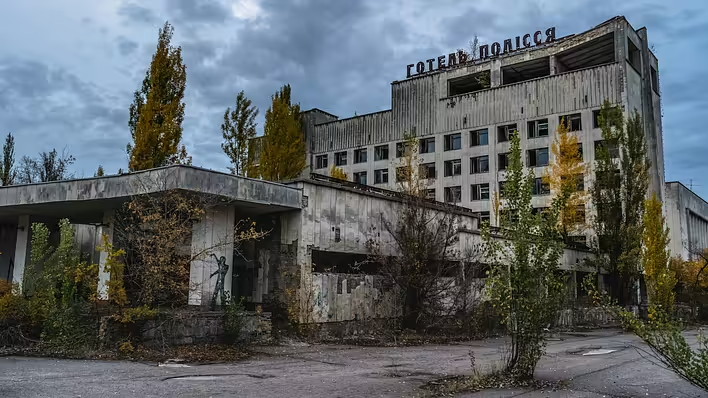
One of the most famous symbols of urban stalking is Pripyat. After the Chernobyl disaster, the city became a world-renowned example of how nature gradually reclaims the space created by humans. Abandoned high-rises, an amusement park, schools, and public buildings have turned into symbols not only of a technological disaster but also of the transience of human civilization. It is Pripyat that has largely shaped the modern perception of abandoned cities.
Equally well-known is the Japanese Hashima Island, often referred to as the "battleship island." Once, it housed one of Japan's largest underwater coal mines, and thousands of people lived in a small area. After the mine closed, the island was deserted, and its multi-story concrete buildings gradually turned into ruins. Today, Hashima is on the UNESCO World Heritage list and is partially open for organized tours.
Completely different is Kolmanskop in Namibia. This town emerged in the early 20th century due to diamond mining, but after the depletion of the deposits, its residents left. Since then, the desert has slowly reclaimed the territory: sand fills rooms, buries staircases, and creates surreal landscapes that have long become a hallmark of global urbex photography.
Among the most famous European ghost towns, Craco in Italy holds a special place. Due to a series of landslides and earthquakes, residents were forced to leave their homes, and the medieval town froze atop a hill. Its narrow streets and ancient stone houses have repeatedly served as natural backdrops for artistic films.
In the United States, one of the most famous abandoned settlements is Bodie in California — a town from the gold rush era. Unlike many other similar places, it has not been left to decay. Today, Bodie is designated as a historic park, allowing visitors to see a well-preserved ghost town almost as it was left over a century ago.
However, experienced urbex enthusiasts often say that the most interesting discoveries await not among world-renowned locations, but right nearby. An old sanatorium, an abandoned factory, a derelict train station, or a forgotten estate can tell just as captivating a story as the legendary places written about in guidebooks. That is why for a true explorer, the importance lies not in the popularity of the site or impressive photographs, but in the opportunity to see and preserve a piece of history that becomes more vulnerable with each passing year.
Is It Legal to Explore Abandoned Places?
At first glance, it may seem that an abandoned building is ownerless and therefore open to anyone interested. In reality, this is not always the case.
Even if a structure has not been used for a long time, it may be privately or publicly owned. Additionally, some sites are located on the territories of enterprises, nature reserves, or other places with restricted access.
That is why responsible urbex enthusiasts always try to clarify the legal status of a location in advance and respect established rules. In many cases, historical sites can be visited legally — as part of an organized tour or after obtaining the appropriate permission.
Safety is equally important. Hazardous ceilings, unstable staircases, open shafts, shards of glass, or remnants of dangerous materials can pose a real threat. That is why experienced researchers prepare thoroughly for such trips, use necessary equipment, and do not risk their lives for the sake of an impressive photograph.
Why Interest in Urbex Does Not Fade
Despite all the risks, interest in urban exploration only grows each year. Some are attracted by architecture, others by photography or history, while some want to see places that may disappear forever in just a few years.
However, perhaps the main reason for the popularity of urbex lies elsewhere. Abandoned buildings remind us that no city, factory, or even an entire era is eternal. What today seems a symbol of development and progress may tomorrow turn into a silent monument of the past.
This thought makes urban stalking something more than just a hobby. It is an opportunity to see history not behind the glass of a museum display, but where it has remained almost untouched.
Urban stalking combines curiosity about history, architecture, photography, and the exploration of urban space. For some, it is a way to see the world from an unusual angle; for others, it is a chance to preserve the memory of places that may soon disappear completely.
Despite the romantic image of abandoned buildings, the true culture of urbex is based on respect. Respect for historical heritage, for the law, for one's own safety, and for the work of the people who once created these structures. This is what distinguishes urban exploration from thoughtless adventure-seeking.
Perhaps that is why interest in urbex has not faded for several decades. After all, it is not just a journey to abandoned buildings, but an opportunity to reflect on how quickly cities, society, and human history itself change.
Like it?React
🧵
This post doesn't have any additions from the author yet.