This content has been automatically translated from Ukrainian.
Needed when the problem is not brightness. High ISO makes the shot brighter but does not change where the light falls from, its color, or whether it keeps up with movement. This is solved by flash – even the one mounted on the camera. And it works best together with raised ISO, not instead of it.
What ISO does and what it doesn't do
The sensor collects as much light as the aperture and shutter speed allow. ISO does not change this amount: it amplifies the already collected signal. Therefore, noise in a dark shot comes not from ISO itself, but from the fact that not enough light has reached the sensor.
Amplification comes at the cost of dynamic range. The measured range of the full-frame Canon EOS R6 at ISO 100 is 13.4 stops, while at ISO 6400 it is just over 10. The shot comes out bright, but details in the darkest and brightest areas are held worse.
For many scenes, this is enough. But if the light in the room falls poorly, high ISO will simply make the same unsuccessful picture brighter.
A typical situation is a birthday party in an apartment in the evening. The chandelier hangs over the table, shadows under the brows on faces, kitchen lamps give a yellow tint, and the window in the frame is blue. The camera easily takes ISO 6400, and the shot comes out bright – only the shadows and yellowness remain in place.
What ISO won't provide and what flash does
- Direction. ISO won't move the chandelier from the ceiling to the side. A flash bounced off a wall provides light from the direction you turned it.
- Color. ISO won't unify the color of lamps and the window. Flash overrides ambient light, and the shot receives one color.
- Movement. In constant light, movement is stopped by shutter speed, while in a dark hall, a short shutter speed incurs even higher ISO. The flash pulse at low power lasts for ten-thousandths of a second and stops movement itself.
- Shadows in sunlight. Outside, there is already too much light, and ISO won't help with shadows from the midday sun or with faces against the light. Flash illuminates these shadows.
Most of this can be done by a camera flash; it's not necessary to shoot it off-camera. Requirements for it depend on the genre: what is important for weddings, street photography, or still life is discussed in the material about how to choose a flash.
Flash and ISO work together
The flash does not cancel high ISO but uses it. Bouncing off the ceiling or wall takes away some light, and the higher the ISO, the less power the flash needs to provide. This benefits everything at once:
- The pulse is shorter, and movement is stopped better;
- Recharge is faster, and the flash keeps up with the series;
- Thermal protection activates later: the instructions for a popular reportage model allow thirty flashes in a row at full power and a thousand at 1/64;
- Ambient light remains in the frame, and the background does not fall into black.
Here's how it looks in an evening restaurant with a white ceiling. The camera is in manual mode: shutter speed 1/125, aperture f/4, ISO 1250. The ambient light is 1–2 stops darker than normal – the background is lively, and the flash illuminates the face. The flash is in TTL mode, flash exposure compensation is zero. If the shot comes out dark or bright – they change the flash compensation, and the camera settings remain untouched.
There is one compromise here – movement. With a difference of 1–2 stops, a light "ghost" from ambient light falls over a fast-moving figure. For the dance floor, ambient light is suppressed more – by shutter speed or aperture.
Direction: how the on-camera flash does not shine directly
Chandeliers and ceiling lights shine from above. Such light casts shadows under the brows and under the nose, making the person in the frame look tired.
In such a room, the on-camera flash is rarely aimed at the face. The head is turned towards the ceiling or wall, and the light bounces off a large bright surface – soft and from the side where this surface is. Reflected from the side wall, it works like a window: it gives volume and shadow on one side of the face.
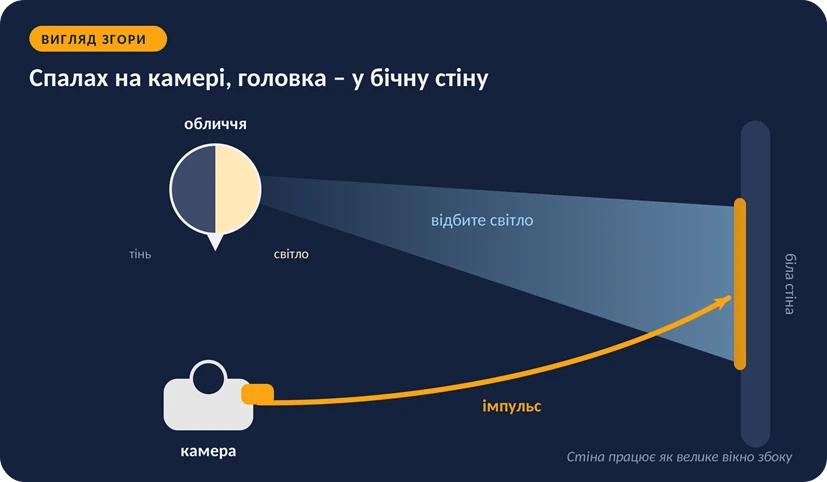
For this, the head must be able to rotate. In full-size Godox V860III, V1Pro, V100, and TT685 II, it rotates 330° horizontally and tilts 120° – that is, vertically, towards the ceiling behind. In the compact iT32, the tilt ends at 90°.
Reflect off a white or light gray surface: a colored wall or beige ceiling will tint the shot in its color. And the further the surface, the more light is lost along the way. Under a high ceiling, reflection stops working – then the light is directed to a closer wall.
Color: one white balance for the entire frame
In a typical room, several sources mix. Incandescent and warm fluorescent lamps shine at 3000 K, cool whites at 4200 K, and daylight comes from the window. The white balance in the frame is one, so one of the sources will appear yellow or greenish.
The flash emits light close to daylight. When it is stronger than the ambient light, the face receives one color, and the white balance is set accordingly.
If the warm atmosphere of the lamps needs to be preserved, an orange CTO filter is placed on the flash head. Full CTO converts daylight 5500 K to 2900 K and takes away a bit more than a stop of light – then the flash and lamps shine in one color.
Movement: the pulse replaces the shutter speed
The pulse of on-camera Godox lasts from 1/300 to 1/20,000 of a second: the longest at full power, the shortest at minimum. In the compact iT32, the shortest pulse is 1/30,000 of a second. Therefore, for movement, the flash is kept at low power, and light is adjusted with ISO.
It is the pulse that stops movement, not the shutter speed, but under one condition: the ambient light must be much weaker than the flash. When it is weaker by 4–5 stops, it is not visible in the frame, and movement freezes even at a shutter speed of 1/60. When the difference is 1–2 stops, that same "ghost" appears.
Thus, in a dark hall, the flash stops the dance, while where there is a lot of ambient light, movement is still stopped by shutter speed.
Street in daylight: illuminate shadows, not overpower the sun
The midday sun casts shadows in eye sockets just like a chandelier. Against the light, the contrast becomes greater than the sensor can capture: either the face is dark, or the sky is white. The flash on the camera illuminates the face and balances the shot without affecting the background.
The limit here is the sync shutter speed, in modern mirrorless cameras from 1/160 to 1/250 of a second. A shorter shutter speed in bright sunlight is provided by high-speed sync (HSS). It is activated on the flash: without it, the camera either won’t allow a shutter speed shorter than sync or part of the frame will come out black. And the shorter the shutter speed in HSS, the less power remains from the flash.
Built-in flash: what it can do in R50 or Z50 II
The built-in flash remains in the younger mirrorless models: in Canon EOS R50, R10, and R100 with a guide number of 6, in Nikon Z50 and Z50 II – 7, in Fujifilm X-S20 – 5. In older cameras, it is absent – neither in Canon EOS R6 Mark II nor in Sony a6700.
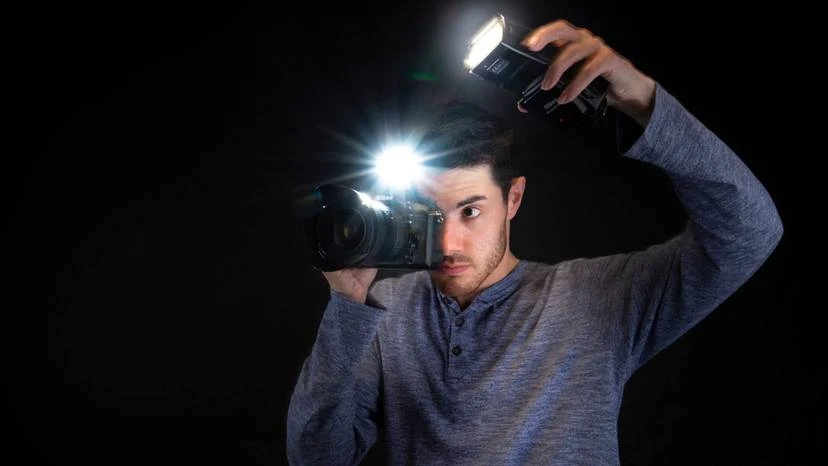
Its light is always flat. The flash is right next to the lens, so the illuminated side of the face is exactly the one the camera sees, and there are no shadows that provide volume in the frame. Hence the red-eye effect: light reflects off the blood vessels on the back wall of the eye directly into the lens. It cannot be turned towards the ceiling – the head does not move.
A guide number of 6 means that at f/4 and ISO 100, the flash illuminates an object at a distance of one and a half meters. In Nikon Z50 with lenses wider than 16 mm, it does not cover the frame completely, and the lens hood casts a shadow on the lower part of the shot. For comparison: a full-size on-camera Canon EL-5 at 24 mm zoom has a guide number of 28.7 – at the same aperture, it reaches almost five times further.
One useful feature of the built-in flash is not available in all cameras. In Fujifilm, it works as a commander and triggers external flashes with light, which is not possible in Nikon Z50 and Canon EOS R10. So the built-in flash is a last-resort fill light, not a replacement for an on-camera flash.
When flash is not needed
If the object is stationary and the light from the window falls to the side, the flash adds nothing. The camera is placed on a tripod, the shutter speed is made longer, and ISO remains low. The shadow on the other side of the face is illuminated with a white reflector, and the person is turned towards the window.
For slow scenes – interviews, items on the table – direction is also provided by an LED panel: its light is visible even before the shot. It cannot stop movement; here, shutter speed works again.
And there are situations where the flash is a hindrance. During a ceremony, it breaks the atmosphere and distracts people, and in some places, it is prohibited to turn it on. Large museums, from the Louvre to the Metropolitan Museum, ban flash. Most artists' contracts prohibit it at concerts. And in some temples, flash cannot be turned on during the service.
How to understand that you need a flash
Before buying, it is enough to review your unsuccessful shots:
- The shot is dark, but the light falls well – raise the ISO, the flash is not needed;
- Under ceiling lamps, shadows under the brows and under the nose – a flash is needed, bounced off a wall or ceiling;
- The face is yellow, and the window is blue – a flash is needed to override the ambient light;
- Movement is blurred even at high ISO – a flash is needed to stop it with a pulse;
- In sunlight, dark eye sockets or a dark face against the light – a flash is needed for fill.
If you recognized your shot in at least one of the points, except the first, you will need a flash. It is worth starting with an on-camera flash with a rotating head: it covers all four tasks, and raised ISO helps it, not hinders.
Like it?React
🧵
This post doesn't have any additions from the author yet.