This content has been automatically translated from Ukrainian.
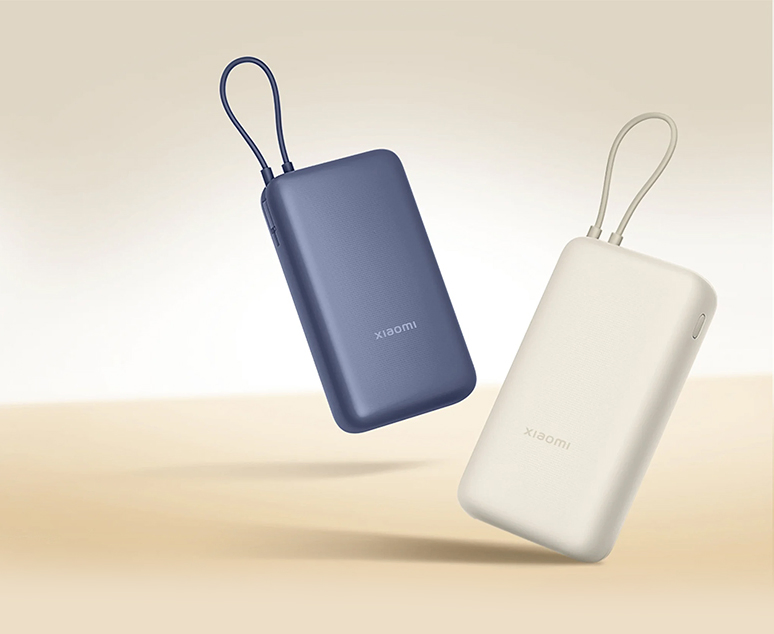
When the question arose of how to choose a power bank with a capacity of 20,000 mAh, I evaluated the models in the following order: first the actual energy in Wh, then the output power, fast charging protocols, number of ports, charging speed of the battery itself, and weight. Based on these parameters, I chose the Xiaomi 20,000 mAh 33W with a built-in cable and a price of 1699 UAH (as of October 2026). The model has USB-C, USB-A, a built-in USB-C cable, support for fast charging, and PD 3.0.
How much of the 20,000 mAh reaches the phone
In reality, I get not 20,000 mAh at the output, but approximately 59–63 Wh of usable energy. The calculation is simple: 20,000 mAh × 3.7 V ÷ 1000 = about 74 Wh, after losses during voltage conversion, 80–85% remains, which means 59–63 Wh.
20,000 mAh does not mean 4–5 full charges of any smartphone. For example, a phone battery of 5000 mAh has about 19 Wh of nominal energy. In reality, I would estimate about 3 full charges of such a smartphone, taking into account losses, heating, and consumption during operation.
33W: what it is sufficient for and what it is not
For a smartphone, 33W is more than enough for me, and for a tablet, it is also a normal option if the device supports the corresponding protocol. However, I do not plan to power a laptop from this power bank.
There is another nuance. The label "33W" does not mean that each port outputs 33W simultaneously. The built-in cable, USB-C, and USB-A have their own modes, and when using multiple outputs, the maximum total power decreases to 22.5W.
USB-C also does not guarantee Power Delivery by itself. It is important that both the power bank and the charging device support PD. This Xiaomi has PD 3.0 support — this is an advantage for me.
Built-in cable: what is its main advantage
For me, the main plus of the built-in cable is that I simply do not have to search for a wire in my backpack. I take out the power bank, connect the phone, and go on. The USB-C cable works for both input and output. Xiaomi provides a maximum mode of up to 27W depending on voltage and current, but the actual speed depends on the specific smartphone.
After a few months of use, I appreciated the convenience of everyday use the most. The cable does not take up separate space and does not stay at home. But I still carry a spare USB-C. If the built-in wire gets damaged, the power bank itself does not turn into a useless piece of plastic: USB-C and USB-A ports remain.
Xiaomi 20,000 vs. Romoss Sense8+, Hama 20,000, and VIYISI G2068: what I chose
I left Xiaomi as the most convenient option for daily use, but there were competitors:
- Romoss Sense8+ has 30,000 mAh, three output ports, and supports PD 3.0, but weighs about 670 g and charges at a maximum of 18W. For long trips, its capacity is decent, but for the city, such weight is already noticeable.
- Hama 20,000 I like for its set of ports. For example, the Power Pack PD20 has two USB-C and USB-A, supports PD 3.0, but weighs about 375 g, and its own charging is limited to 20W.
- VIYISI G2068 is cheaper, has 20,000 mAh, power up to 30W, a display, and a built-in cable. Its weight is about 295 g.
What downsides of the Xiaomi 20,000 mAh I noticed
The main downside is that it is still a heavy device to carry. The second point is that it is not a power bank for a laptop. The third is that when multiple gadgets are connected simultaneously, the available power decreases. Its own charging also takes time: about 5.5 hours with a 9V / 2.5A adapter and about 10.5 hours with a 5V / 2A. And I would not rely on the built-in cable as eternal. It is very convenient, but mechanically it is used more often than a regular wire.
Where to choose a model within your budget
Before buying, I checked not only the price but also the power of each port, supported protocols, equipment, and characteristics of the specific modification. I looked at the Xiaomi 20,000 mAh with a built-in cable on the Allo website: https://allo.ua/ua/universalnye-mobilnye-batarei/zovn-akb-xiaomi-20 000mah-33w-integrated-cable-bhr8975gl-goluboj.html.
Conclusion
I would choose Xiaomi for a smartphone, tablet, and small electronics when a power reserve for a day or two without a socket is needed. With 20,000 mAh, you can expect about 59–63 Wh of usable energy, not the entire nominal capacity. For a phone, this is enough for about three full charges, depending on its battery and losses.
My short checklist: I look at Wh, the power of each port, PD/QC, the number of outputs, the charging speed of the power bank itself, and weight. I put the built-in cable as the last point. It is very convenient, but it does not replace the normal characteristics of the battery.
Like it?React
🧵
This post doesn't have any additions from the author yet.