Every year, tablets seem to be tested for relevance. Smartphones get bigger, laptops are thinner, and tablets stay somewhere in the middle. Will they lose their meaning in 2026? The question sounds logical, but the answer is not so obvious.
It is important to consider the trend: tablets not only do not disappear, but constantly update their positioning. This is easy to track by looking into the Allo online store on the thematic page: https://allo.ua/ua/products/internet-planshety/operacionnaya_sistema-android/. Hundreds of product items and a dozen filters prove that these are very niche devices. Manufacturers bet on mobility, work with content, training and remote services. It is through the tablet that it becomes an entry point for people who need to “do more than the smartphone” gives, but without too much laptop load.
Tablet as a format: why it survives
The paradox is that a tablet does not compete directly with a laptop or phone at all. Its strength lies in the flexibility of the format: The main reasons for the relevance of – are:
mobility + sufficient power
separate work area: books, documents, training, webinars
screens from 8 to 12 inches (golden mean for multimedia)
stylus, manuscript and note optimization
most mobile applications work more conveniently on a tablet.
Therefore, the – tablet is in no way an attempt to supplant another format. This is a separate style of interaction with technology.
2026: a new stage or a period?
A look at the market shows that tablets may get a new positioning in the coming years: “home work and entertainment center”. This especially applies to Android solutions that already have:
voice assistant
the possibility of transformation into a mini-laptop
second screen mode
integration with “smart home”.
That is, instead of competing with phones, they will most likely occupy the niche of a personal home smart hub. And it is Android tablets that look the most flexible for this scenario.
For whom tablets will not lose their relevance
Education and distance learning
Students and schoolchildren already use tablets as a notebook, synopsis, classroom and reader at the same time.
Business and freelance
Easy to take with you, work with documents, edit photos or videos — and send to customer immediately.
Creative professions
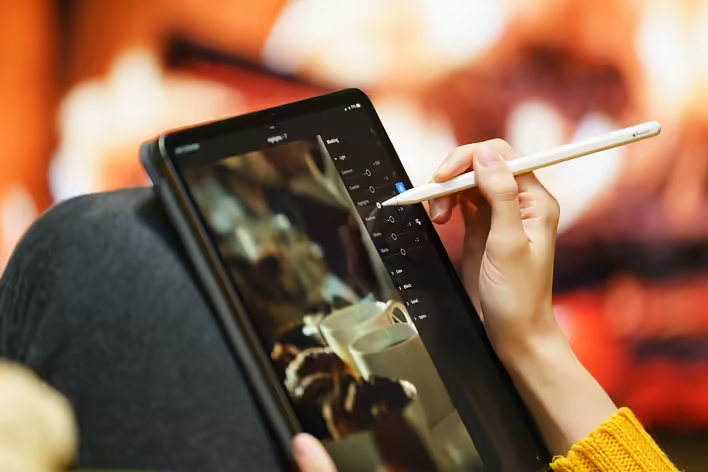
Stylus + tablet = mobile studio of a designer or illustrator. And the cost of Android devices is much lower than professional equipment.
Family use
Kids play games, adults watch the series or read – books and all on one device. This feature will only increase in 2026.
Who will not like a tablet
Despite the advantages, there is still a category of users who do not need a tablet today. Most likely, this audience will not need it in 2026 either:
those who work with powerful programs (installation, 3D, large databases)
users who fully “live” in a smartphone
owners of ultrabooks who are ready to wear them every day.
And that's normal. Everyone should not need a tablet. It should be needed by those who need more mobility than the laptop gives and more space than the phone offers.
What will change the situation in 2026?
Three trends that “zareload” tablets can:
AI assistants inside the OS: personal task management, voice editing, working with content without a keyboard
Cooperation with cloud services: video editing, AI photo processing, working with heavy files without a powerful processor.
Android ecosystem development: There's a chance that tablets will become part of «smart home», not just a separate device.
So will the format disappear or change?
Tablets will not disappear, but will cease to be an alternative to a laptop.. Most likely, in 2026 they will approach the status of a personal work/cloud interface, rather than a regular gadget. This is already visible today – trends towards transformation have begun.
So the question is not whether the tablet will survive, but what form it will survive in. And it is Android tablets that can become a key bridge between a smartphone, a laptop and the technologies of the future.
Share this post
Cite post
Select and copy the required citation standard:
This post doesn't have any additions from the author yet.