This content has been automatically translated from Ukrainian.
The first months at school are not just about reading, writing, and math. The child gets used to a new schedule, learns to spend time without parents, meets classmates, and gradually understands the rules of communal living. For some, this transition is easy, while others need time to feel confident. Therefore, in primary education, it is important to consider not only the academic program but also adaptation and communication.
First steps in school life
In kindergarten, a child could move freely from one activity to another, but at school, there is a clear daily rhythm. It is necessary to arrive on time for classes, prepare notebooks, listen to assignments, wait for their turn, and complete the work. Therefore, parents looking for “private primary school Kyiv” pay attention not only to the curriculum but also to the daily environment. Clear rules and a calm atmosphere help first-graders understand more quickly what is expected of them.
Adaptation does not happen in one day. At first, a child may forget necessary things, feel shy to ask questions, or get lost in a new situation. The adult's task is not to do everything for them but to gradually show how to act independently. For example, a student can learn to check their backpack, approach the teacher if the assignment is unclear, and ask a classmate for help.
Why it is important to learn to work in a group
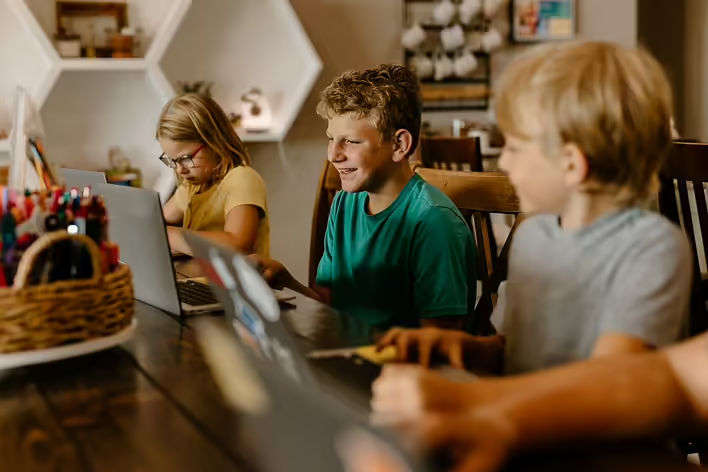
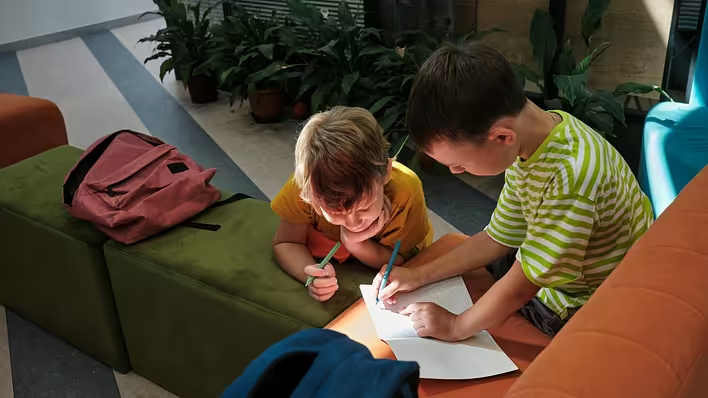
In early school age, social skills are formed in everyday situations that repeat daily. A child asks a classmate for a pen, agrees on the rules of a game, works in pairs, or resolves a dispute. From the outside, it seems trivial, but this is how a student gains real experience interacting with others. Team tasks quickly show how a child interacts with others. One student may suggest an idea, another may draw well, and a third may speak confidently. If all decisions are made by the teacher, the children merely follow instructions. If part of the responsibility is left to them, they learn to listen to each other and distribute work.
Conflicts in such situations are inevitable. Someone interrupts, someone does not want to yield, and someone remains silent. This does not mean that group work does not work. On the contrary, a real example can show how to express disagreement without quarreling, propose a compromise, or ask for help.
How the school supports adaptation
It is important that communication does not remain a separate topic of one lesson. It should be part of the regular school day: during lessons, projects, breaks, and joint activities. The child can gradually move from simple pair tasks to working in a small group and then independently present the result to the class.
At the same time, not all children adapt to the new environment at the same speed. One first-grader easily gets to know classmates, while another feels more comfortable observing at first. Therefore, the goal of the school is not to make everyone behave the same way but to create conditions in which each child can gradually become more confident and independent.
Conclusion
Primary school teaches a child much more than reading, writing, and counting. Daily situations help them get used to a new routine, understand the rules, find their place among classmates, and learn to solve simple problems without constant adult assistance. It is important for the student to have the opportunity to work in pairs, complete group tasks, ask questions, express disagreement, and try to negotiate. Mistakes in such situations are a normal part of learning. Today, a child may find it difficult to ask for help, but after some time, they will be able to explain their problem to the teacher independently.
Like it?React
🧵
This post doesn't have any additions from the author yet.