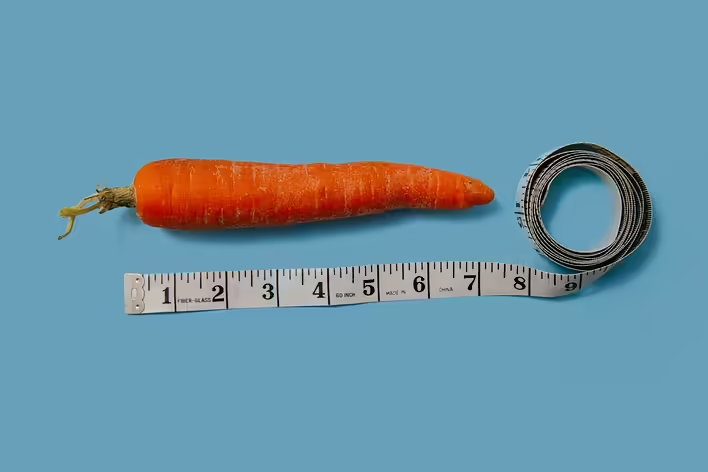
Metric system is an international system of measures based on the decimal principle and is the most widely used in the world. Its emergence is associated with the era of the French Revolution: in 1795, the meter, kilogram, and other units created based on universal and natural quantities were officially introduced in France. The goal of the new system was to replace numerous local measures that varied from region to region, creating a single, understandable, and scientifically grounded system.
In the 19th and 20th centuries, the metric system gradually spread across the world. Today, it forms the basis of the International System of Units (SI), established in 1960. In most countries, this system is the primary one for measurements in science, engineering, medicine, education, and everyday life. For example, the meter is used for length, the kilogram for mass, the liter for volume, and the degree Celsius for temperature.
How the designations were formed
1. Choice of the meter
The first base unit was the meter. It was defined as one ten-millionth of the distance from the equator to the North Pole along the meridian through Paris. This approach made the meter a "natural" quantity rather than an arbitrary convention.
2. Decimal system
Instead of complex fractions (as in feet or inches), they decided to use the decimal principle:
1 meter = 10 decimeters
1 meter = 100 centimeters
1 meter = 1000 millimeters
That is, all divisions were based on the number 10, as it is the most convenient for humans (we have 10 fingers). This was a revolution: previous systems often relied on 12 (inches in feet, ounces in pounds, etc.), which complicated calculations.
3. Liter and kilogram
From the meter, other units were derived:
Liter = the volume of a cube with sides of 10 cm (i.e., 1 dm³).
Kilogram = the mass of 1 liter of pure water at the melting point of ice.
Thus, the base units were interrelated and "logical": length → volume → mass.
4. Prefixes
To denote larger or smaller multiples, a system of prefixes was introduced:
“kilo-” (1000),
“deca-” (10),
“deci-” (1/10),
“centi-” (1/100),
“milli-” (1/1000).
Later, the system was expanded to include “micro-,” “nano-,” “mega-,” and others. All of them were based on powers of the number 10, ensuring universality.
5. Why the system looks this way
The metric system looks this way because its creators aimed for maximum simplicity and universality:
decimal divisions – the most convenient for counting;
unity of units – length, volume, and mass are interrelated;
universal basis – initially through the size of the Earth, and now through fundamental physical constants.
This approach allowed the metric system to become the "language of science" and a convenient basis for international standards.
How the definitions of the meter and kilogram changed
Initially, the meter was defined as one ten-millionth of the distance from the equator to the North Pole along the meridian through Paris. Later, for accuracy, a standard was created — a platinum rod with markings. In the 20th century, the definition was changed several times: initially, the meter was tied to the length of a light wave, and since 1983, to the speed of light in a vacuum.
A similar story applies to the kilogram: it was based on the mass of 1 liter of water, later on a platinum-iridium cylinder, and in 2019 it was finally "decoupled" from a physical object and began to be defined through fundamental physical constants (specifically, Planck's constant).
Thus, the decimal structure remained unchanged, but the standards were refined according to the advancement of science.
Transition to the metric system: difficulties and curiosities
Despite the obvious advantages, the introduction of the metric system did not always go smoothly. In different countries, it was accompanied by resistance, curiosities, and even political debates.
United Kingdom
In Britain, the metric system began to be gradually implemented from the 19th century, but the population clung to traditional imperial measures for a long time. For example, beer is still served in pints in pubs, and distances on road signs are measured in miles. At the same time, kilograms and liters are actively used in stores and production. This led to a kind of "double life" of the measurement system.
United States
In the US, the US customary system (feet, inches, pounds, gallons) is officially used. Although in 1975 Congress passed the "Metric Conversion Act," which was supposed to encourage the transition, public resistance was so strong that the process effectively stopped. Americans are accustomed to their measures and even consider them "more human," as a pound or inch is easier to visualize. However, in science, medicine, and the military, the US still uses the metric system.
Interestingly, in 1999, NASA lost the Mars Climate Orbiter worth $125 million due to confusion over units: one group of engineers used pounds-force, while another used newton-seconds (metric units). As a result, the calculations were incorrect, and the probe entered the Martian atmosphere at too steep an angle and burned up.
Canada and Australia
Canada officially transitioned to the metric system in the 1970s, but parallel usage can still be encountered: gasoline is sold in liters, but in everyday life, people sometimes refer to height in feet or weight in pounds. Australia, however, took a more decisive step — there, the metric system completely replaced the old units in the 1980s.
Other countries
In several African and Asian countries, the transition to the metric system was also challenging. Locals often retained traditional units related to daily life (for example, "pumpkin" as a measure of grain or "basket" for fruits). This created parallel systems that gradually disappeared only under the pressure of international trade.