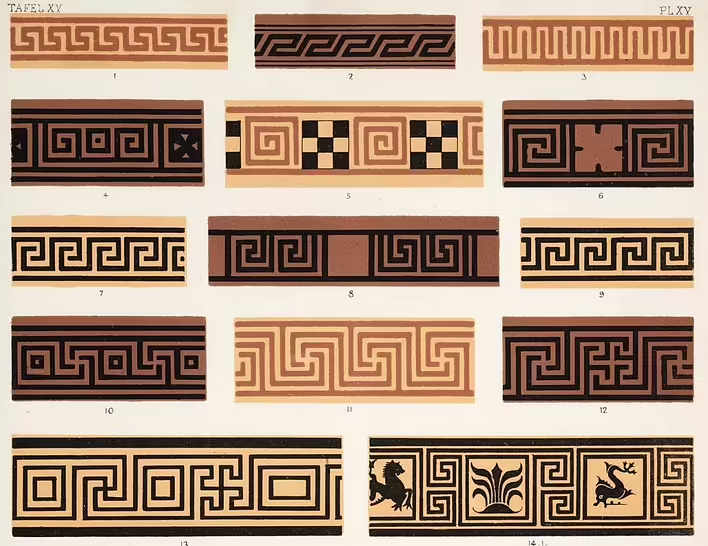
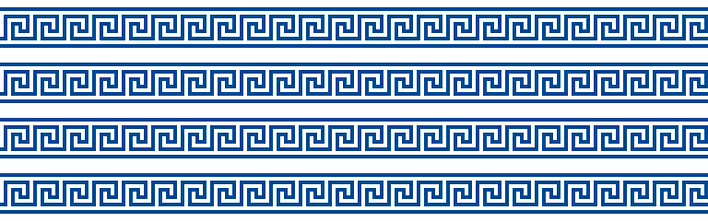
Meander is a complex, often symmetrical ornamental motif consisting of a continuous line that bends repeatedly at right angles, forming a geometric pattern. The most common form is the so-called "Greek meander," or "Greek key," which resembles a labyrinthine line. The name comes from the Meander River (modern Büyük Menderes) in Asia Minor, known for its extremely winding course.
грецький меандр
The meander is considered one of the oldest decorative motifs in the history of art. It was used as far back as the Neolithic period, and later gained great popularity in ancient Greece and Rome, where it adorned pottery, architectural friezes, mosaics, coins, clothing, and weapons. In Greek culture, the meander symbolized infinity, unity, continuity of life, or the eternal circle. Because of this, it was often associated with the concept of eternity or protection.
This ornament spread beyond the Mediterranean. It can be seen in the decorative arts of ancient Mesopotamia, China, Persia, as well as in traditional Ukrainian embroidery and wood carving. In modern design, the meander continues to be popular — it can be seen on textiles, jewelry, architectural elements, and logos (for example, the Versace brand actively uses this motif).
меандр на продукції бренду Versace
Interesting to know:
In Greek architecture, the meander often adorned the entablature — the horizontal element between the columns and the roof.
In symbolism, the meander is sometimes viewed as a scheme of a journey or path, especially in the context of a labyrinth.
In mathematics and physics, the term "meandering" is also used to describe a complex, curved trajectory of a river or another process.
The meander is not just a decorative pattern, but a symbol that has absorbed deep cultural meaning and has passed through the millennia, preserving its form and significance.