This content has been automatically translated from Ukrainian.
Videos of someone cutting soap, pouring concrete, sharpening a knife, baking bread, or spending hours restoring a rusty object can hold attention better than series. They often lack a plot, conflict, or even words — but it's hard to look away. This is not coincidence or "mindless scrolling": such videos hit very precisely at the basic mechanisms of our psyche.
Feeling of completion and control
The human brain loves predictability and completed cycles. In "how something is done" videos, we see a clear process: it was chaotic — it became orderly, it was broken — it became whole, it was empty — a result appeared. This gives a sense of control over the world, which is often lacking in real life. Even if we do nothing ourselves, the brain "counts" the observed order as a small victory.
Dopamine without stress
Unlike dramatic videos or news, there is almost no threat here. The process unfolds calmly, logically, and without unexpected twists. The brain receives dopamine not from tension, but from the gradual movement towards a result. It's similar to the satisfaction of assembling a puzzle or tidying up — but without physical effort.
Mirror neurons in action
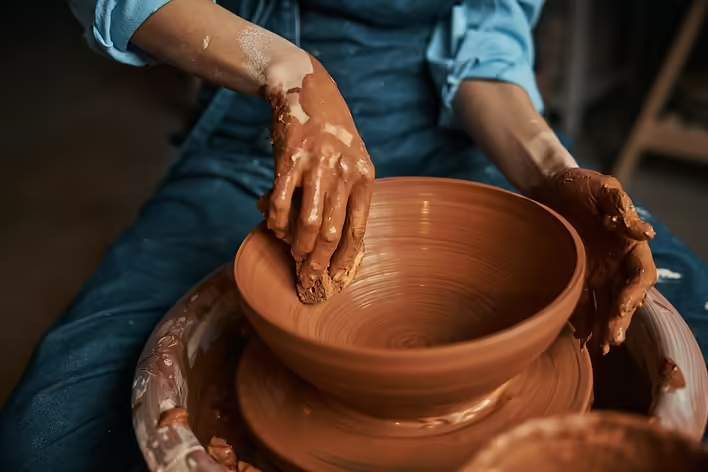
When we watch someone doing something with their hands, mirror neurons are activated — the same ones that work when we perform the action ourselves. The body seems to "experience" the process along with the video creator. That’s why such clips often feel calming or even meditative: the brain behaves as if we are also participating in the creation.
Sound comfort
Process videos are often accompanied by soft, pleasant sounds — even grinding, cutting, tapping, or the monotonous work of tools. Even if it's not classic ASMR, the effect is very similar: attention gently focuses, tension decreases, and the body transitions into a calmer rhythm. The repetition of movements and sounds acts as a soothing background that helps the nervous system "exhale".
Nostalgia for manual labor
In a world of digital services and abstract work, such videos bring us back to a sense of "authenticity". We see a tangible result: an object, food, an item that can be held in our hands. This appeals to a very old human experience — doing something by hand and seeing the fruits of our labor. Even if we are just observing, this feeling still works.
A small escape from chaos
Process videos are a microcosm where everything makes sense. There is no politics, deadlines, or complex moral choices. There are only materials, tools, and time. That’s why such videos are often watched before sleep or during fatigue: they do not overwhelm, but rather "ground" us.
In conclusion, "how something is done" videos attract not because they are useful or educational (though they often are), but because they give the brain what it lacks: calm, order, and a sense of completion. In a world where many things remain unfinished, watching something brought to completion is almost therapeutic.
Like it?React
🧵
This post doesn't have any additions from the author yet.