This content has been automatically translated from Ukrainian.
There are scents that are instantly recognizable. As soon as the first drops fall on dry ground after the heat, a special aroma appears in the air — fresh, earthy, slightly green, sometimes with light mineral or sweet notes. It's hard to describe in one word, but almost impossible not to recognize.
This scent is often associated with relief. The heat subsides, dust settles to the ground, the air seems to be cleansed, and a garden, forest, or city street begins to smell completely different for a few moments. For many people, it is one of the most pleasant scents of nature.
The scientific name for this phenomenon is petrichor. The word appeared in 1964 when Australian researchers Isabel Bear and Richard Thomas described the characteristic aroma that arises after rain on dry soil. They formed the name from Greek words related to stone and a mythical liquid that supposedly flowed in the veins of the gods. It sounds poetic, but the phenomenon itself has a quite material nature: it is the result of the interaction of soil, plants, microorganisms, and water.
The term petrichor was indeed proposed in an article published in the journal Nature in 1964. Later studies showed that microscopic aerosols play an important role in spreading this scent, which are formed when raindrops fall on the porous surface of the soil.
The smell of the earth, not the rain itself
Rainwater has almost no smell of its own. What we call the smell of rain arises when water interacts with the earth, plants, stones, dust, leaves, or asphalt.
Petrichor becomes particularly pronounced after prolonged heat or drought. During this time, various organic substances accumulate in the soil and on the surfaces of plants. When the rain begins, the drops help them enter the air, and we perceive the familiar aroma.
That is why after a summer downpour, the scent in a coniferous forest will be resinous and cool, on a dirt road — richly earthy, and in the city — mixed with the smell of wet asphalt, stone, and dust.
Geosmin — the main note of the rainy aroma
One of the main substances that form the smell after rain is geosmin. It is produced by certain soil bacteria, primarily members of the genus Streptomyces. These microorganisms are also known for producing many natural antibiotics.
Geosmin has a characteristic earthy aroma. It is responsible not only for the smell of damp soil but also for the characteristic earthy notes of beets, and sometimes — of water or fish, if this substance accumulates in water bodies.
The human nose is extremely sensitive to geosmin. We can detect it in concentrations at the level of parts per trillion. That is why even a very small amount of this compound creates such a vivid aroma.
Interestingly, geosmin is significant not only for humans. Studies have shown that it can serve as a signal for some soil invertebrates that help spread the spores of Streptomyces bacteria. Thus, this substance is part of a complex ecological interaction.
How raindrops lift the aroma into the air
Geosmin alone does not explain everything. It is equally important to understand how it gets from the soil into the air.
In 2015, researchers at the Massachusetts Institute of Technology used high-speed filming to demonstrate an interesting mechanism. When a raindrop falls on a porous surface, air bubbles form in the microscopic pores. As they rise, they burst and release the tiniest aerosol particles into the air.
These particles carry aromatic compounds from the soil. That is why the characteristic smell often appears after the very first drops.
This mechanism works best during light or moderate rain. If the downpour is too heavy, large drops are more likely to pound particles into the ground than to lift them into the air. That is why the most pleasant aroma is often felt at the very beginning of the rain.
Plant oils also play a role
Petrichor is not created solely by geosmin. The plants themselves also play a significant role.
During dry weather, many plants release volatile organic compounds and essential oils that accumulate on the surface of the soil, stones, dry leaves, and dust. When rain arrives, water helps these substances transition into the air.
That is why the aroma after rain has not only earthy but also green, herbaceous, woody, or resinous notes. In a steppe, coniferous forest, flower bed, or fruit orchard, it will be different, as each environment has its own set of volatile compounds.
Ozone before the storm
Sometimes it seems that rain can be sensed even before it begins. Partly this is related not to petrichor, but to ozone.
During a thunderstorm, lightning and powerful electrical discharges contribute to the formation of ozone — a molecule consisting of three oxygen atoms. Ozone has a characteristic fresh, slightly sharp, "metallic" smell.
The wind can carry it a significant distance from the thunderstorm front, which is why we sometimes perceive this freshness even before the first drops.
However, the smell of ozone is different from petrichor. Ozone smells colder and sharper, while petrichor has a warm earthy character. In nature, these scents often mix.
Nostalgia, memory, and the smell of rain
Chemistry explains the origin of the aroma after rain, but it does not fully answer the question of why so many people like it.
The sense of smell is directly linked to the centers of memory and emotions in the brain. Therefore, scents can instantly evoke very vivid memories: childhood vacations, walks after a thunderstorm, a wet garden, open windows during a summer downpour, or the way home from school.
Moreover, rain often brings coolness after exhausting heat, cleans the air of dust, and symbolizes renewal. That is why this aroma often evokes feelings of calm, coziness, and relief.
The evolutionary version
Some scientists suggest that sensitivity to the smell of damp soil may have been beneficial to our distant ancestors. In arid regions, the ability to sense the approach of rain or to find a place where precipitation has recently fallen could help locate water and vegetation.
Although this hypothesis cannot yet be definitively proven, it aligns well with the fact that not only humans respond to geosmin, but also some other living organisms.
Urban rain smells different
Petrichor is most often associated with the smell of wet earth, but in the city, a completely different aroma forms after rain.
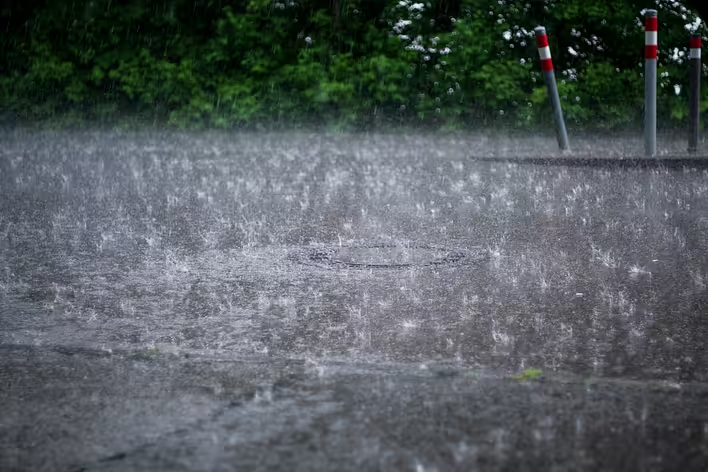
Raindrops fall on asphalt, concrete, dust, metal surfaces, and heated buildings, creating a complex mixture of scents in the air. There are fewer natural components and more smells of stone, bitumen, road dust, and the urban environment.
That is why the same downpour can smell completely different depending on the location.
Petrichor in culture and perfumery
The smell of rain has long been a source of inspiration for writers, artists, and perfumers.
In perfumery, it is recreated using a combination of ozonic, green, woody, mineral, and earthy notes. It is impossible to completely replicate true petrichor, as it consists of hundreds of different volatile compounds.
Therefore, perfumers do not create "the smell of rain" literally — they convey the feeling of wet earth, cool air, stones after a downpour, or a forest that has come alive after precipitation.
Like it?React
🧵
This post doesn't have any additions from the author yet.