What to do if a dangerous Telegram channel has already been blocked, and the next day several more appeared in its place? What will change if one fraudulent page is deleted, but users still cannot recognize deception? And is it even possible to "cleanse" the Internet of all fakes, manipulations, and dangerous content?
It is obvious that it is impossible to completely get rid of such phenomena. The Internet is constantly changing, with new platforms, channels, pages, and ways to influence users emerging. That is why countering digital threats cannot be limited to just blocking individual resources.
It is important to teach a person to independently notice danger.
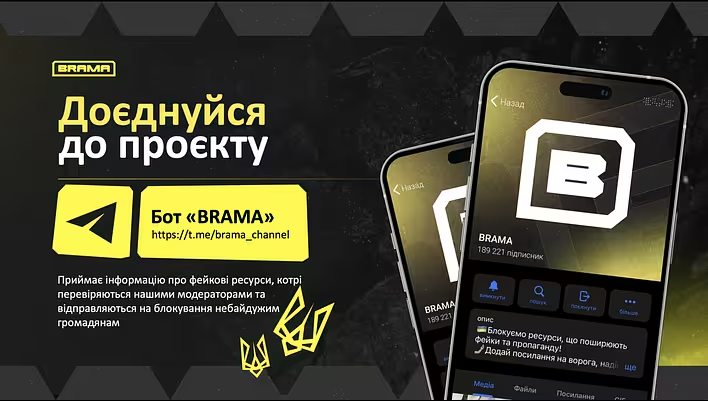
The activities of the social project BRAMA, created by volunteers with the support of the Cyber Police of Ukraine, are built on the combination of practical counteraction and digital education.
A few years ago, users could relatively easily recognize a dubious resource: errors in the text, strange page titles, obviously false promises, or low-quality design.
Today, the situation is much more complicated.
Fraudulent pages can look almost like official websites. Propaganda Telegram channels can disguise themselves as Ukrainian news resources. Manipulative publications can contain real facts but present them without important context. And fakes can spread in the name of well-known media, government institutions, or popular individuals.
In such an environment, it is no longer enough to simply memorize a list of dangerous websites or channels. Users need to understand how manipulations work, why people trust fakes, and what signs to pay attention to.
Learning not only to react but also to recognize
On the project's resources, users can find materials dedicated to cyber hygiene, information security, countering fraud, and media literacy.
It is not just about theoretical rules. People are explained how common fraud schemes can work, why they should not share confirmation codes with third parties, how to verify dubious messages, and why a loud headline does not always mean an important news story.
Special attention is paid to information hygiene. After all, the modern user receives dozens, and sometimes hundreds, of messages from various sources every day. The faster we get used to consuming information, the less time we leave for its verification.
It is this haste that authors of fakes and manipulations often exploit.
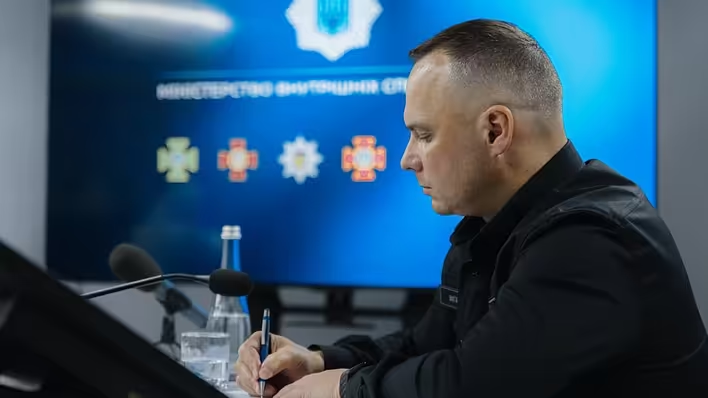
“Today, it is important not only to teach a person to press the 'Report' button. It is much more important to instill in them the habit of asking questions: who spread this information, where did it come from, is there any confirmation, and who might benefit from its dissemination. If a user learns to critically evaluate content, they will be significantly less vulnerable to most digital threats,” says Anatoliy Fil, head of the Cybercrime Counteraction Department in the Odesa region of the Cyber Police of Ukraine.
From fakes to fraud: different threats share a common mechanism
At first glance, Russian propaganda and online fraud are completely different problems. However, they have something in common: in both cases, malicious actors try to influence a person's decisions.
In the case of fraud, it may be the fear of losing money or, conversely, the desire to quickly gain profit. In the case of disinformation – fear, outrage, anxiety, or distrust.
A person is forced to act quickly, leaving no time for verification.
BRAMA works simultaneously in several areas: countering Russian propaganda and disinformation, online fraud, cyberbullying, and the spread of drugs and other dangerous content. At first glance, these problems are different, but they all use the opportunities of the digital environment to influence a person.
Blocking as a reaction, education as prevention
If a user notices a dangerous resource, they can report it to the BRAMA community. Project participants can join in sending complaints through the mechanisms provided by the platforms. This allows for a response to an already identified problem. But blocking is only part of the work.
The educational component allows for proactive work. A person who knows about common fraud schemes is more likely to notice a dangerous link. A user who understands the principles of manipulation will not rush to share an emotional post. Those who know how pseudo-Ukrainian information resources disguise themselves will be able to critically assess their content.
Thus, BRAMA effectively combines two approaches: responding to threats and developing skills that help avoid similar threats in the future.
“In the digital environment, it is impossible to create an absolutely safe space where a person will never encounter fraud or disinformation. But it is possible to prepare them for such situations. The more people can independently recognize dangerous content, the harder it will be for manipulators to achieve their goals,” emphasizes Anatoliy Fil.
Knowledge as part of digital protection
Within the project, various resources and communication channels operate. Through them, participants can receive information about current digital threats, join in responding to dangerous content, and increase their own awareness.
Information resources of BRAMA play a special role in this. They contain materials dedicated to safe behavior online, common fraud schemes, cyber hygiene, and media literacy.
One of the key principles of the project is that knowledge must be accessible. To learn to better protect oneself online, one does not need to be a specialist in cybersecurity. Sometimes it is enough to know a few simple rules and, most importantly, not to rush to act under the influence of emotions.
Digital resilience starts with the user
Today, online safety depends not only on technical protection measures. A strong password or two-factor authentication will not help if a person themselves shares access codes with a fraudster. Blocking one propaganda channel will not have a lasting effect if users do not learn to recognize new ones.
That is why the main value of BRAMA lies not only in the number of resources reported by the community.
The project fosters a different culture of behavior online: not to trust information automatically, to verify dubious messages, to understand risks, and not to stand aside when dangerous content can harm others.
And perhaps this is the most important form of protection. After all, a resource can be blocked, a page can be deleted, and a channel can be created again. But a user who has learned to recognize danger is much harder to mislead.