This content has been automatically translated from Ukrainian.
What does a person do when they see propaganda, fraudulent advertising, or a channel spreading dangerous content in their social media feed? Most often – they scroll further. Some don’t want to spend time on a complaint, some don’t know where to turn, and some believe that one complaint won’t change anything.
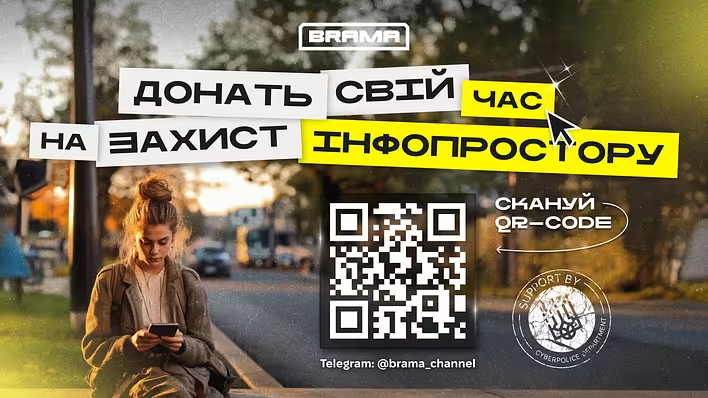
This passivity is what the social project BRAMA, created by volunteers with the support of the Cyber Police of Ukraine, aims to change. Its idea is simple: the user should not remain just a consumer of information – they can become a participant in protecting the information space.
From one user – to collective action
The internet generates huge volumes of content every day, so it is impossible to fully control it solely through the efforts of government agencies or platform administrations. At the same time, it is the users who first see a significant portion of dangerous publications.
BRAMA offers to turn this advantage into a mechanism for collective counteraction. A project participant can report a resource that spreads unacceptable content. After that, the information reaches the community, and users join in sending complaints through the mechanisms provided by the platforms themselves.
So instead of the situation “I saw – I scrolled,” a different algorithm is formed: saw → reported → joined in the response.
Senior investigator of the Cybercrime Counteraction Department in the Odesa region of the Cyber Police of Ukraine, Tetiana Shmihol, notes:
“One user may notice a dangerous resource, but it is the unification of such users into a community that allows for a systematic response to the problem. BRAMA shows that civic engagement in the digital space is not an abstract concept. A person can spend a few minutes and take a specific action that will help reduce the spread of dangerous content.”
What exactly do they help block?
The project’s activities are not limited to Russian propaganda. BRAMA participants counter various types of dangerous and illegal content, including:
- Russian propaganda and disinformation;
- Fraudulent resources;
- The distribution of drugs online;
- Cyberbullying and harassment;
- Other illegal or prohibited content.
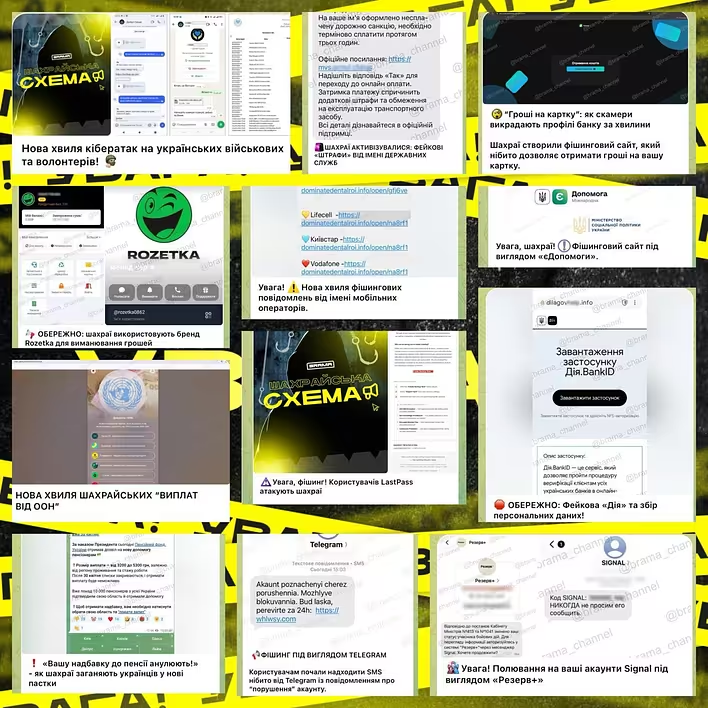
Thus, it is not just about an information war. The goal of the project is to make the digital environment safer for the users themselves.
But blocking is only part of the work
Another important direction of BRAMA is education.
The problem is that even a blocked resource can be replaced by dozens of new ones. Therefore, it is important not only to remove already identified dangerous content but also to teach people to recognize it independently.
Project participants receive information about current fraudulent schemes, learn to distinguish fakes and manipulations, and find out about the rules of cyber hygiene and safe behavior online.
The Cyber Police emphasizes that the educational component is fundamentally important:
“Our goal is not just to show a person what they need to complain about. It is important that next time they can already recognize dangerous content themselves. Therefore, blocking and education must work in parallel: the first allows for a response to the problem now, the second helps to prevent it in the future.”
Digital security starts with information hygiene
Another problem that BRAMA draws attention to is the habit of consuming information without verification. A user may not support Russian propaganda but may unconsciously spread it. They may be cautious with banking data but click on a link to a fraudulent resource. They may know about fakes but believe a message that emotionally aligns with their own beliefs.
Therefore, information hygiene is not only the ability to determine what is true but also the readiness to stop before spreading information further.
“Today we must understand that information security is not only the responsibility of the state. Every user influences what content others will receive through their actions. If a person verifies information, does not spread fakes, and reports dangerous content – they are already contributing to a safer information environment,” says Tetiana Shmihol.
Information defense is also a collective effort
The name BRAMA has symbolic significance. In the past, a gate protected cities and fortresses from external threats. Today, the Ukrainian information space also needs protection – but it cannot be ensured by just one “lock.”
We need people who notice danger, report it, and do not allow it to go unnoticed.
That is why the main idea of BRAMA is not just to block individual resources. The project forms a community of people who understand: in the digital environment, every user can be either a passive observer or part of the protection system.
Sometimes, it only takes a few minutes – to see dangerous content, report it, and join in collective action.
Like it?React
🧵
This post doesn't have any additions from the author yet.