Education has traditionally been viewed as a process of transferring knowledge from teacher to student. Its main task was to ensure basic literacy and the mastery of academic disciplines, which met the needs of industrial society, but the modern educational paradigm goes beyond these boundaries. It focuses on the development of competencies and skills necessary for adaptation and success in a constantly changing world.
Modern education integrates three key functions: it is a tool for knowledge transfer, a platform for developing critical thinking and soft skills.
How the Approach to Education Has Changed Over the Last Hundred Years
Education used to be one-sided, but now it is becoming individualized and interactive. This change indicates a transition of society from the industrial era to the information and globalized one.
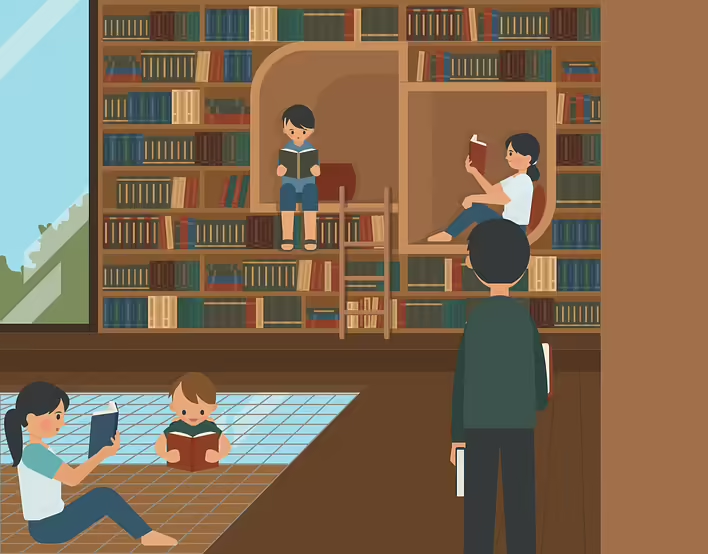
From the 1920s to the 1970s, education was aimed at preparing for industrial society. Its main goal was to impart a certain amount of knowledge necessary for working in factories and plants. Learning was focused on memorizing facts and acquiring basic skills such as reading, writing, and arithmetic. The frontal method dominated, where the teacher acted as the sole source of knowledge, and the student was a passive recipient. Assessment was primarily conducted through standardized tests and exams that only checked the level of memorization. Technology was limited to textbooks, blackboards, and chalk.
From the 1980s to the 2000s, the era of computers and information began. There was an understanding that there was too much knowledge, so the key became not memorizing it, but the ability to find and analyze information. New methodologies began to be introduced into the educational process, including project-based learning, which allowed students to work on real problems, combining knowledge from different disciplines. Assessment became more diverse: in addition to traditional tests, presentations, portfolios, and project work emerged. The first computers in schools were mainly used to study the basics of programming, but had not yet been integrated into everyday learning processes.
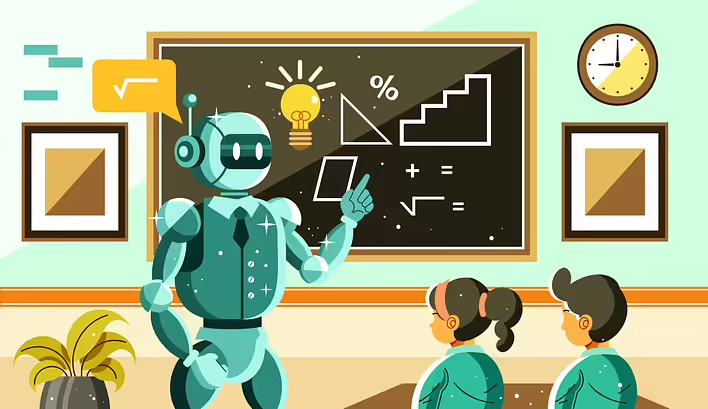
Modern education is global and technological, its goal is to develop competencies necessary for a flexible and rapidly changing world. Educational programs focus on critical thinking, creativity, communication, and teamwork. Learning is becoming personalized, allowing students to choose individual educational trajectories. The teacher transforms into a mentor who helps students unlock their potential. Technologies are fully integrated into the process: artificial intelligence, virtual reality, and online platforms make learning interactive and accessible. Assessment has also changed; it is based on simulations, virtual labs, and other methods that check not only knowledge but also the ability to apply it.
Current Trends in Education
Technologization of Education
Thanks to the integration of technologies, geographical and financial barriers that previously limited access to knowledge are gradually disappearing. Through online platforms, students from around the world can acquire knowledge from leading universities, obtaining certificates that hold high value in the global labor market.
Personalization of Learning
The traditional approach, where all students in one class learn according to a single program, is becoming ineffective. The modern educational philosophy is based on the principle that each person has a unique pace, style, and interests in learning. Personalization allows adapting educational programs to the individual needs of the student.
Lifelong Learning
In the modern world, professional knowledge becomes outdated, and the concept of one-time education loses its relevance. A diploma is no longer the endpoint of learning. Instead, continuous updating of knowledge and skill development throughout life becomes a necessity. This is related to the fact that the labor market is constantly transforming, requiring flexibility from professionals. This is addressed in the concept of Lifelong Learning.
Challenges of Modern Education
The excessive flow of unlimited access to information creates a new problem — information overload. The availability of data does not always guarantee its reliability, making the development of media literacy and critical thinking extremely necessary. Modern education must teach students not just to consume information but to analyze it, distinguishing facts from fakes. This skill is becoming one of the most important for navigating the modern world.