This content has been automatically translated from Ukrainian.
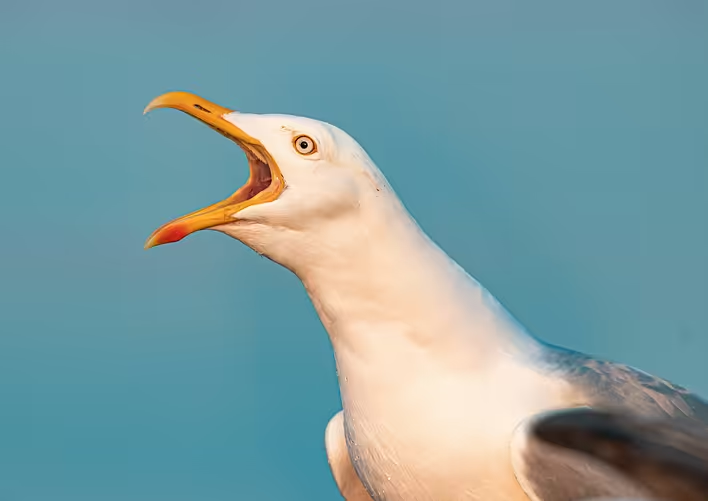
Everyone who has ever been to the seaside remembers this sound. As soon as you step onto the beach or walk through the port, sharp, prolonged cries of seagulls echo overhead. It seems as if they are constantly arguing, calling someone, squabbling, or warning of danger.
It appears that these birds scream incessantly and completely without reason. In reality, their vocal behavior is a complex system of signals that has developed over millions of years of evolution. For seagulls, voice is one of the main ways of interaction.
It is important to make a significant clarification right away. In Ukrainian ornithological terminology, the birds that most people call seagulls are usually referred to as gulls. They belong to the subfamily Larinae and are the white-gray sea birds that loudly scream near the sea, rivers, and lakes. The term “seagull” in Ukrainian scientific nomenclature refers to a completely different group of birds — the genus Vanellus, the most well-known representative of which is the lapwing (crested seagull). However, in everyday language, the word “seagull” has become so firmly associated with gulls that most people use it. In this article, we also use the word “seagull” in its commonly accepted meaning.
Voice — the main means of communication
For humans, the most important way of conveying information is words. For seagulls — sounds.
These birds live in an extremely social environment. Most species nest in large colonies, which can number from several dozen to tens of thousands of pairs. In such a noisy society, silence is simply impossible.
Each cry serves a specific function. Some signals help find a partner, others warn of danger, while others inform about food or help defend the territory around the nest.
Ornithologists have long established that different species of gulls have their own set of characteristic vocalizations. This is not chaotic noise, but a whole system of signals that other birds recognize well.
It's loudest during the breeding season
If it seems that in spring and early summer seagulls have become particularly noisy, it is no coincidence.
This is when the breeding season begins. Pairs take nesting sites, build nests, lay eggs, and raise chicks. All of this is accompanied by a constant exchange of signals.
The birds use their voices to inform their partners of their location, maintain pair bonds, scare off competitors, and warn of danger.
Especially many sounds can be heard in large colonies. Each pair defends a small area around its nest. If a neighbor approaches too closely, a sharp warning cry rings out. If the conflict does not cease, demonstrative posturing or even fights may begin. This is why gull colonies seem so noisy.
Seagulls recognize their chicks
At first glance, all seagull chicks seem the same. But for the parents, this is not the case at all.
In large colonies, each pair must quickly find its own offspring among hundreds of other chicks. This is aided not only by appearance and the location of the nest but also by voice.
Research shows that adult gulls can recognize the individual vocal characteristics of their chicks, and the chicks, in turn, remember their parents' voices. This significantly eases the search for one another in a noisy colony.
This becomes particularly important after the chicks grow and start moving actively near the nest.
Cries help find food
Not all signals are related to danger.
Seagulls watch each other very closely. If one bird finds a food source, others quickly notice it.
This is why near fishing boats or waterfronts, you can often see dozens of birds loudly screaming and circling together. Partly these sounds are related to excitement, partly to competition for food.
For colonial species, such behavior makes sense. If one bird has found food, there is a high probability that more will be nearby.
Warnings of danger
Seagulls have a well-developed system of alarm signals.
When a falcon, eagle, fox, dog, or a person approaches the nest, one of the birds may start to scream loudly. Others quickly respond, taking to the air or joining in the defense.
Such collective attacks are well known to people who accidentally got too close to a colony during egg incubation. The birds can not only scream loudly but also swoop rapidly over the intruder's head, trying to drive them away.
This looks aggressive, but in reality, it is a natural defensive behavior.
Why they are particularly loud by the sea
Many people notice that at the seaside, the cries of seagulls seem much louder than by urban lakes or rivers.
There are several reasons for this.
Firstly, in open spaces, there are almost no obstacles that absorb sound. Over water, sound waves travel very well.
Secondly, the seaside often hosts large colonies where hundreds or even thousands of birds are screaming at the same time.
Thirdly, the constant noise of the waves forces the birds to "shout over" the surrounding background. Similar to people who automatically speak louder in a noisy room, seagulls also increase the volume of their signals.
Why their voice seems so sharp
The voice of seagulls is hard to describe as melodic. It is sharp, piercing, and clearly audible even from a great distance.
And that is exactly how it should be.
Signals need to cut through the noise of the surf, wind, and cries of other birds while remaining recognizable. High and sharp sounds attract attention better and help convey messages to other colony members more quickly.
Therefore, what people often perceive as an unpleasant scream is, for the birds themselves, an extremely effective communication system.
Do seagulls "talk"?
In a sense — yes.
Of course, their signals cannot be compared to human language. But each type of cry serves a specific function: helps find a partner, defend territory, call chicks, warn of danger, or inform about food.
Ornithologists describe dozens of different vocalizations in large gull species. Some of them are used only during courtship, others during conflicts, flight, or nest defense. This is why experienced researchers can roughly understand what is happening in a colony just by listening to the birds' voices.
The clamor without which the sea would be different
For many people, the cries of seagulls have become as much a symbol of the sea as the sound of the surf or the smell of salty air. But behind these sounds lies not random noise, but a complex system of interaction that helps birds find partners, protect their offspring, coordinate behavior, and survive in large colonies.
The next time you hear the familiar sharp "kree-uh" over the shore, you can imagine that it is not just noise. Most likely, one seagull has just informed its neighbors of something important — about danger, found food, the boundaries of its territory, or a place in the noisy life of the colony.
Like it?React
🧵
This post doesn't have any additions from the author yet.