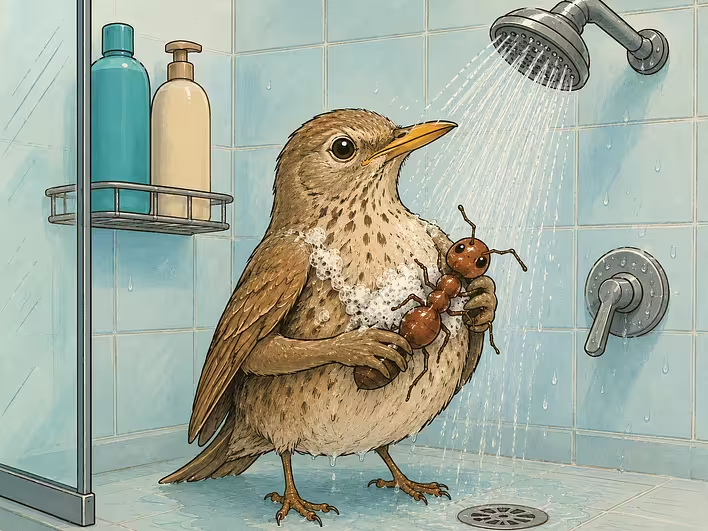
Anting is a special form of hygienic behavior in birds, during which they intentionally come into contact with ants. In the international scientific literature, this phenomenon is referred to as anting (from the English ant).
During anting, a bird either takes ants in its beak and rubs them on its feathers, or simply sits or lies on an anthill, allowing the insects to crawl over its body. Scientists refer to these two options as active and passive anting.
This behavior is not random at all. It has been observed in more than 200 species of birds across almost all continents. Anting has been described in thrushes, starlings, crows, jays, woodpeckers, sparrows, magpies, mockingbirds, American jays, and many other species.
Despite decades of research, scientists still cannot definitively answer why birds do this. There are several compelling hypotheses, each explaining only part of the observations. That is why anting remains one of the most interesting mysteries of bird behavior today.
Researchers are also intrigued by the fact that not only wild birds exhibit this behavior. Similar behavior has been repeatedly observed in parrots, crows, and other birds that live in captivity. If there are no ants nearby, they sometimes try to use other objects or even aromatic plants, indicating the complexity of this instinct rather than a random reaction to insects.
Why Birds Engage in Anting
Although anting was described over a century ago, there is still no single answer as to why it is needed. Biologists believe that this behavior may serve several functions at once. Different species of birds, and sometimes even the same individual, may use anting for different purposes depending on the season, feather condition, or the number of parasites.
That is why today scientific papers discuss not one correct theory, but several of the most likely explanations.
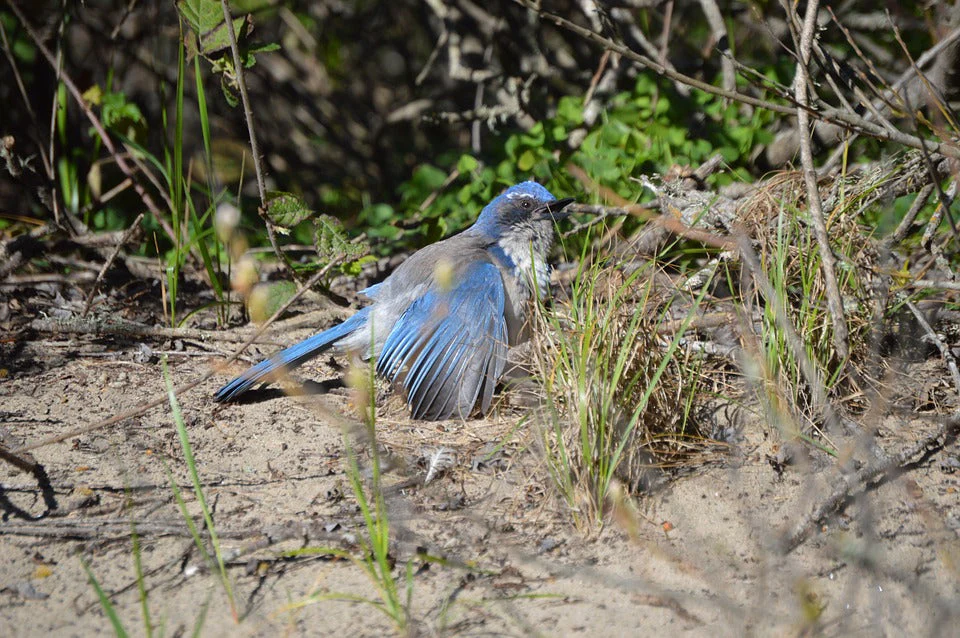
блакитна сойка
Fighting Parasites
The most common hypothesis is related to feather care.
Most of the ants used by birds belong to the Formicinae family. When threatened, they release formic acid — a substance with antimicrobial and insecticidal properties. When in contact with feathers, this acid can potentially repel or even kill small parasites:
feather mites;
downy mites;
lice and other ectoparasites.
Some laboratory experiments confirm that formic acid does indeed negatively affect certain parasites. However, field studies do not always show a consistently pronounced effect, so this hypothesis is not yet considered definitively proven.
Feather Care
Another version suggests that the acid helps maintain feathers in proper condition.
Feathers gradually become soiled with grease, skin debris, dust, fungi, and bacteria. Contact with formic acid may partially inhibit the development of microorganisms and aid in cleaning the surface of the feather.
This is especially important for birds, as even a slight deterioration in feather condition affects insulation, water-repellent properties, and the ability to fly.
Facilitating Molting
Some ornithologists suggest that anting may help during molting.
When old feathers are replaced with new ones, the skin often itches, and new feathers remain covered with thin keratin sheaths. Contact with ants or their acid may partially reduce irritation or stimulate the cleaning of new feathers.
There is little direct evidence for this theory, but interestingly, in some species, anting is indeed observed more frequently during the molting period.
Preparing Ants for Consumption
There is another interesting hypothesis that explains active anting.
Before eating an ant, some birds squeeze it several times with their beak or rub it on the ground or feathers. As a result, the insect releases almost all of its formic acid, which has a sharp taste.
This way, the bird seems to "disarm" the ant's defense mechanism, making it much easier to swallow.
That is why it can sometimes be difficult to determine whether a bird is engaging in anting for feather care or simply "preparing" its food. In some cases, these two forms of behavior may even combine.
Perhaps There Is Not Just One Correct Answer
Today, most researchers lean towards the idea that anting does not have a single universal function.
Most likely, this behavior evolved as a multifunctional way of caring for the body. It may simultaneously help control parasites, maintain feather cleanliness, facilitate molting, and sometimes even make ants safer for consumption.
That is why even after dozens of scientific studies, anting remains one of the most interesting and mysterious examples of bird behavior.
Active and Passive Anting
Ornithologists distinguish between two main types of anting: active and passive. They differ in the way the bird interacts with the ants, although the purpose of such behavior is likely the same.
Active Anting
Active anting (active anting) is the most well-known form of this behavior.
In this case, the bird takes a live ant in its beak and begins to rub it on its feathers. Most often, it treats those areas that are difficult to reach during regular preening:
the underside of the wings;
the tail;
the back;
the shoulders;
the area near the base of the neck.
Sometimes the bird uses several ants at once, picking them up from the ground in turn. If the insect stops releasing formic acid or dies, the bird may discard it or swallow it and take the next one.
From the outside, it appears as if the bird is very carefully "combing" itself with live ants.
Active anting best supports the hypothesis of using formic acid for feather care.
Passive Anting
During passive anting (passive anting), everything happens differently.
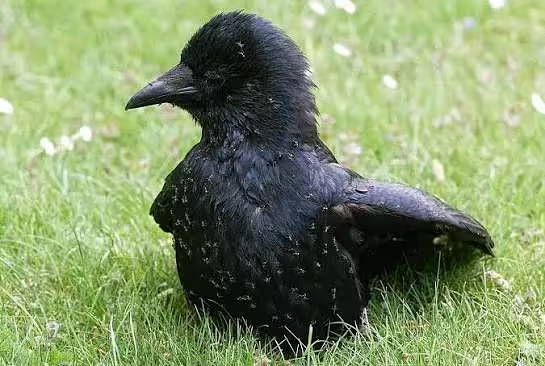
The bird finds an anthill or a place where ants are actively moving, then sits or even lies directly on it. It spreads its wings wide, lowers its tail, sometimes tilts its head, and remains still for several minutes.
During this time, the ants crawl over the bird's body, getting between the feathers. Defending themselves from the unexpected "giant," they release formic acid.
The bird hardly moves and only occasionally slightly changes its body position so that the ants can reach different areas of its plumage.
To an outside observer, such a posture may look strange or even alarming, but in reality, it is quite normal behavior.
Which Method Occurs More Often
There is no definitive answer.
Different species of birds tend to favor different options. Some almost always use active anting, while others practice passive anting much more frequently.
Sometimes the same bird may use both methods depending on the situation. For example, if there is a large anthill nearby, it may take advantage of passive anting. If there are not many ants, it is more convenient to pick them up one by one.
Interestingly, in some cases, birds use not only ants. Researchers have described similar behavior with millipedes, beetles, caterpillars, and even aromatic plants. However, ants remain the most common "assistants" during this unusual feather care procedure.
Why Do Birds Use Ants
At first glance, it may seem strange that birds have chosen ants, as there are many other insects around. However, the reason likely lies not in the ants themselves, but in their defensive substances.
Most of the species involved in anting belong to the subfamily Formicinae. In case of danger, they do not sting but spray or release formic acid. This substance is considered the main reason why birds show such unusual interest in them.
At the same time, not all ants are suitable for anting. Ornithologists have noticed that birds often ignore species that primarily defend themselves with strong bites or have another type of chemical defense. This suggests that they do not randomly choose any ants, but somewhat "prefer" those that release the desired substances.
Another interesting fact is that some birds squeeze the ant with their beak before using it. This forces the ant to release most of its formic acid before the bird starts rubbing it on its feathers or swallowing it.
This selectivity further indicates that anting is not a random play with insects, but a complex behavior that has evolved over time. Although all its functions are not yet fully understood, birds clearly gain some benefit from this procedure.
Which Birds Engage in Anting
Anting is not a behavior of just one or two species. To date, it has been described in more than 200 species of birds, and new observations continue to emerge. It is most frequently recorded in songbirds (passerines), but not exclusively.
Interestingly, this behavior has arisen in species that are not closely related. This means that anting is likely not inherited from a common ancestor, but has independently evolved in different evolutionary lines as a beneficial way to care for feathers.
Birds Most Frequently Observed Engaging in Anting
Species for which anting is well documented include:
thrushes;
starlings;
jays;
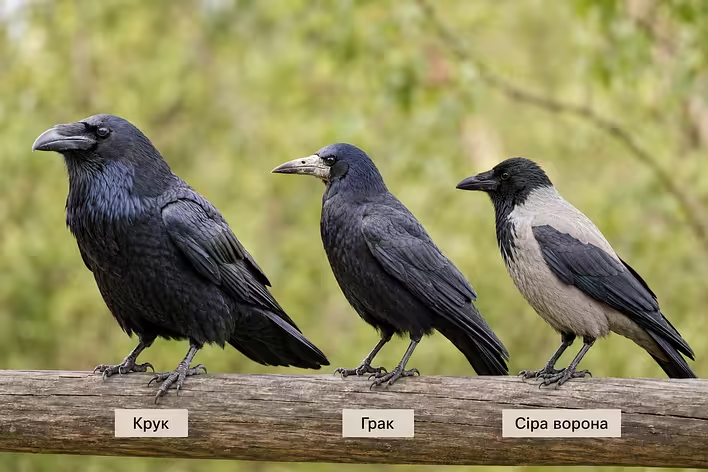
crows;
jackdaws;
magpies;
mockingbirds;
waxwings;
blackbirds;
robins;
woodpeckers;
some species of pigeons;
certain species of sparrows.
This behavior has been particularly well studied in members of the crow family. Jays, crows, and magpies not only regularly use ants but also demonstrate a very diverse array of anting methods — both active and passive.
Do Parrots Engage in Anting
Yes. Although parrots are not the most well-known "fans" of ants, such behavior has been repeatedly observed both in the wild and in captivity.
Some parrots pick up ants with their beaks and rub them on their feathers, while others use aromatic leaves, flowers, or even citrus peels instead. This leads researchers to suggest that for some species, not only the ants themselves may be important, but also certain chemical substances they release.
However, the use of plants is not considered classic anting — it is a separate type of so-called self-anointing with plant materials (self-anointing), although the principle of behavior is very similar.
Can Anting Be Observed in Ukraine
Yes, although it is not easy.
Many species of birds in Ukraine have been described as engaging in anting in other European countries. Primarily, these include:
common starling;
blackbird;
song thrush;
jay;
gray crow;
magpie;
jackdaw;
great spotted woodpecker.
However, witnessing the process itself is quite difficult. Anting lasts for a short time, and birds usually engage in it in quiet places where they are not disturbed.
That is why most people never notice this behavior, even though it may occur literally in a city park or a nearby forest.
Other Hygiene Methods in Birds
Anting is just one of many body care procedures. In fact, birds spend a significant part of the day maintaining their feathers, as their condition affects their ability to fly, retain heat, and stay healthy.
Preening with the Beak
The most important daily procedure is preening (in English preening).
The bird carefully goes through each feather with its beak, cleaning it of dust, straightening the barbs, and removing small impurities. During this, it also distributes the secretion from the uropygial gland — a fatty substance that helps maintain feather elasticity and improves its water-repellent properties.
This procedure is what most birds dedicate the most time to.
Bathing in Water
Many species regularly bathe in puddles, streams, lakes, or even in droplets of dew.
Water helps wash away dust, dirt residues, and some parasites. After bathing, the bird thoroughly dries and rearranges its feathers with its beak.
Dust Baths
Not everyone knows that for many birds, dust is just as beneficial as water.
Sparrows, quails, partridges, pheasants, and many other species deliberately roll in dry soil or sand. Fine particles get between the feathers, absorb excess grease, and help get rid of some parasites.
After such a procedure, the bird vigorously shakes its plumage, ejecting dust along with impurities.
Sunbathing
Another unusual behavior is sunbathing (sunning).
The bird sits in a well-lit spot, spreads its wings, lifts its feathers, and remains still for several minutes. For a long time, it was believed that the sun's heat helps combat parasites, although modern research shows that this behavior likely serves several functions: feather care, thermoregulation, and even stimulating vitamin D production on the surface of the uropygial gland secretion.
Using Plants
In some species, another interesting form of body care has been described.
Birds rub their feathers with aromatic leaves, flowers, or other plants that contain essential oils. These substances are believed to help repel parasites or inhibit the growth of bacteria and fungi.
This behavior has been observed, in particular, in some parrots, starlings, crows, and other species.
All of this shows how complex the hygiene system in birds is. Anting is just one of its elements, although undoubtedly one of the most remarkable.