
This content has been automatically translated from Ukrainian.
For many years, one of the most prominent television characters has been the brilliant yet unbearable man. He could belittle colleagues, neglect loved ones, and avoid honest conversations — a complex character that needed to explain, if not everything, then a lot. Comedies often built on mutual dislike: spouses dreamed of escaping from each other, friends exchanged insults, and any display of sincerity had to be immediately defused with a joke.
“Ted Lasso,” “True Therapy,” and other series of the new non-toxic wave offer a different perspective. Their characters are not perfect and do not always behave correctly. They get angry, feel jealous, act selfishly, cross boundaries, and make poor decisions. However, these stories do not convince us that cruelty is a sign of strength, and that the inability to talk about feelings makes a hero more interesting.
On the contrary, the most important changes begin when characters dare to acknowledge their own vulnerability, ask for help, or simply listen to another person. Conflicts here are not needed for endless confrontation, but to show that even difficult relationships can be gradually rebuilt. These are series about therapy in the broad sense — not necessarily in a psychologist's office, but through friendship, love, work, and a sense of community.
“Ted Lasso”


An American coach arrives in England to lead a football club, despite knowing almost nothing about European football. It seems like the perfect setup for a comedy about a naive outsider who is laughed at by everyone. However, Ted's true strength lies not in professional knowledge, but in his ability to notice people.
He does not respond to aggression with aggression, does not try to manage the team through fear, and allows men to talk about anxiety, insecurity, and loneliness. At the same time, the series does not turn kindness into a magical superpower: Ted himself experiences panic attacks, a divorce, and the fear of losing loved ones. His optimism is not a denial of problems, but a conscious choice not to transfer his own pain onto others.
“True Therapy”

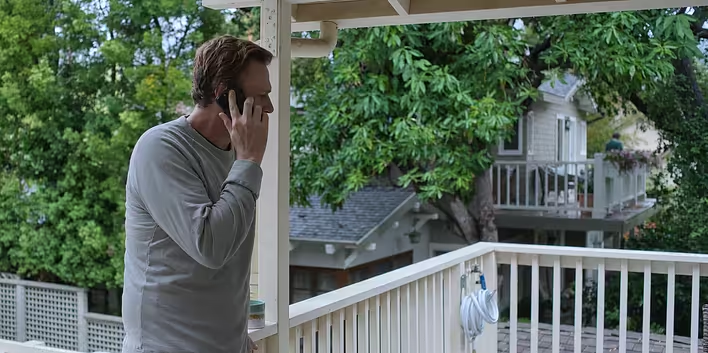
After the death of his wife, psychotherapist Jimmy cannot return to his usual life. He distances himself from his daughter, neglects professional rules, and one day begins to tell his patients exactly what he thinks of them. Sometimes his radical honesty helps, and sometimes it creates new problems.
“True Therapy” does not idealize either psychologists or the process of healing. People who professionally help others also need support and do not always follow their own advice. But even after serious mistakes, the characters do not completely turn away from each other. They argue, set boundaries, acknowledge guilt, and try to rebuild trust.
“Rooster”
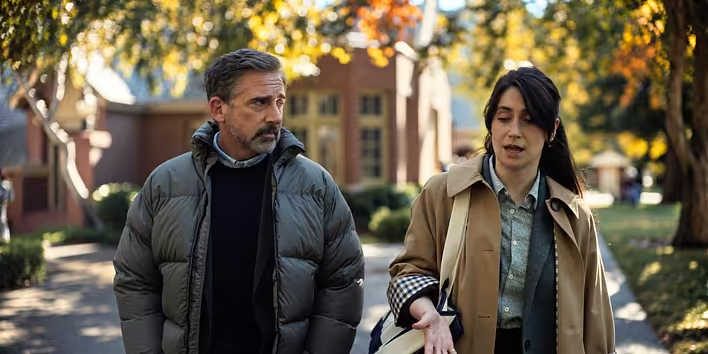

At the center of the series is successful writer Greg Russo, known for his popular detective novels about a character nicknamed Rooster. Behind the confidence, wit, and public persona lies a man who finds it much easier to invent other people's adventures than to sort out his own relationships.
A new job at a small college forces Greg to be among people who cannot be impressed solely by fame. His relationship with his adult daughter becomes particularly important: the series does not try to instantly turn them into an ideal family, but shows the slow and awkward restoration of closeness. “Rooster” continues the tone of “Ted Lasso” and “True Therapy”: a person is defined not by the absence of mistakes, but by the willingness to see their consequences and change something.
“Nobody Wants This”


Joanne hosts a podcast about sex and relationships, while Noah serves as a rabbi. Their meeting quickly grows into mutual affection, although friends, relatives, religious traditions, and past experiences suggest that this couple will have a hard time.
The main appeal of the series lies not only in the romantic chemistry between the characters. Joanne and Noah start discussing things that couples in romantic comedies usually remain silent about until the final episode. They voice fears, ask uncomfortable questions, and do not expect their partner to guess everything on their own. The contradictions between them do not disappear, but love here emerges as a constant dialogue, not a game of silence.
“It’s Complicated / Creating a Family”


Nikki and Jason want to have a child, but due to conception issues, they decide to go through the adoption process. Along with checks, interviews, and waiting, they have to confront doubts: are they responsible enough, financially secure, and ready to become parents at all?
In many sitcoms, long-term relationships become a source of jokes about mutual irritation. In “Creating a Family,” it’s the opposite. Nikki and Jason can argue and act recklessly, but they remain a team. Their closeness is not based on perfect compatibility, but on the ability to support each other when achieving a shared dream turns out to be nothing like they imagined.
“Somebody Somewhere”


After the death of her sister, Sam feels like a stranger in her hometown in Kansas. She doesn’t know what she wants from life, struggles to connect with her family, and seems to occupy a space that once belonged to another person. Her way out of isolation begins with meeting Joel and a small community of like-minded people who do not fit into conventional notions of normalcy.
The series has almost no loud plot twists. Its main events are a shared song, an evening conversation, a failed joke, or the decision to show up at a gathering. “Somebody Somewhere” particularly well illustrates that support does not always take the form of wise speeches. Sometimes it’s just a person who regularly stays close and doesn’t require you to become more comfortable first.
“Abbott Elementary”
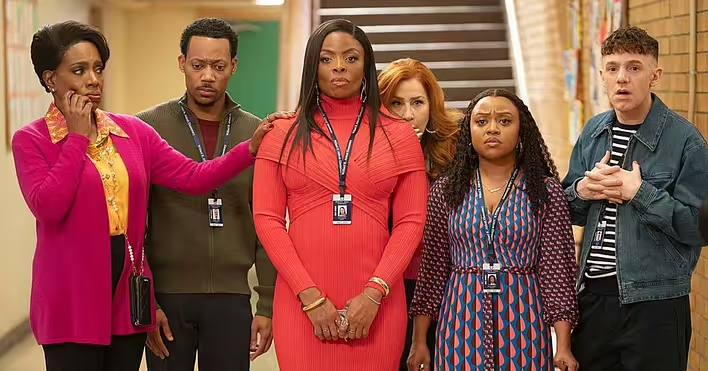

Teachers at a public school in Philadelphia work under conditions of constant lack of funds, outdated equipment, and strange administrative decisions. They get tired, frustrated, and have varying attitudes toward their profession, yet they continue to come to school for the sake of the children.
The pseudo-documentary sitcom format allows the characters to poke fun at each other, but the series does not turn the staff into a group of enemies accidentally locked in one room. Young teachers learn from the experienced ones, and the experienced gradually acknowledge that they can also make mistakes. Even the most eccentric characters are not reduced to a single comedic trait.
“The Informant”

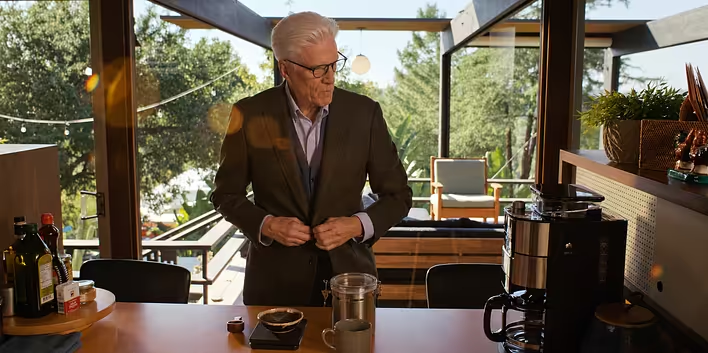
Widower Charles does not know how to fill his life after the death of his wife. His daughter advises him to find a new hobby, and he indeed finds one: he gets a job as an assistant to a private detective and goes undercover in a retirement home to find a missing jewel.
The detective intrigue serves as a reason to talk about loneliness, aging, memory loss, and the fear of becoming a burden to one’s family. The residents of the nursing home are not reduced to the role of sweet or funny old folks: they fall in love, make friends, feel jealous, and harbor resentments. While investigating others’ secrets, Charles gradually returns to his own life.
“Acapulco”


Adult Maximo tells his nephew how he got the dream job at the luxurious Las Colinas resort in his youth. In the 1980s, this place seems to him the embodiment of success: wealthy guests, vibrant parties, and the opportunity to finally help his family.
Very quickly, Maximo realizes that career advancement requires compromises. He has to decide whether it is possible to remain a decent person in an environment where everyone tries to use each other. With its colorful decor and sunny mood, “Acapulco” may seem like a light fairy tale, but this softness allows the series to talk about ambition without the usual admiration for ruthless winners.
“Schitt’s Creek”


The Rose family loses their fortune and moves to a small town, once purchased as a joke. Initially, they are spoiled and detached people who view the locals as a temporary inconvenience. However, gradually Schitt’s Creek becomes their home.
This series is important for the non-toxic wave, even though its characters are not like that from the very beginning. It shows how people change through acceptance, responsibility, and daily closeness. Romantic relationships are depicted particularly warmly here, where love does not need to be proven through suffering, jealousy, or a constant struggle for power.
“In the Best World”

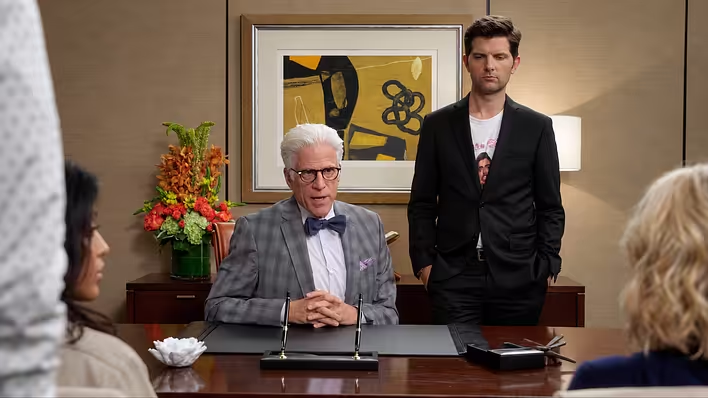
Eleanor dies and ends up in an ideal afterlife neighborhood. The only problem is that in life she was far from being an exemplary person, and thus, she ended up here by mistake. To avoid exposure, the heroine begins to study ethics and tries to at least pretend to become a better person.
“In the Best World” can be considered one of the main precursors of the new non-toxic wave. The series turns philosophical questions into witty comedy, but its central idea is surprisingly simple: it is almost impossible to be a good person on your own. We change thanks to those who patiently explain, argue, forgive, and give us another chance.
Like it?React
🧵
This post doesn't have any additions from the author yet.