This content has been automatically translated from Ukrainian.
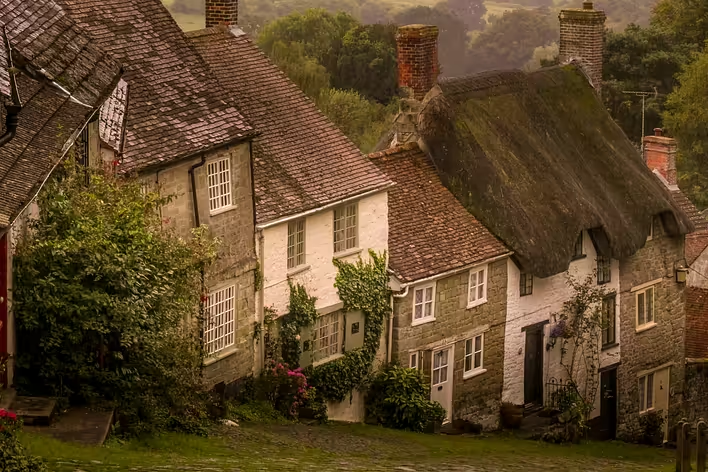
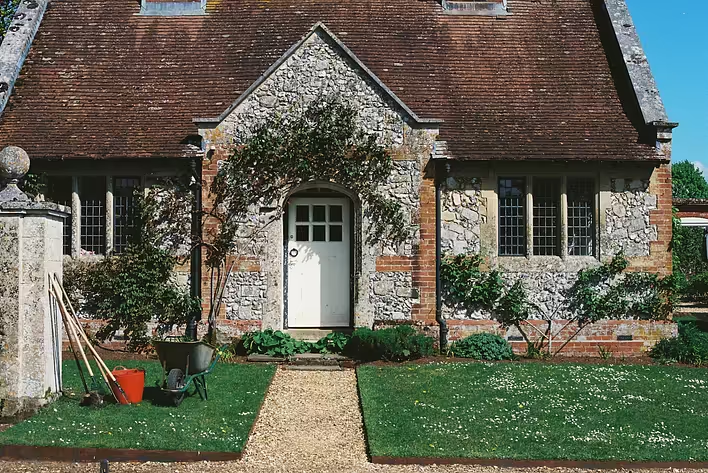
A cozy British detective story doesn't necessarily have to take place in a small village where everyone meets in one pub. Sometimes its settings become Victorian London, the university town of Cambridge, a seaside town, or an old house in Yorkshire. The atmosphere is created not only by the location but also by the very rhythm of the narrative: thoughtful investigation, expressive characters, gentle humor, and the feeling that even after the most complicated case, life will return to its usual course.
The second part of the selection includes both light detective comedies and slightly more serious dramas. They are united by beautiful British landscapes, a love for old houses and interiors, attention to detail, and characters with whom it is pleasant to spend more than one evening.
“Queens of Mystery” (Queens of Mystery)
Young detective Matilda Stone returns to her hometown and finds herself alongside her three aunts — writers, each of whom works in her own variety of the detective genre. They certainly do not intend to stay away from their niece's cases.
The series deliberately does not strive for realism. It features vibrant colors, symmetrical compositions, somewhat fairy-tale decorations, and an omniscient narrator who comments on the events. The town of Wildemarsh resembles an illustration from a whimsical book: old houses, forest roads, a cozy bookstore, and homes filled with characterful items.
Behind the light form lies a pervasive mystery about the disappearance of Matilda's mother, but it does not make the series gloomy. The main focus here is on family dynamics, literary jokes, and the enjoyment of a classic puzzle.
“Death in Paradise” (Death in Paradise)
A British detective is dispatched to the small Caribbean island of Saint Marie, where he has to get used to the heat, bright sun, leisurely local life, and a completely different style of work. Over time, the main investigators change, but the foundation of the series remains unchanged: each of them has their quirks, a unique method of investigation, and a complicated relationship with the tropical climate.
Almost every case is structured like a classic mystery with a limited circle of suspects. The crime can occur in a large estate, a hotel, on the beach, at a private party, or in the midst of a local festival. At the end, the detective usually gathers all involved and explains step by step who did what and how the murder was committed.
Despite the significant number of crimes, the series remains surprisingly light. The turquoise sea, colorful houses, palm trees, a small police station, and a familiar bar create a feeling of a prolonged vacation. Equally important is the team: colleagues gradually become close friends, and their jokes and everyday interactions balance the detective aspect.
In character, “Death in Paradise” is close to English rural detectives, although instead of misty roads and stone cottages, it offers a sunny island. It is the same cozy format, just in tropical settings.
“Beyond Paradise” (Beyond Paradise)
In “Death in Paradise,” Inspector Humphrey Goodman investigated crimes on the sunny Caribbean island, and in this spin-off, he moves with Martha to the small town of Shipton Abbott in Devon. Palm trees and tropical beaches are replaced by stone promenades, boats, cool seas, and green English hills.
Humphrey remains the same awkward, kind, and surprisingly perceptive detective. Local cases often begin with strange circumstances and not always with murder, making the series even less like a grim crime drama. At the same time, significant attention is paid to the personal lives of the characters and the town itself, whose residents gradually form a familiar circle.
“Beyond Paradise” is particularly enjoyable to watch for its coastal atmosphere. It is not a postcard-perfect rural England with roses by the cottage, but a slightly windy, maritime, and very lively southwest of the country. The series retains the lightness of its predecessor but makes the story more homely and personal.
“Ludwig” (Ludwig)
John Taylor creates intricate puzzles under the pseudonym Ludwig and prefers to remain almost entirely within his orderly world. When his twin brother goes missing, John is forced to impersonate him — a detective with the Cambridge police — and take on real investigations.
The series hinges on the clash of characters: a hero who feels confident only among schemes and puzzles finds himself in an unpredictable world of people. The crimes are structured like logical problems, and the humor arises not from deliberate jokes but from John's inability to behave as expected.
Cambridge, with its colleges, courtyards, arches, and old libraries, adds a special sophistication to the story. The series is modern, but its love for closed mysteries and an eccentric detective recalls classic British tales.
“Grantchester” (Grantchester)
The events take place in an English village in the 1950s, where the local vicar helps police officer Geordie Keating investigate crimes. The heroes complement each other well: the detective relies on experience and knowledge of the law, while the priest sees what people are not ready to tell the police.
However, “Grantchester” is not just a series of separate mysteries. Its characters fall in love, make mistakes, experience losses, and doubt their own beliefs. The investigations become an opportunity to discuss guilt, faith, prejudice, and the line between law and justice. Because of this, the series is more dramatic than most others in the selection.
At the same time, it retains an appealing rural atmosphere: the vicar's house, the churchyard, bicycle rides, green meadows, and nearby Cambridge. The tranquil landscapes here create a striking contrast with the internal crises of the characters.
“Magpie Murders” (Magpie Murders)
Editor Susan Ryland receives a manuscript of a new novel from the famous detective author Alan Conway, but it is missing the final chapter. Soon after, the writer dies, and Susan must figure out whether the answer is hidden within the book itself.
The series unfolds in two worlds simultaneously. The first is modern England of publishers, manuscripts, and literary ambitions. The second is a stylized village of the 1950s, where the fictional detective Atticus Pünd investigates a classic murder. Characters from reality are reflected in the heroes of the novel, and the two mysteries gradually intertwine.
“Magpie Murders” is more complex than most series in the selection, but it does not lose its cozy atmosphere. It features old estates, provincial hotels, retro cars, offices with bookshelves, and a special pleasure in playing with the rules of classic detective fiction.
“Miss Scarlet and the Duke” (Miss Scarlet and the Duke)
London, 1882. After her father's death, Eliza Scarlet tries to maintain his detective agency, even though Victorian society is not at all ready to accept a young woman as a professional investigator. In her investigations, she is often helped — and just as often hindered — by Inspector William Wellington, nicknamed The Duke.
This is not a rural detective story: instead of cottages and parish fairs, there are foggy streets, newspaper offices, theaters, luxurious houses, and poor neighborhoods. However, the series does not become too heavy. Its character is defined by the verbal sparring between Eliza and The Duke, the slow development of their relationship, and the protagonist's stubbornness.
Particularly attractive are the historical settings — the detective agency's office, dresses, carriages, gas lighting, and interiors of Victorian London. In newer seasons, the original title has been shortened to Miss Scarlet, but in the Ukrainian dubbing, the series is known as “Miss Scarlet and the Duke.”
“All Creatures Great and Small” (All Creatures Great and Small)
This is the only series in the selection that does not feature detective investigations. However, it fully matches its mood: old provincial England, a small community, a constant circle of characters, and leisurely stories where humanity and attentiveness to others matter.
Young veterinarian James Herriot arrives to work in Yorkshire in the late 1930s. He has to get used to a strict but kind boss, get to know local farmers, and treat patients who cannot tell him what exactly hurts. The stories combine gentle humor, romance, and small life dramas.
The Yorkshire valleys, stone farms, winding roads, and the cozy Skeldale House create an environment to which one wants to return. It is a series with a rare ability to soothe without turning into empty idyll.
Like it?React
🧵
This post doesn't have any additions from the author yet.